
The aviation industry runs on precision, and the systems that support it need to match. Whether you’re managing a Part 145 repair station, running flight operations for a regional carrier, operating a parts trading business, or overseeing a CAMO organization, the enterprise software you choose shapes every operational outcome, from regulatory compliance to turnaround time to cash flow.
The challenge in 2026 is not a shortage of options. The aviation ERP market has matured significantly, with cloud-based solutions now accounting for nearly 50% of aviation software revenue (Mordor Intelligence, 2025) and the overall market projected to grow from $13.13 billion to $18.12 billion by 2030. The challenge is fit, finding the platform that matches your specific operation rather than forcing your operation to fit the platform.
Monica Badra, founder of Aero NextGen, works with aviation organizations across the spectrum: “The technology available today is dramatically more capable than what existed even three years ago. But capability alone doesn’t determine success. The operators who get the most value from their ERP investment are the ones who start with a clear understanding of their own workflows, pain points, and growth trajectory, and then find the system that aligns with those realities.”
The Evolution: From Adapted to Aviation-Native
The first generation of aviation ERPs were generic manufacturing systems adapted, often poorly, for aviation’s regulatory requirements. The result was heavy customization, long implementation timelines, and systems that never quite fit the way aircraft maintenance, parts trading, or flight operations actually work.
Today’s aviation-native platforms are built from the ground up for the industry’s specific workflows: Part 145 and Part-M compliance, airworthiness tracking, serialized component traceability, multi-currency billing, and the complex interplay between engineering, planning, execution, and supply chain. This shift from “adapted” to “purpose-built” is the single most important development in aviation enterprise software over the past decade.

As Alex Preston writes in Aerospace Innovations’ Q2 2026 article “Mobility Matters”, the next frontier is mobile-first design, platforms that put full functionality into the hands of technicians, warehouse staff, and planners on the hangar floor rather than tethering them to desktop terminals in back offices. The article makes a compelling case that mobile-first MRO software unlocks quantifiable, tangible benefits in productivity, data accuracy, and turnaround time. This is a practical shift, not a theoretical one, and it applies across aviation operations, not just MRO.
What Modern Aviation ERP Software Must Deliver
The requirements differ by operation type, but several capabilities have become non-negotiable across the industry:
Regulatory compliance architecture
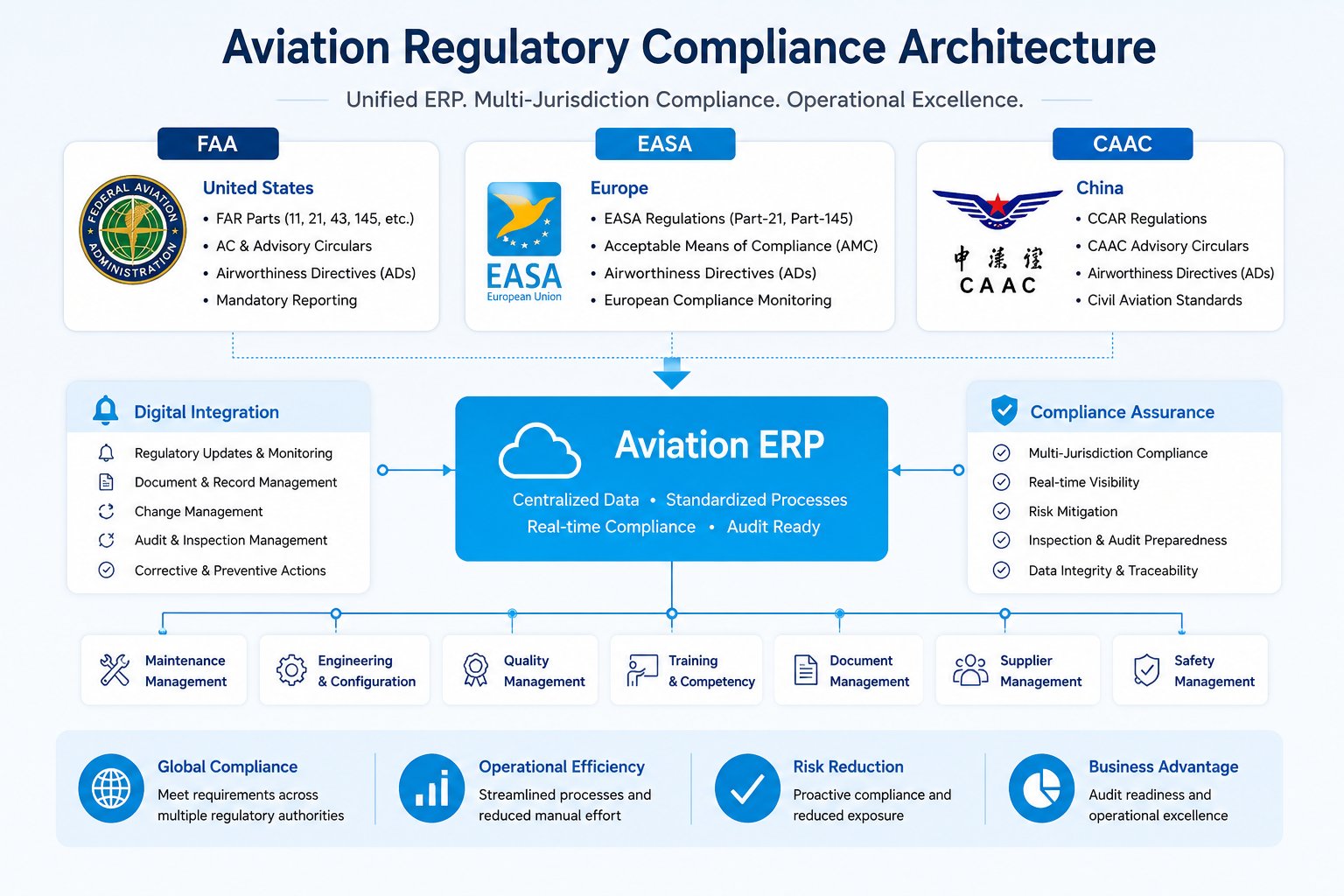
Aviation operates under FAA Part 145, EASA Part 145 and Part-M, CAAC regulations, EASA Part-IS information security requirements (effective October 2025 and February 2026), and countless OEM-specific requirements. The ERP must support these frameworks through core architecture, not bolt-on modules added after the fact. Compliance automation that generates required documentation, flags approaching deadlines, and maintains audit-ready records is now a baseline expectation.
Full parts traceability
Aviation parts are not commodities. Every serialized component carries a genealogy that must be tracked from birth to retirement, maintenance history, modification records, airworthiness documentation, and certification status. James Careless’ article “Mastering Spare Parts Management” in the same Q2 2026 issue of Aerospace Innovations examines why the aviation industry still struggles with parts management and paperless operations, and why getting this right is fundamental to operational efficiency, AOG resolution, and regulatory compliance.
Financial integration for complex billing
Aviation billing involves customer-owned parts, pooled inventory, warranty claims, exchange and consignment management, subcontractor cost allocation, and multi-currency transactions. When financial processes are disconnected from operational workflows, revenue leakage through billing errors and delayed invoicing becomes a systemic issue. Modern aviation ERPs integrate work order management directly with invoicing, ensuring that every labor hour, consumable, and overhead allocation flows accurately to customer billing.
Mobile accessibility
As the “Mobility Matters” article documents, the productivity gains from mobile-first platforms are measurable and significant. Technicians who can access work cards, sign off tasks, record findings, and request parts from the point of work, without returning to a desktop terminal, reduce non-productive hours and improve data quality simultaneously. This capability is increasingly a selection criterion, not a nice-to-have.

Integration capability
No aviation ERP exists in isolation. Seamless connectivity with OEM portals, customer platforms, supply chain partners, marketplace systems (ILS, PartsBase, AeroXchange), and financial tools determines whether your investment delivers strategic value or creates another data silo. McKinsey’s 2024 MRO research found that more than 80% of operators identify data limitations as the most significant barrier to digital adoption, and disconnected systems are the primary cause.
Choosing the Right ERP: Strategy Before Software
The vendor landscape includes dozens of platforms claiming aviation expertise. The selection process that works consistently starts with operational requirements, not vendor demonstrations.
Start with your pain points, not the feature list|
Document the specific problems you need to solve, “reduce emergency purchase orders by 40%” or “cut quote turnaround from 4 hours to 30 minutes” creates measurable success criteria that generic goals cannot.
Match the platform to your operation type
A line maintenance operation supporting narrow-body aircraft has different requirements than a component overhaul shop, which has different requirements than a parts trading company or a CAMO organization. The right ERP for one is rarely the right ERP for another.
Evaluate deployment model flexibility
Cloud, on-premise, or hybrid, the right model depends on your data sovereignty requirements, IT resources, and operational geography. Cloud-native platforms offer clear advantages in multi-site collaboration, automatic updates, and reduced IT infrastructure, but some operations require on-premise or hybrid options.
Assess implementation methodology, not just the product
The most common cause of ERP implementation failure is not bad software, it’s poor fit and insufficient change management. Phased rollouts that build organizational confidence consistently outperform big-bang deployments. And upfront investment in data cleanup before migration is essential, clean data is the prerequisite for every downstream benefit the platform is supposed to deliver.
Verify vendor stability
Aviation ERP implementations take 3–24 months, depending on complexity. Your vendor must have the financial stability, domain expertise, and support infrastructure to see the project through, and to support you for years beyond go-live.
The Bottom Line: Fit Determines Value
The right ERP software for your aviation operation transforms every function it touches, compliance, inventory, billing, planning, customer communication, and strategic decision-making. But technology alone doesn’t deliver that value. Strategic selection, disciplined implementation, and organizational commitment do.
The aviation ERP market in 2026 offers more capable, more accessible, and more aviation-specific options than at any point in the industry’s history. The opportunity is real, and the operators who act on it with clarity and purpose will build the operational advantage that compounds over time.

Not sure which platform fits your operation? Aero NextGen’s Solution Finder Quiz matches you with vetted aviation ERP and software providers based on your specific business type, fleet size, and operational requirements, in under two minutes. Take the quiz and discover your ideal solution today.
Sources & References
Mordor Intelligence (2025), Aviation Software Market: $13.13B (2025) to $18.12B (2030); cloud solutions held 49.80% of revenue in 2024
McKinsey & Company (2024), “Aircraft MRO 2.0: The Digital Revolution”: 80%+ cite data limitations as top barrier to digital adoption
EASA Part-IS, Information Security Regulations (EU) 2023/203 and 2022/1645, applicable October 2025 / February 2026
Aerospace Innovations Q2 May 2026, “Mobility Matters” by Alex Preston: mobile-first MRO software delivers quantifiable productivity benefits
Aerospace Innovations Q2 May 2026, “Mastering Spare Parts Management” by James Careless: aviation industry’s ongoing challenge with parts management and paperless operations