

Agentic AI is now being sold to every aviation procurement team, from airline materials departments to parts distributors and traders. The analyst data is clear on what happens next: Gartner predicts that over 40% of agentic AI projects will be canceled by the end of 2027, citing escalating costs, unclear business value and inadequate risk controls. In aviation MRO, Oliver Wyman reports that 58% of companies remain at the experimental stage of AI, with data quality and availability named as a key reason projects stop at proof of concept. The technology works when the foundation is in place. This article sets out why autonomous procurement agents stall in aviation, what separates the projects that reach production, and a realistic roadmap for procurement automation across the aviation supply chain.
The market is moving fast, and most projects are still experiments
Agentic AI has moved from slideware to live aviation procurement products in 2026. In April, AAR launched Airvoyant, a parts procurement platform for airlines and MROs in which AI agents analyze multiple supplier quotes and generate ranked purchase recommendations from historical procurement data (Aviation Week, April 2026). The platform integrates with the Trax ERP so requisitions flow directly into it, Aeroxchange is the first connected vendor, and agents for vendor optimization and automated negotiation are planned for later in 2026.
The adoption data tells a more measured story. When Gartner polled 3,412 webinar attendees in January 2025, 19% reported significant agentic AI investment, 42% conservative investment, 8% none and 31% were waiting or unsure. Gartner analyst Anushree Verma stated that “most agentic AI projects right now are early stage experiments or proofs of concept” (Reuters via The Star).
- Over 40% of agentic AI projects are predicted to be canceled by the end of 2027 (Gartner, June 2025).
- Only about 130 of the thousands of vendors marketing agentic AI offer genuine agentic capability, according to Gartner’s estimate. The rest is “agent washing”: chatbots, RPA and assistants rebranded.
- The long-term direction holds. Gartner still expects 33% of enterprise software applications to include agentic AI by 2028, up from less than 1% in 2024.
- Procurement leaders know the gap. A Gartner survey of 101 CPOs (January to February 2026) found just 36% are very confident in their ability to redesign roles and processes around AI.
The implication for aviation buyers is direct. The question is not whether agentic AI belongs in procurement. It is which projects are built to survive contact with production data.
Why aviation procurement is the hardest test case
Aviation procurement combines everything that breaks an autonomous agent: regulated parts, fragmented supplier data and high cost of error. A purchase decision depends on part number interchangeability, condition codes, certification paperwork (8130-3, EASA Form 1), traceability back to birth, approved vendor lists and contract terms. An agent that recommends the cheapest quote without validating trace and certification is not an asset. It is a compliance exposure.
The operating environment raises the stakes. Oliver Wyman’s 2026 MRO survey puts the global MRO market above $136 billion in 2025, up 8% year over year, with spending forecast to approach $193 billion by the end of the decade. Material cost inflation outpaced expectations by 100 to 200 basis points per segment in 2025, and some 90% of respondents reported tariff impacts on component purchases, repairs and engine overhauls.
- Higher spend, tighter supply. Every sourcing decision now carries more margin and more risk, which makes procurement automation valuable and error-intolerant at the same time.
- Delayed purchase order placement extends lead times and turnaround time, one of the core supply chain issues in Aero NextGen’s library of 150+ aviation pain points.
- Obsolescence sourcing for aging fleets demands judgment on alternates and condition that generic procurement agents are not trained on.
- Tactical-only purchasing leaves volume rebates and supplier negotiating power unused because spend data is not consolidated.
Agentic AI addresses each of these. It only does so when the agent can trust the data it reads.
Data quality and integration: where pilots actually stop
The barrier to production is the data foundation, not the model. Gartner predicts that through 2026, organizations will abandon 60% of AI projects unsupported by AI-ready data. In the same research, 63% of organizations either lack the right data management practices for AI or do not know whether they have them (survey of 1,203 data management leaders, July 2024).
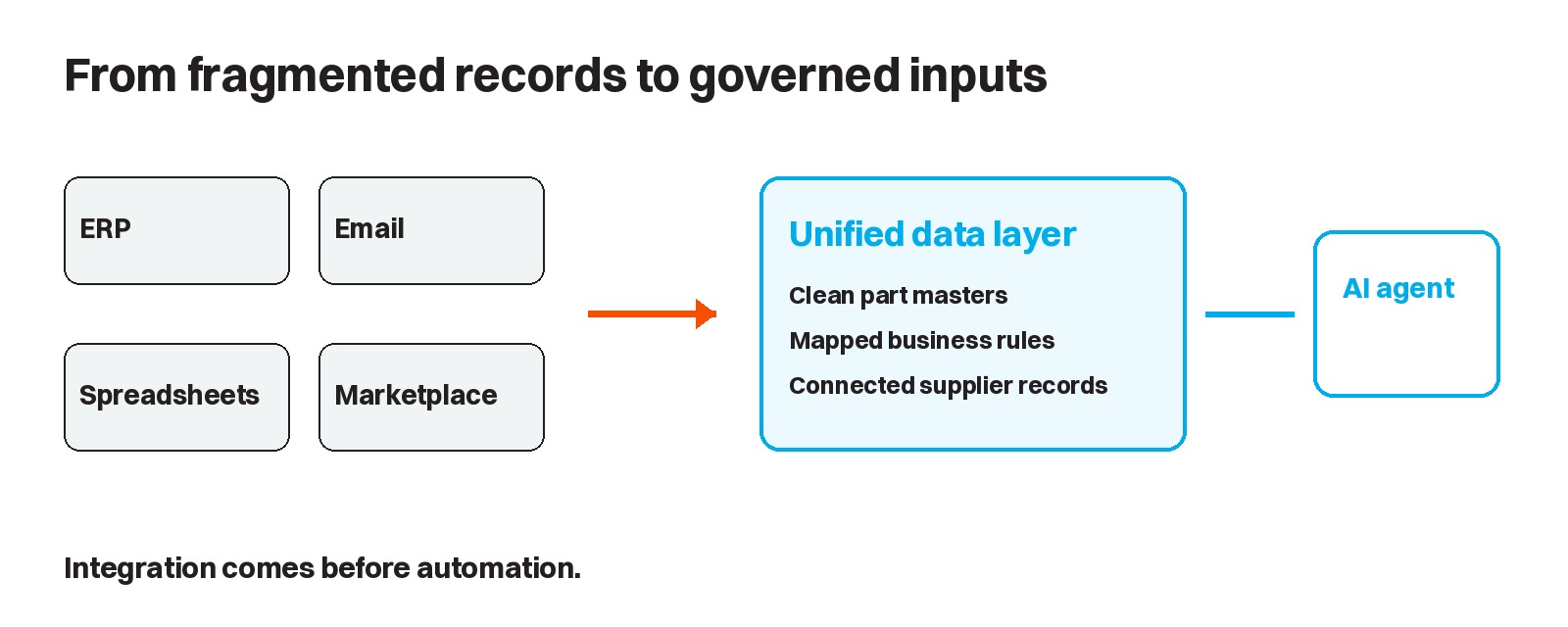
Aviation data makes this concrete. Part masters carry duplicate numbers, inconsistent descriptions and missing alternates. Supplier records sit across the ERP, email inboxes and marketplace accounts. Quote history lives in spreadsheets. An agent reading that data produces confident recommendations on a broken base.
Oliver Wyman’s survey shows the investment pattern behind it: half of respondents plan to invest in AI over the next five years, while only a third plan to invest in IT infrastructure. Oliver Wyman’s Livia Hayes called this a “fundamental mismatch” in Aviation Week’s October 2026 analysis, which also counted at least two dozen AI software companies with MRO-specific applications.
- Poor data quality impairs every KPI an agent is supposed to optimize, from fill rate to cost per part.
- System integration gaps leave no single source of truth for inventory, open POs and supplier performance.
- Siloed systems mean the agent sees the ERP but not the quality system, or sees the marketplace but not the contract.
- Clean, mapped data is a solvable project. Data cleansing, business data mapping and system integration are established service categories with aviation specialists such as Tsunami Tsolutions and Jetelligence. Both list ERP selection and system integration, data cleansing and business data mapping in their Aero NextGen profiles (vendor-reported).
What production-ready looks like in aviation
The projects that reach production start narrow, use governed inputs and measure one outcome. Aviation Week reported in October 2025 that MyTechnic adopted an AI-driven sourcing platform to automate low-value component purchases, freeing staff for strategic supplier relationships. The company reported real-time market availability for 94% of parts and three or more quotes for 77% of parts. The inputs it supplied were specific: its approved vendor list, business rules and alternate part number lists. Integration required a data exchange with the provider, not a system replacement.
That pattern is the template. A defined scope, governed rules and measurable output. IAG’s Ben Dias put the principle plainly in Aviation Week: “You have to start with the business problem, not the technology or the data.”
Gartner’s supply chain data supports the incremental path. In a survey of 140 supply chain leaders (November 2025), only 17% were pursuing immediate transformational redesign, while 83% were applying AI incrementally to specific use cases or scaling it gradually into integrated processes.
Several Aero NextGen marketplace providers describe capabilities that map to this staged model. All descriptions below are vendor-reported from their Aero NextGen profiles:
- CAMP Aviate is designed for phased adoption, with AI and workflow solutions deployable alongside an existing ERP before it becomes the system of record. Its profile lists procurement RFP automation, supplier relationship management and AI agents.
- AvSight is an ERP for aviation suppliers and MROs with embedded AI (AvSight Intelligence) that surfaces sourcing opportunities and accelerates quoting decisions, built on Salesforce cloud infrastructure.
- Pentagon 2000 centralizes procurement, inventory, maintenance and finance in one aviation ERP, with AI-powered email RFQ to quote processing and integrations with third-party marketplaces.
- AirNxt is an M&E platform covering logistics, purchase management and stores, with AI agents that collect data from multiple sources to support user decisions.
- Locatory.com is a parts marketplace offering Amber A.I., an email-based tool that parses part requests and distributes RFQs to matching suppliers.
- SmartCert reviews certifications against compliance criteria automatically and keeps them connected to the parts and shipments they belong to.
- Pelico provides real-time supply chain visibility for MRO networks, with AI-powered simulations and recommendations to prevent and respond to disruption.
A realistic roadmap from pilot to production
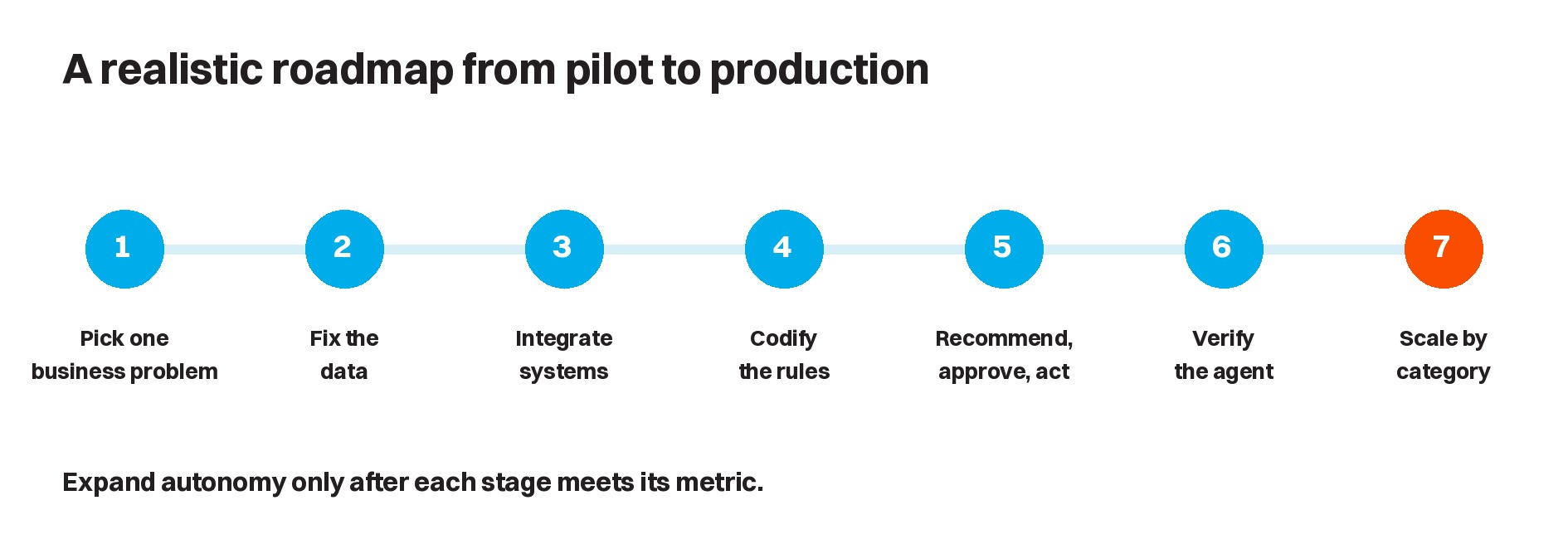
Production readiness in aviation procurement follows a sequence. Skipping steps is what drives cancellation. Based on the Gartner and Oliver Wyman findings above, a grounded roadmap for airlines, MROs, OEMs, distributors and lessors looks like this:
- Pick one business problem with a measurable outcome. Examples: quote cycle time on consumables, PO placement lead time, or number of quotes per AOG request. Gartner’s cancellation drivers (cost and unclear value) are answered by a metric set before the pilot starts.
- Fix the data the agent will read. Clean the part master, map alternates and condition codes, and consolidate supplier and quote history. This is the 60% abandonment risk Gartner identifies, addressed directly.
- Integrate before automating. Connect ERP, quality, marketplace and email data so the agent works from one source of truth.
- Codify the rules. Approved vendor lists, certification requirements, spend thresholds and escalation paths become the guardrails that answer Gartner’s third driver: inadequate risk controls.
- Start with recommend, then approve, then act. Let the agent recommend, keep a human approval step on regulated or high-value purchases, and extend autonomy to low-value, low-risk buys once accuracy is proven.
- Verify the agent is an agent. With Gartner estimating only about 130 genuine agentic AI vendors, ask every provider to demonstrate autonomous multi-step execution on your own data.
- Scale by category, not by announcement. Expand from consumables to rotables to repairs as each stage meets its metric.
The Aero NextGen take
Agentic AI will reshape aviation procurement, and the operators who prepare their data first will capture the value. The analyst numbers do not describe a failed technology. They describe projects launched before the foundation was ready, and tools bought on marketing claims rather than verified capability. The move for every procurement leader in aviation is to pair the right agentic tool with the right data partner, in the right sequence.
That is the matching problem Aero NextGen solves. The platform connects aviation companies with 600+ vetted solution providers across 60+ categories, including procurement automation, inventory management, parts marketplaces, ERP and AI agents, matched to the operator’s environment and its specific pain points.
“Agentic AI in procurement is an execution question, not a technology question. Clean data, clear rules and one measurable outcome get a pilot to production. Aero NextGen exists to match each aviation operator with the providers who can deliver that sequence.”
Monica Badra, Founder & CEO, Aero NextGen
Find your fit in 3 minutes: Complete the Aero NextGen Solution Finder quiz, list your procurement and supply chain pain points, and receive a custom shortlist of vetted aviation solutions built for your operation.
Sources
- Gartner, “Gartner Predicts Over 40% of Agentic AI Projects Will Be Canceled by End of 2027,” June 25, 2025: https://www.gartner.com/en/newsroom/press-releases/2025-06-25-gartner-predicts-over-40-percent-of-agentic-ai-projects-will-be-canceled-by-end-of-2027
- Reuters via The Star, “Over 40% of agentic AI projects will be scrapped by 2027, Gartner says,” June 25, 2025: https://www.thestar.com.my/tech/tech-news/2025/06/25/over-40-of-agentic-ai-projects-will-be-scrapped-by-2027-gartner-says
- W.Media, “Over 40 percent of Agentic AI projects could face the axe by end of 2027: Gartner,” June 2025: https://w.media/over-40-percent-of-agentic-ai-projects-could-face-the-axe-by-end-of-2027-gartner/
- Gartner, “Lack of AI-Ready Data Puts AI Projects at Risk,” February 26, 2025: https://www.gartner.com/en/newsroom/press-releases/2025-02-26-lack-of-ai-ready-data-puts-ai-projects-at-risk
- Gartner, “Gartner Survey Shows AI is Not Driving Supply Chain Operating Model Transformation,” May 6, 2026: https://www.gartner.com/en/newsroom/press-releases/2026-05-06-gartner-survey-shows-ai-is-not-driving-supply-chain-operating-model-transformation
- Gartner, “Gartner Survey Shows Just 36% of Chief Procurement Officers Are Very Confident in Ability to Redesign Function for AI,” May 19, 2026: https://www.gartner.com/en/newsroom/press-releases/2026-05-19-gartner-survey-shows-just-36-perecent-of-chief-procurement-officers-are-very-confident-in-ability-to-redesign-function-for-ai
- Oliver Wyman, “The new MRO supply paradigm,” April 13, 2026: https://www.oliverwyman.com/our-expertise/insights/2026/apr/aviation-mro-labor-and-material-supply-chain-paradigm.html
- Aviation Week, “Talking Shop: Will The Bubble Burst On MRO’s AI Frenzy?”, October 6, 2026: https://aviationweek.com/mro/emerging-technologies/talking-shop-will-bubble-burst-mros-ai-frenzy
- Aviation Week, “MyTechnic Taps AI For Revamped Procurement Processes,” October 21, 2025: https://aviationweek.com/mro/emerging-technologies/mytechnic-taps-ai-revamped-procurement-processes
- Aviation Week, “AAR Launches Agentic AI-Based Parts Procurement Platform,” April 21, 2026: https://aviationweek.com/mro/supply-chain/aar-launches-agentic-ai-based-parts-procurement-platform