
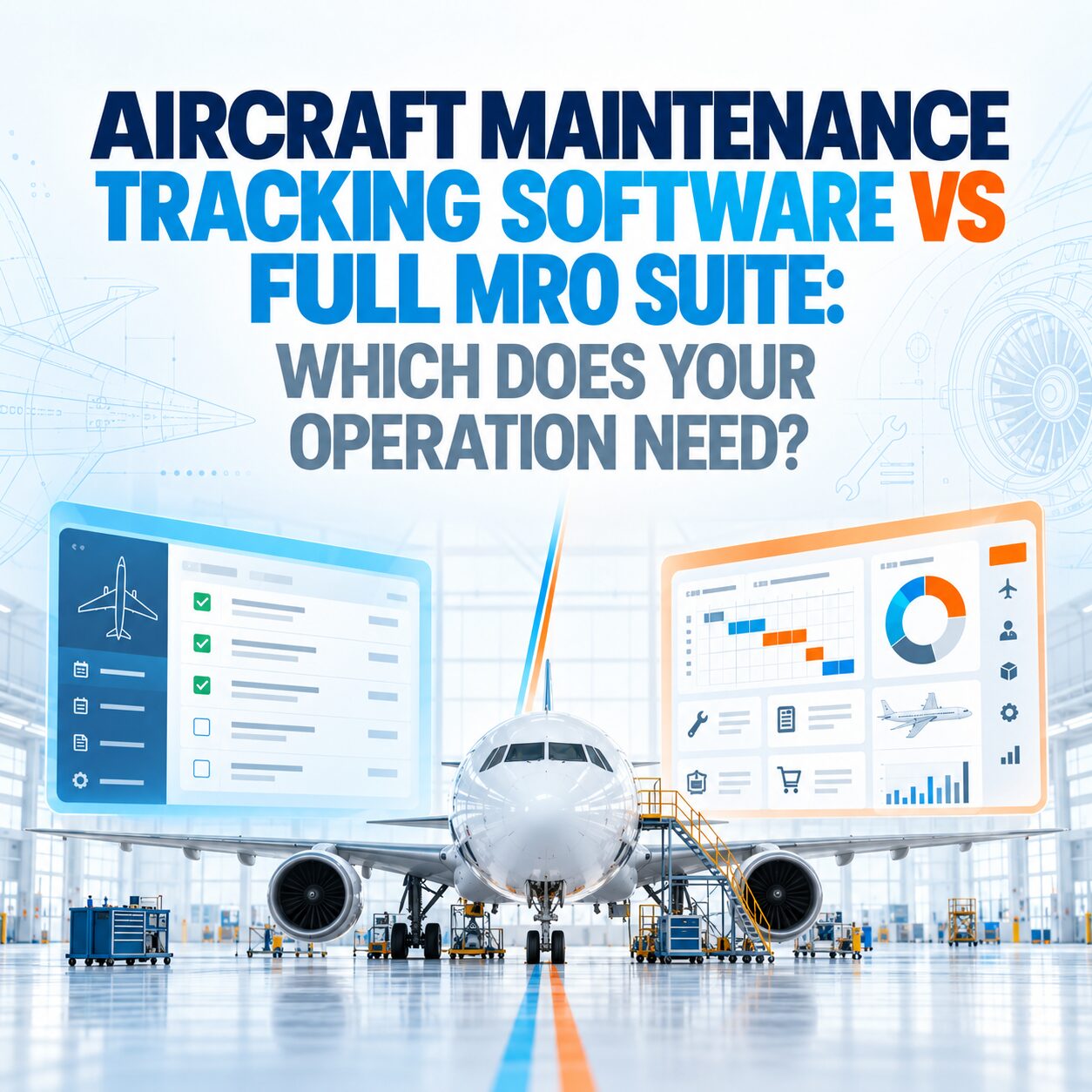
Aircraft maintenance tracking software and full MRO suites solve different problems. Tracking software answers one question with precision: what is due, on which aircraft, and when. A full MRO suite runs the business around that answer: work orders, labor, parts, procurement, quality, billing and finance. The right choice depends on what your operation does, not on how many modules a vendor can demonstrate. This guide sets out the difference, who needs which, and the signals that tell you it is time to move from one to the other.

The two categories, defined
Maintenance tracking software is a compliance and forecasting tool. A full MRO suite is an operating system for a maintenance business. Both sit inside the same regulatory frame. Under FAA rules, owners and operators must keep records of total time in service, the current status of life-limited parts, time since last overhaul, current inspection status, the status of applicable airworthiness directives, and the forms for each major alteration (14 CFR 91.417, Cornell LII). Tracking software exists to keep that picture current and forecast what comes next.
Maintenance tracking software typically covers:
- Aircraft, engine and component times and cycles
- Inspection programs, airworthiness directives and service bulletins
- Life-limited part status and due-list forecasting
- Logbook and technical records, often with digitized document storage
- Electronic techlog entries from the flight line
A full MRO suite (often called an ERP or M&E system) adds:
- Work order and task card management with labor recording
- Inventory, procurement, repair orders, exchanges and consignment
- Quoting, sales orders, customer billing and accounts receivable
- Quality, audit and training records management
- Financial reporting and, in many systems, the general ledger
The overlap is real. Many suites include tracking. Many tracking tools now offer task cards and inventory. The question is which system is the system of record for your business.
Who needs maintenance tracking software
Operators who maintain their own fleet but do not sell maintenance as a service are the natural fit for tracking-first software. That includes business aviation flight departments, charter and fractional operators, helicopter operators, smaller airlines that outsource heavy checks, and lessors who need to monitor asset condition and records quality across a portfolio.
- The core risk is compliance and asset value, not throughput. A missed AD or an incomplete back-to-birth record grounds an aircraft or cuts its resale value. Tracking software protects both.
- Implementation is lighter. The data model centres on the aircraft, not on a shop’s labor, inventory and invoicing. Go-live is usually faster and the team is smaller.
- Integration still matters. Tracking data feeds flight operations, parts ordering and the CAMO. Confirm how it connects before you buy.
Providers on the Aero NextGen marketplace whose listings emphasize tracking, technical records, traceability and electronic techlog include CAMP Software, Flydocs, ProvenAir Technologies and RayMach Technologies.
Who needs a full MRO suite
Any organization that sells maintenance, parts or repairs to a customer needs a suite. That includes Part 145 repair stations, component and engine shops, airline in-house MROs that cross-charge internal customers, parts distributors that also run repair management, and OEMs with aftermarket service operations.
- The core risk is margin and turnaround time. Global MRO demand reached $136 billion in 2025, up 8% from 2024, and Oliver Wyman reports longer turnaround times and capacity bottlenecks across the market (Oliver Wyman, Global Fleet and MRO Market Forecast 2026-2036). A suite connects labor, parts and billing so every hour and every part is captured and invoiced.
- The workforce math favours integration. BCG estimates that roughly half of technician time goes to non-wrench activity such as waiting for parts, searching for documentation or resolving authorization questions (BCG, 2026). When the work order, the parts request and the technical data live in one system, that time shrinks.
- The commercial side is part of the job. Quotes, RFQs, exchanges and warranty claims are revenue events. A tracking tool does not manage them.
Providers listed as ERP, M&E and core operating systems on the Aero NextGen marketplace include AirNxt, AMOS, AMS, AvPro Software, AvSight, Impresa Corporation, Pentagon 2000, Vellox Group and Vista-Suite by Ambry Hill Technologies.
Side by side: the decision criteria
Use the operation, not the feature list, to decide.

| Criterion | Maintenance tracking software | Full MRO suite |
|---|---|---|
| Primary user | Operator, CAMO, flight department, lessor | Repair station, MRO, distributor with repair, OEM aftermarket |
| System of record for | Aircraft status and compliance | The maintenance business (work, parts, money) |
| Revenue functions | None or minimal | Quoting, sales orders, billing, receivables |
| Inventory and procurement | Basic or via integration | Native, including exchanges and consignment |
| Typical implementation | Weeks | Weeks to months, depending on scope and data migration |
| Data migration effort | Aircraft records and status | Records plus inventory, open orders, customers and financials |
| Main risk if mis-sized | Outgrowing it as you add shop work | Paying for and maintaining modules you never use |
Five signals you have outgrown tracking software
Most operations start with tracking and add a suite when the business model changes. These signals indicate that point has arrived:

- You started selling maintenance to third parties. The moment you invoice an outside customer, you need labor capture, quoting and billing tied to the work order.
- Parts are managed in a spreadsheet next to the tracking tool. Double entry between two systems is where traceability gaps appear.
- Your finance team reconciles maintenance cost by hand. If month-end requires exporting work data into accounting, the integration is missing.
- Turnaround time is a commercial metric. If customers measure you on TAT, you need visibility across labor, parts and approvals in one place.
- Audit preparation takes days. When records, training and quality evidence live in separate systems, audits pull people off the floor.
The reverse also applies. A flight department that bought a full suite and uses only the due list is carrying cost and upgrade effort it does not need.
The integration path, not the either-or
For many operations the right answer is a tracking system connected to an ERP, not a single platform. SITA reports that 49% of airlines name data integration and consistency as their primary technology barrier (Travolution, reporting SITA). A well-integrated pair of specialist systems often outperforms a single suite configured beyond its strengths.

- Define the system of record for each data type. Aircraft status, parts, labor and money should each have one owner system.
- Insist on proven integrations. Ask for live customer references that run the exact connection you need.
- Plan the data migration first. Records quality decides the value of either system. Digitization and data cleansing specialists such as Flydocs and JETELLIGENCE can prepare the data before go-live.
Where the category is heading
The line between tracking and suite is blurring, and AI is accelerating it. Tracking vendors are adding task cards, inventory and technician assistants. Suite vendors are moving to cloud and browser delivery to compete on implementation speed. Grand View Research reports that cloud already accounts for 66% of aviation software deployments and MRO software for 34% of the market (Grand View Research). The decision will increasingly rest on data model, integrations and support for your segment, not on module count.
The Aero NextGen take
Buy for the business you run, and for the one you plan to run in three years. An operator that will never sell maintenance should not carry the cost and complexity of a full suite. A repair station that runs on a tracking tool and spreadsheets is leaving labor and parts revenue uncaptured. The decision is operational, and it is measurable. Aero NextGen matches fleet operators, MROs, OEMs, parts distributors and lessors to vetted providers in both categories based on operation type, segment, fleet size, region and integration needs.
“Tracking software and MRO suites are not competing products. They answer different questions. The operators who get this right define their business model first, then buy the system that runs it. The ones who get it wrong buy the longest feature list and spend three years configuring around it.”
Monica Badra, Founder & CEO, Aero NextGen
Find your fit in 3 minutes: Complete the Solution Finder quiz to get matched to the maintenance tracking and MRO software providers that fit your operation.
Sources
- 14 CFR 91.417, Maintenance records (Cornell Legal Information Institute): law.cornell.edu
- Oliver Wyman, Global Fleet and MRO Market Forecast 2026-2036 (February 2026): oliverwyman.com
- BCG, Older Aircraft, Too Few Technicians: Why Aerospace MRO Needs a Digital Fix (2026): bcg.com
- SITA, 2025 Air Transport IT Insights, as reported by Travolution (April 2026): travolution.com
- Grand View Research, Aviation Software Market Report, 2026-2033: grandviewresearch.com
- Vendor categories: Aero NextGen Solution Finder vendor profiles (self-reported by each provider)