By Monica Badra, Founder & CEO, Aero NextGen
Every aviation company that buys parts, materials, or repair services carries a quiet, compounding cost: the labor required to prove, over and over, that its vendors still deserve to be trusted. It rarely appears on an income statement as its own line. It is buried inside the hours of Quality specialists, buyers, and compliance managers rebuilding a performance history the business already lived through once. This piece models that cost at three company sizes, then looks closely at what changes when vendor evidence is captured continuously inside the system of record instead of reconstructed after the fact, using ERP.Aero’s Vendor Scoring and Approval capability as the working example.
Vendor truth is scattered, not scarce
Aviation companies do not lack information about their vendors. Every transaction generates it. The evidence exists. It is simply separated across purchase orders, receiving logs, quality files, email threads, shared drives, personal notes, and calendar reminders, spread across the very people who are also busy running the operation. When a vendor review comes due, someone has to physically bring all of that back together before the actual judgment can even begin.
That manual model has five structural problems, none of which is a failure of effort:
- It is retrospective. Evidence is assembled when a review is due, not maintained as events happen.
- It is fragmented. Commercial, operational, quality, and compliance signals all live in different places.
- It depends on who does it. Two reviewers, same policy, can reasonably reach different conclusions.
- The score hides its basis. A spreadsheet number with no auditable path back to the transactions behind it.
- It wastes expert attention. Quality professionals spend their time gathering and calculating, not judging.
This is what happens when an important governance process runs on tools never built to connect to the transaction underneath it.
What manual governance actually costs
Priced honestly, the labor is not a rounding error. ERP.Aero’s companion analysis models the cost with one formula, annual manual cost equals reviews per year times hours per review, plus weekly background hours times 52, all multiplied by a loaded hourly rate, applied across three company sizes. The figures below are an illustrative, assumption-driven model rather than measured customer results, and every input is meant to be replaced with a company’s own numbers.
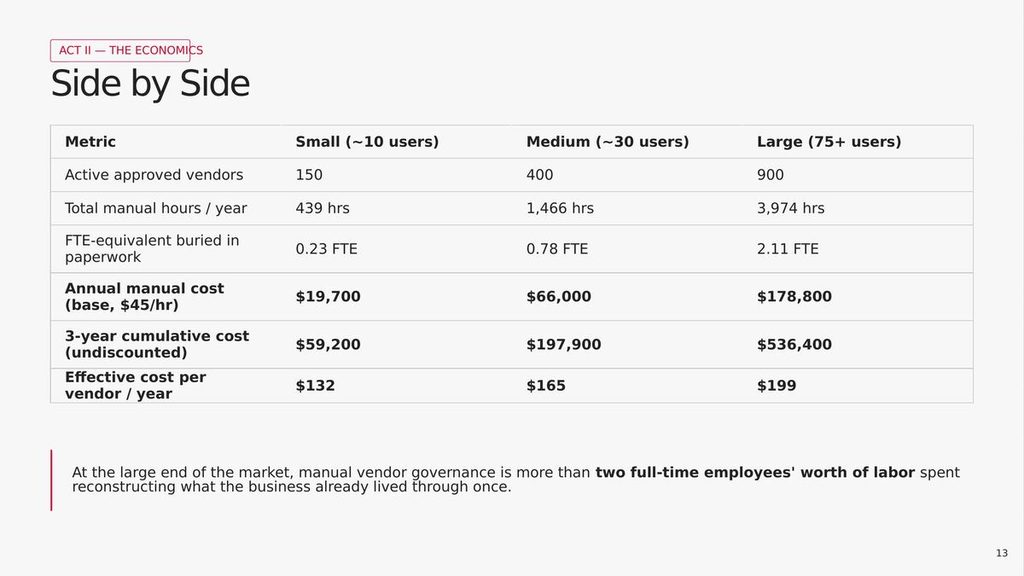
Source: ERP.Aero, The True Cost of Manual Vendor Governance. Illustrative model, replace with your own inputs.
The pattern is the important part: the burden gets heavier as a company grows, not lighter. More users mean more transactions per vendor, which means more evidence to reconcile by hand at review time. At a roughly ten-person operation the base case runs about $19,700 a year. At seventy-five-plus users it is roughly $178,800 a year, more than two full-time employees’ worth of labor spent reconstructing history the business already generated once.
Those hours can be read two ways, and they should not be added together. The cost lens is what the labor costs in loaded dollars, the floor of the argument. The capacity lens is what the business could do with those hours instead: more sourcing comparisons, faster reviews, tighter audit readiness, a Quality function that spends its time on the vendors that actually deserve scrutiny. For most leadership teams the capacity lens is the more persuasive one.
The purchase price is never the full cost of the vendor
The model above prices only the labor of scoring and re-approving vendors. It does not price what a poorly performing vendor costs once it is already approved. Receiving labor, quarantine and storage, corrective-action administration, replacement purchasing, customer delays, and eventual margin erosion all sit outside the labor figure. A useful way to frame the total is: effective vendor cost equals purchase cost plus administrative cost plus quality cost plus delay cost plus failure risk. The administrative cost is what the model quantifies; the rest require a company’s own baseline. The strategic point holds regardless: the price on the purchase order is never the full cost of the vendor.
What changes: from manual reconstruction to governed intelligence
ERP.Aero’s Vendor Scoring and Approval capability addresses the qualification layer of this cost today. It answers the question every accredited distributor must be able to answer: is this vendor still allowed to sell to us, and can we prove why? Five capabilities are live in the product:
- A configurable scoring engine, where administrators define categories and assign additive, transparent point values with no hidden weighting.
- Automated status assignment, where the system totals each vendor’s score against admin-set thresholds and assigns status automatically.
- Manual and automated data capture: what the system can determine on its own it does; what it cannot, such as sole-source or customer-mandated status, is entered once.
- Status-driven controls that can block or allow purchase orders and vendor offers, or simply notify, configurable by status and transaction type.
- Role-based governance: only administrators configure scoring, and only the QM Manager or President can override an approval status.
In practice, that turns a vendor’s transaction history into a scored decision package: a strong performer re-approved on the evidence, a conditional one flagged for a 90-day review as documentation slips or a certificate nears expiry, a high-risk one restricted pending manual review, and a vendor with too few receipts held as insufficient evidence rather than passed by default. The score is not the decision. It prepares the decision a human still makes.
The shift is from reconstructing evidence under time pressure to retrieving a record that was already connected:
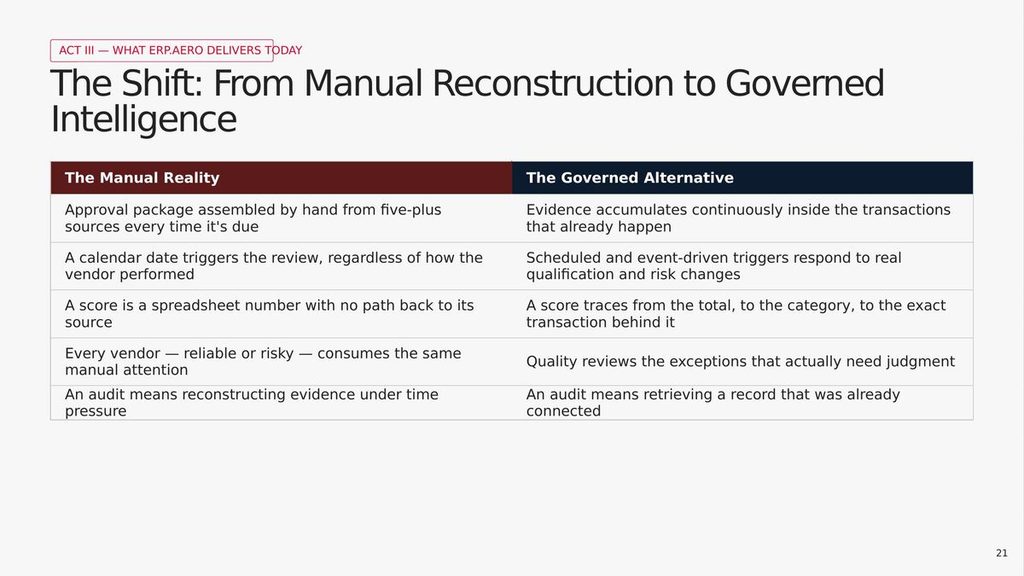
Source: ERP.Aero, The True Cost of Manual Vendor Governance.
Critically, this does not replace a company’s quality system. ASA-100 Revision 5.0 requires an accredited distributor to maintain a list of approved suppliers, keep a quality history for each, and describe its own approval criteria. It does not prescribe one universal scoring model, one weighting scheme, or one mandatory review interval. ERP.Aero applies the company’s own criteria, weights, thresholds, and intervals, and preserves the evidence behind every result. Automation strengthens Quality’s authority with better evidence, faster. It does not stand in for it.
IN PARTNERSHIP WITH ERP.AERO
ERP.Aero is an aviation-native, cloud ERP built for aviation suppliers, distributors, brokers, and MROs. Founded in 2017 and built on the AWS infrastructure, it manages sales, procurement, inventory, and operations for aviation businesses, with its Vendor Scoring and Approval capability now live as the qualification layer of vendor governance.
“Vendor re-approval should be a decision, not a research project. Every accredited distributor already does this work; the only question is whether they pay for it once, as a byproduct of the transactions they are already running, or over and over in hours nobody is tracking. We built Vendor Scoring and Approval so the evidence assembles itself and Quality’s judgment is where the time goes.”
– Ralph Merhi, Chief Executive Officer, ERP.Aero
The Aero NextGen take
Manual vendor governance is one of the most expensive processes that never shows up as a line item. It scales the wrong way, it consumes exactly the expert attention that should be spent on judgment, and it prices in only the labor, never what a bad vendor costs once it is already through the gate. Capturing the evidence continuously, inside the system of record, is how that cost gets paid once instead of repeatedly. Aero NextGen exists to map that kind of operational pain point to the vetted providers who can solve it, so operators start from the cost that is actually hurting them rather than from a vendor shortlist.
“The work of proving a vendor still deserves trust is not optional, and it is not free. What is optional is paying for it by hand, every review cycle, in hours no one is measuring. The operators who pull ahead treat vendor evidence as something the system captures once, so their Quality experts spend their time deciding, not assembling.”
– Monica Badra, Founder & CEO, Aero NextGen
Find your fit in 3 minutes: complete the Solution Finder quiz. Answer a short set of questions and get matched to the providers built for your operation.
Sources
- ERP.Aero – The True Cost of Manual Vendor Governance (whitepaper companion deck, September 2026): cost model, five capabilities, ASA-100 context, and the two exhibits reproduced above
- ERP.Aero – Aero NextGen vendor page – www.aero-nextgen.com/vendors/erp-aero
- ERP.Aero – company site – erp.aero