
Home / Technologies / Inventory Management
Aviation inventory management keeps the right serviceable part, with the right paperwork, in the right place when the aircraft needs it. Live stock across stations, rotables and repairs tracked to the serial number, and forecasting that orders before shelves run dry. We help MROs, airlines and parts distributors find inventory software built for aviation’s rules.
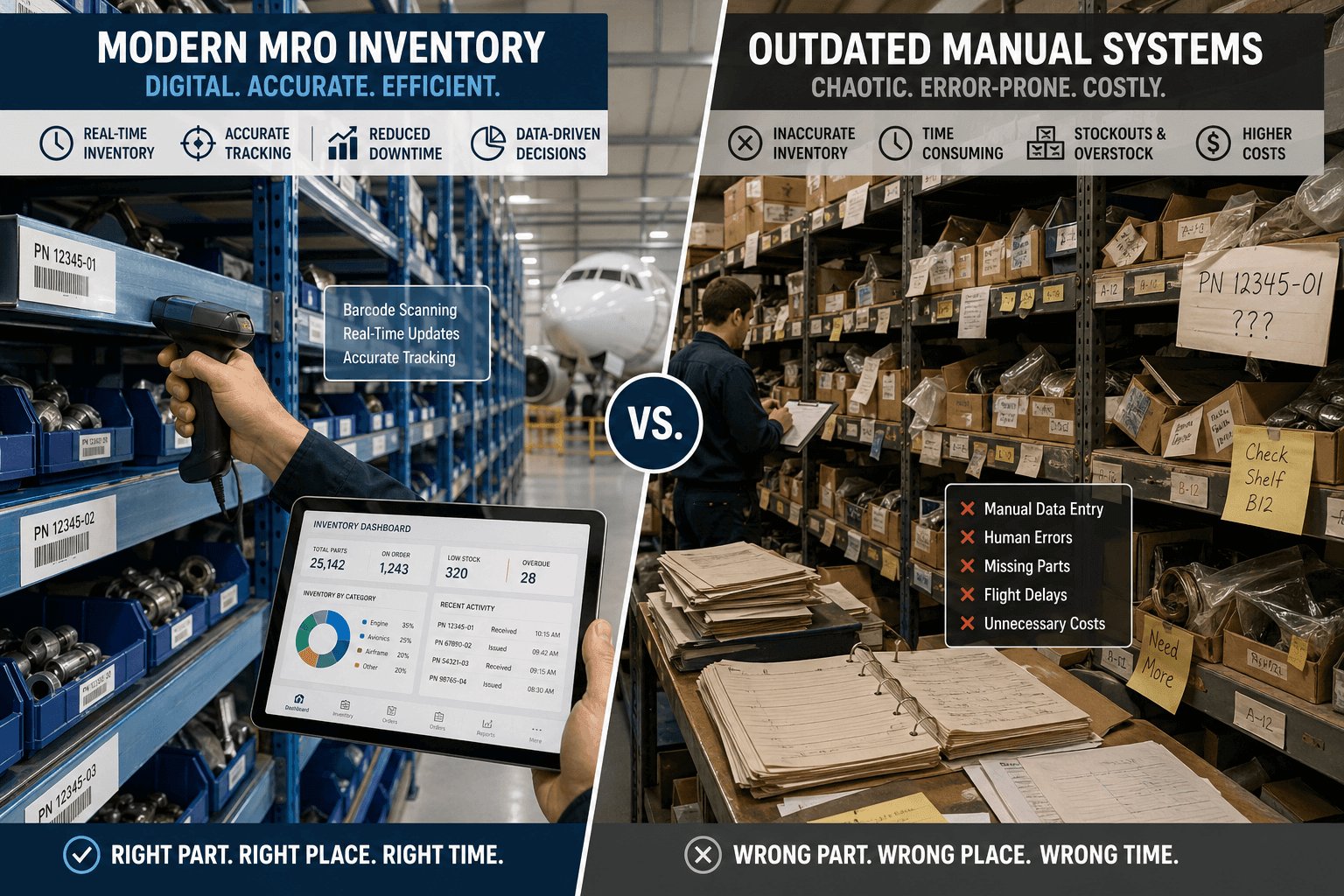
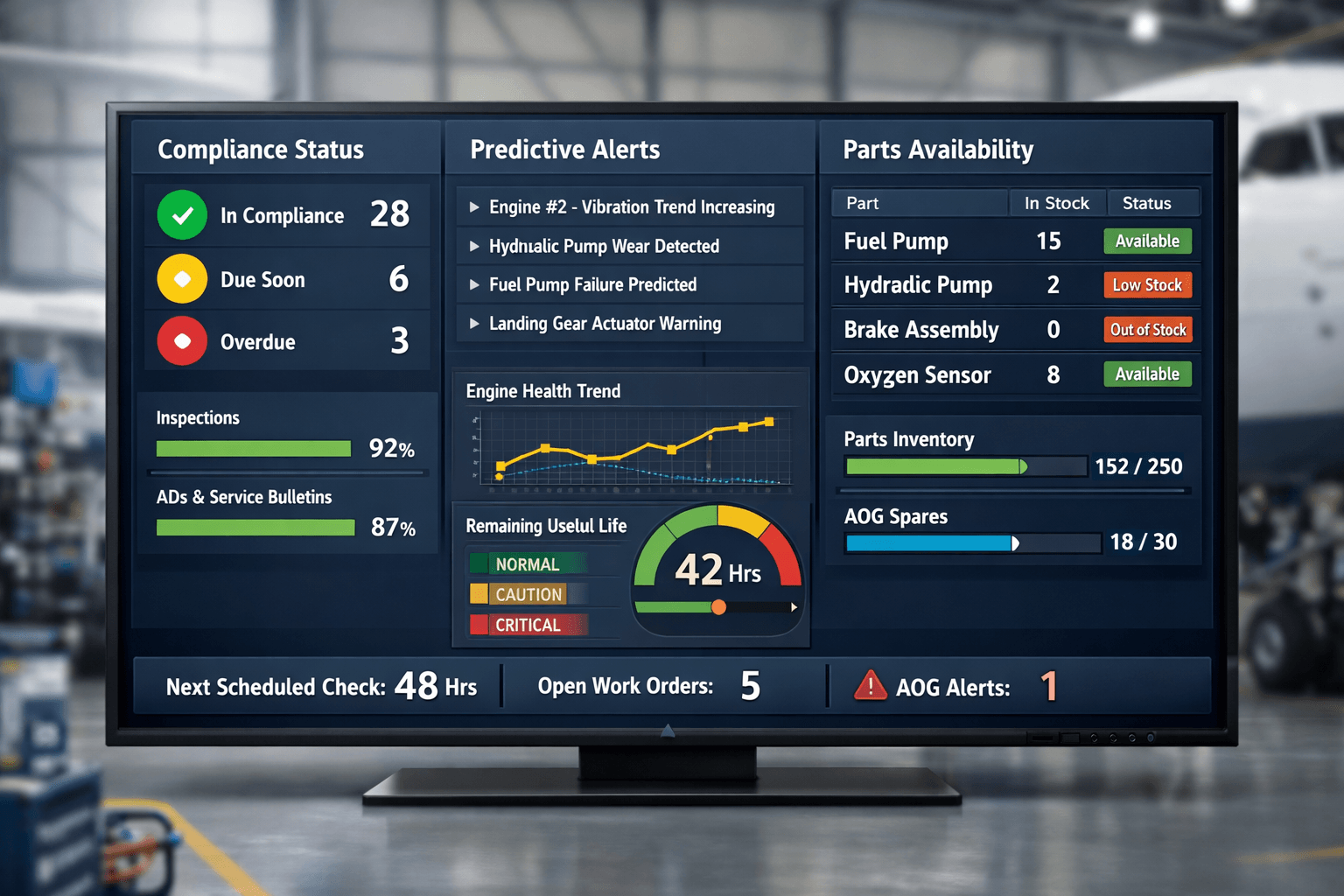
Illustrative dashboard, sample values
Aviation inventory management is the software and process for tracking, forecasting and controlling aircraft parts, rotables, consumables and tooling across stores, stations and repair loops. Unlike general inventory systems, it handles serial numbers, shelf life, certificates, condition codes, exchanges and repair orders, so every part issued is traceable and airworthy.
Inventory is where aviation cash and aviation delays meet. Too little stock and aircraft wait on the ground for parts. Too much and millions sit on shelves, aging and losing value. In between are the daily headaches: rotables lost in the repair loop, consumables past shelf life, certificates missing from a stockline and buyers ordering by gut feel.
Modern aviation inventory management fixes the visibility first. Every part is tracked by location, condition, serial number and certificate. Repair and exchange loops are followed to the vendor and back. Forecasting uses consumption, fleet plans and lead times to set reorder points. The result is higher fill rates, fewer AOG premiums and working capital released from slow-moving stock.
Every part, every certificate, every station: live stock visibility from the main store to the line.
These six capabilities are the core of an aviation-grade inventory system.
Every part tracked by part number, serial, batch, condition code, location and owner.
Trace documents attached to each stockline, with alerts for expiring shelf life and missing paperwork.
Repair orders, exchanges, loans and core returns followed from removal to serviceable again.
Demand forecasts from consumption and fleet plans that set min and max levels automatically.
Stock across warehouses, line stations and consignment locations in one view.
Inventory value, aging and slow movers, so excess can be sold, consigned or written down.
Supply chain delays have made every part on the shelf more valuable and every missing part more expensive.
Aircraft production is still constrained by the supply chain, so airlines are keeping older aircraft flying longer. That drives demand for spares and repairs while lead times for many parts stay long and unpredictable.
In that environment, inventory decisions made on spreadsheets are risky. Teams need to see what they have, what is in repair, what is coming and what they will need, so they can buy ahead without tying up cash in the wrong parts.
Aircraft held back by supply chain limits through at least 2030.
Unfilled aircraft orders at the start of 2026, more than 12 years of current production.
Average age of the global fleet in 2025, about a year and a half older than in 2024.
These are the improvements stores, purchasing and finance teams report most often.

“The most expensive part is the one you have, in the wrong place, without its paperwork.”
The Aero NextGen advisory principle
Forecast-driven reorder points and multi-station visibility mean the part is on the shelf when the work order needs it.
Better availability and visibility of stock at other stations cut emergency orders and expedite fees.
Aging and excess reports show what can be sold, consigned or returned, freeing cash tied up on shelves.
Certificates and histories attached to every stockline make audits and customer reviews straightforward.
Repair loops are visible, so units come back on time and pools are sized to real demand.
Barcode and mobile workflows speed up receiving, issuing and counting, with far fewer errors.
Inventory priorities differ by business. Pick your operation to see where better inventory control usually pays off first.

MROs need piece parts available when units clear inspection, accurate kitting and tight control of customer-owned and consigned stock.

Operators balance stock across main base and outstations, manage rotable pools and loans and keep minimum equipment items available where aircraft overnight.
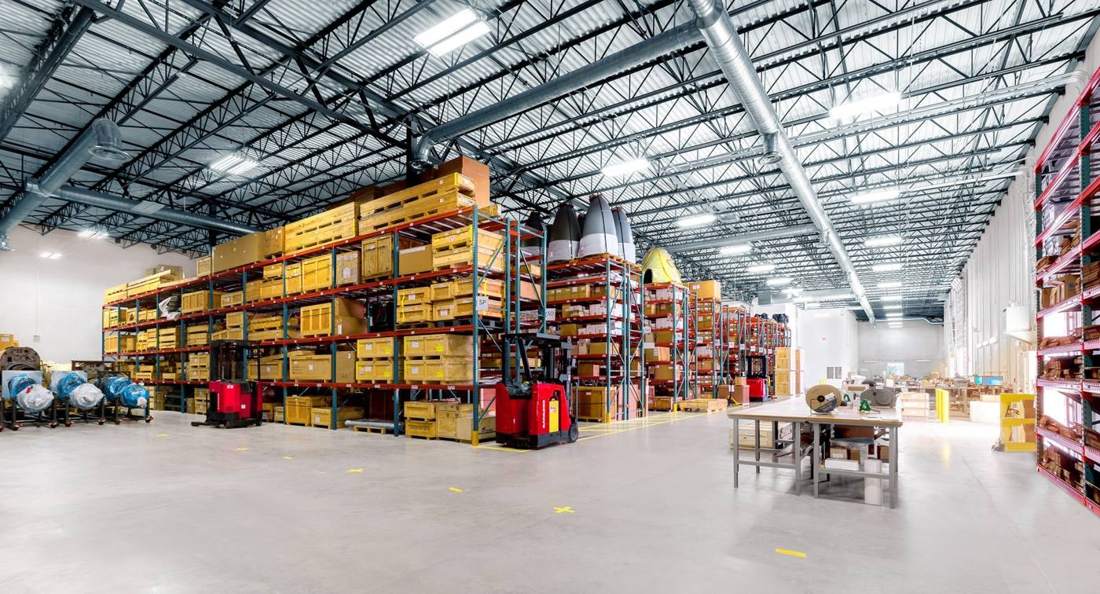
Distributors need accurate, searchable stock with certificates, quote integration and marketplace listings that match what is actually on the shelf.

OEMs manage spares distribution and service parts networks, while lessors track engines, landing gear and other high-value assets across operators.
Many stores teams still track critical stock in spreadsheets or generic systems. Here is what changes with aviation-grade software.
| Area | Spreadsheets or generic system | Aviation inventory management |
|---|---|---|
| Part identity | ✕ Part number only | ✓ Serial, condition, owner and certs |
| Reordering | ✕ When someone notices | ✓ Forecast-driven reorder points |
| Rotables | ✕ Lost in the repair loop | ✓ Tracked to vendor and back |
| Other stations | ✕ Phone around to find stock | ✓ Live view across locations |
| Shelf life | ✕ Discovered expired | ✓ Alerts before expiry |
| Excess stock | ✕ Unknown, aging quietly | ✓ Visible and actionable |
The fix: multi-station visibility shows where every serviceable part is, so it can be moved before an emergency order is placed.
The fix: repair loop tracking follows every unit to the vendor and back, with alerts when turnaround times slip.
The fix: aging and demand analysis show slow movers to sell, consign or return, and forecasts stop the next over-buy.
The fix: trace documents are captured at receiving and attached to the stockline, so nothing is issued without its paperwork.
Better inventory control pays back through fewer AOG premiums and cash released from shelves.
Carrying cost is the easiest saving to estimate. Excess inventory typically costs a meaningful percentage of its value every year in capital, storage and obsolescence. Use the calculator to see yours.
Start with visibility, then add control and forecasting. These five stages keep it practical.
Run a full count and clean part numbers, conditions and locations before anything else.
Link certificates to stocklines and flag anything missing or expiring.
List every rotable in repair, exchange or loan and where it is today.
Use consumption, fleet plans and lead times to set reorder points by station.
Review aging stock quarterly and decide what to sell, consign or return.

Not sure which inventory system fits your operation? The Solution Finder scopes it in about three minutes and matches you with vetted vendors.
General warehouse software does not understand condition codes, 8130s or exchanges. Use these criteria to compare aviation options.
Serial numbers, condition codes, shelf life, certificates and ownership must be native, not custom fields.
Check how the system handles repair orders, exchanges, loans and cores.
Look for demand forecasting that uses consumption, fleet data and lead times.
Inventory should connect to maintenance, purchasing, finance and parts marketplaces.
Receiving, issuing and counting should work from handhelds on the floor.
Include licenses, hardware, migration and training in the comparison.
Moving years of stock history is hard. Ask how the vendor supports it.
A sample of providers listed under inventory management, shown alphabetically. A listing is not an endorsement; the Solution Finder matches you on fit.

Monica Badra
Founder and CEO, Aero NextGen
Aero NextGen was founded by Monica Badra, who has spent more than a decade inside aviation translating real business needs into the right technology. That experience shapes how we approach aviation inventory management: see every part and its paperwork first, then let demand data decide what to buy.
We are vendor-neutral. We do not resell software, and our matching is based on your operation, your systems and your budget. Our perspective on digital MRO and aviation technology has been featured across the industry press.


The questions aviation leaders ask us most before they start. Have one we did not cover? The Solution Finder routes it to the right expert.
It is the software and process for tracking, forecasting and controlling aircraft parts, rotables, consumables and tooling, with serial numbers, condition, certificates and repair loops handled natively.
Aviation inventory must track serial numbers, condition codes, shelf life, trace documents, ownership, exchanges and repair orders, which general systems do not handle well.
By forecasting demand, setting reorder points by station and showing serviceable stock across locations, so parts are available or can be moved before an emergency order.
Yes. Good systems follow every rotable through removal, repair order, vendor, return and serviceable stock, with alerts when repairs run late.
Use aging and demand reports to identify slow movers, then sell, consign or return them, and use forecasting to avoid over-buying in future.
No, barcodes work well. RFID adds faster counts and real-time location where volumes justify it.
Often yes. Many aviation ERPs include inventory, while specialist tools add optimization on top. See cloud ERP.
Start with the free Solution Finder. It maps your stock, rotable and traceability pain points and matches you to the right inventory tools.
Find every tool, part and asset on the shopfloor in seconds.
Back-to-birth chain of custody for every serialized part.
Match sales forecasts to capacity, manpower and parts.

Run finance, maintenance, inventory and HR on one connected core system.
Track stock, rotables and certificates across every station and forecast what to buy before shelves run dry. Start with the free Solution Finder to scope the right aviation inventory management system.