

Aviation inventory is now a balance-sheet decision, not a back-office one. Global MRO demand reached $136 billion in 2025 and is forecast to approach $198 billion by 2036, according to Oliver Wyman. At the same time, IATA estimates supply chain failures cost airlines more than $11 billion in 2025, including $1.4 billion in surplus inventory holding costs. Airlines, MROs, distributors, parts traders, lessors and OEMs are all carrying more stock, holding it longer and proving its pedigree to a higher standard. This guide sets out the criteria that separate aviation-grade inventory software from generic warehouse tools, then compares 22 platforms listed on Aero NextGen using the capabilities each vendor reports.
The market has moved: why aviation inventory management software matters in 2026
Demand is rising faster than the supply chain can deliver. The aircraft order backlog now exceeds 18,000 and the average fleet age has hit a record 15.2 years, per IATA’s June 2026 supply chain priorities. Older aircraft fly longer, and Oliver Wyman reports that aging fleets have raised demand for replacement parts and pushed up parts and labor prices.
Engines dominate spend. Oliver Wyman’s 2026 forecast puts engine MRO at $70.1 billion of a $139.6 billion market in 2026, roughly half the total (ARSA / Oliver Wyman executive summary). Engine shops, lessors and traders handling life-limited parts need inventory systems that track cycles, hours and back-to-birth history, not just quantity on hand.
Material shortages extend turnaround time. The same report cites shortages of composites and titanium tying up MRO schedules, and production constraints that will limit aircraft output until at least 2030.
Inventory cost is now measurable at industry level. IATA breaks the $11 billion down into $4.2 billion of excess fuel burn, $3.1 billion of extra maintenance, $2.6 billion of engine leasing and $1.4 billion of surplus inventory holding (IATA, October 2025). Extra maintenance, engine leasing and inventory holding all depend on how well parts are planned, located and turned.
IATA is pointing at data. One of IATA’s four 2026 priorities calls for airline maintenance systems to integrate with external market intelligence to improve inventory management, warranty claims and repair-or-replace decisions.
These pressures map directly to recurring items in Aero NextGen’s library of 150+ pain points: no visibility into fill rates mid-workflow, missing parts that stall work in progress, manual cycle counts, excess and surplus stock tying up capital, and no demand-based forecast for parts requirements. The software decision is where those costs get fixed or locked in.
Traceability is the license to trade
A part without clean paperwork has no value. The AOG Technics case made this concrete. On 23 February 2026, the UK Serious Fraud Office secured a prison sentence of four years and eight months for the company’s director, who sold more than 60,000 engine parts, mostly for the CFM56, between 2019 and 2023 using forged Authorised Release Certificates (UK SFO). The UK CAA, FAA and EASA issued safety alerts, and aircraft were grounded worldwide. The scheme surfaced when an airline asked Safran to verify a certificate.
Release documents differ by authority and part condition. FAA Form 8130-3 is the Authorized Release Certificate governed by FAA Order 8130.21H. Under EASA Part-145, EASA’s component release FAQ states that EASA Form 1 is the only acceptable release document for used parts, and FAA 8130-3 is accepted for new parts or as a dual release.
The system must enforce the rule, not just store the PDF. The forward move is software that attaches certificates to the serial number at receiving, validates them against the destination authority, and blocks issue to a work order when documentation is incomplete.

Evaluation criteria: what to test in a demo
Use this checklist to compare any aviation inventory platform. Ask each vendor to show the function live with your own part numbers.
Serialized and rotable tracking. Serial, batch and lot control, with time since new, cycles since new and time since overhaul carried on every rotable and life-limited part.
Certification and traceability. Certificates (FAA 8130-3, EASA Form 1, UK CAA Form 1, TCCA Form One) linked to the serial number, with back-to-birth history for life-limited parts and an audit trail of every movement.
Quarantine and inspection holds. A dedicated quarantine status that prevents unserviceable, suspect or undocumented stock from being picked, sold or installed.
Shelf life and expiry. Expiry dates on sealants, chemicals, elastomers and other consumables, with alerts and first-expiry-first-out picking.
Consignment, exchange, loan and borrow. Ownership and location tracked separately, with exchange fees, core due dates and consignment settlement automated.
Core returns and repair loops. Repair order tracking from removal to vendor shop and back, with core return deadlines and over-and-above charges visible.
AOG sourcing speed. RFQ management that searches internal stock, pooling partners and marketplaces in one step, so an AOG request is quoted in minutes.
Marketplace integrations. Native connections to parts marketplaces such as ILS and PartsBase for publishing stock and sourcing demand, instead of manual uploads.
Multi-warehouse and multi-entity. Stock across bases, hangars, outstations and legal entities, with multi-currency pricing and inter-site transfers.
Compliance and export control. Customs and export documentation, digital recordkeeping and e-signoff, plus security attestations (SOC 2, ISO 27001) and, for defense work, NIST/CMMC alignment.
Data capture at the dock. Barcode or RFID receiving and cycle counting to remove manual entry, a core driver of inventory inaccuracy.
2026 platform comparison: inventory platforms to evaluate
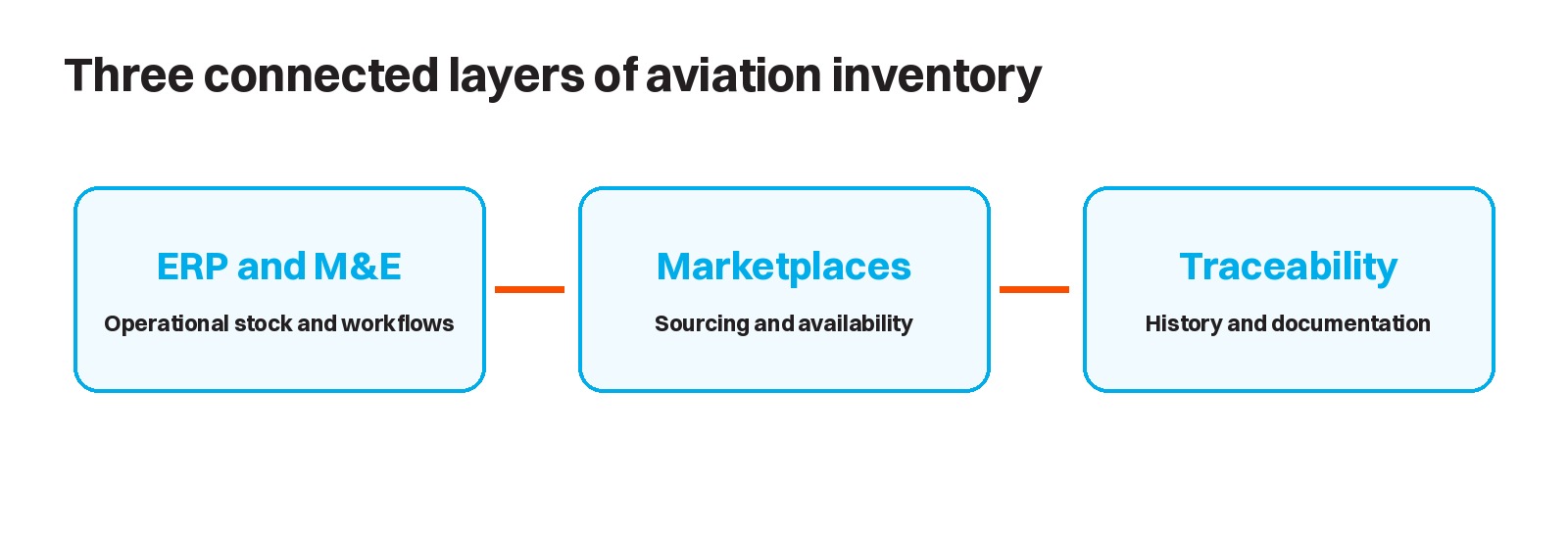
The tables below list solution providers featured on the Aero NextGen marketplace whose profiles cover inventory, parts, supply chain, ERP, M&E or parts trading. Platforms are listed alphabetically within each group. Order is not a ranking. All capability, segment, deployment and region data is vendor-reported from each provider’s Aero NextGen profile and has not been independently tested. Validate every capability in a live demo.
Aviation ERP and M&E platforms with inventory management
| Platform | Best-fit segments (vendor-reported) | Core inventory capabilities (vendor-reported) | Deployment | Regions |
|---|---|---|---|---|
| 2MoRO Aero-Webb | Operators, MROs, OEMs | Inventory, material planning, kitting and marshalling, cycle count, scrap; Part M and Part 145 system of record | Cloud or on-premise | Global |
| AirNxt | Operators, MROs, CAMOs | Stores and inventory control, consignment, exchange, loan and borrow, part pooling, cycle count; integrations listed include ILS, PartsBase, Locatory.com, ePlane | Cloud | Global |
| AMOS | Operators, MROs, OEMs | Inventory, consignment, exchange, loan and borrow, part pooling, cycle count; integrations listed include ILS, PartsBase, AeroXchange | Vendor-flexible | Global |
| AMS AIR22 | Operators, MROs, CAMOs (small to mid-sized) | Inventory, part pooling, goods in and out, kitting, scrap, customs and exports | Hybrid | Global |
| AvPro | Operators, MROs, distributors, OEMs | Inventory, consignment, exchange, part pooling, cycle count, scrap | On-premise or cloud-hosted | North America, South America, Europe |
| AvSight | Distributors, MROs | Inventory, consignment, exchange, loan and borrow, part pooling, cycle count; integrations listed include ILS, PartsBase, Locatory.com, SkySelect | Web-based | Global |
| CAMP Aviate | Operators, MROs, distributors, OEMs | Inventory, consignment, exchange, loan and borrow, part pooling, cycle count; integrations listed include ILS, PartsBase, ePlane, SkySelect | Commercial cloud | Global |
| CorePilot | Distributors (aviation aftermarket) | Inventory, consignment, exchange, kitting, RMA and warranty, warehouse operations; integrations listed include ILS, PartsBase, Locatory.com, AVSpares | Web-based | Global |
| Impresa | Operators, MROs, distributors, OEMs | Inventory, consignment, exchange, loan and borrow, kitting and marshalling, quarantine management, RFID asset tracking | Self-hosted, vendor-flexible | Global |
| Infor CloudSuite Aerospace and Defense | OEMs, suppliers, defense contractors, MROs | Aerospace and defense ERP with supplier collaboration, contract flow-down, quality and depot repair; AWS GovCloud option for CMMC 2.0 and DFARS | Hybrid | Global |
| Pentagon 2000 | Operators, MROs, distributors, OEMs | Inventory, consignment, exchange, loan and borrow, part pooling, cycle count, teardown; integrations listed include ILS, PartsBase, ePlane, AeroXchange | Hybrid | Americas, Europe, Middle East, Asia Pacific |
| Skyzen | Operators, MROs, distributors, OEMs | Inventory, purchase and repair orders, customs and exports, multi-currency | Commercial cloud | Global |
| Vellox Maintenance Hub | Airlines, MROs, CAMOs (fixed-wing and helicopter) | Inventory and Procurement package, quarantine management, parts traceability; EASA and FAA aligned | Modular SaaS | Global |
| Vista-Suite by Ambry Hill | Parts traders, distributors, Part 145 repair stations, teardown | Inventory, consignment, exchange, quarantine management, parts traceability, FAA digital recordkeeping (AC 120-78B); integrations listed include ILS, PartsBase, Locatory.com | Cloud-native | Global |
Parts marketplaces and sourcing networks
| Platform | Best-fit segments (vendor-reported) | Core capabilities (vendor-reported) | Regions |
|---|---|---|---|
| ILS (ILSmart) | Operators, MROs, distributors, OEMs | Global marketplace to buy, sell, market and analyze parts inventory in real time | Global |
| Locatory.com | Operators, MROs, distributors, OEMs | Parts and capabilities marketplace, AI-based RFQ parsing and distribution, surplus inventory management service | Global |
| Spaero | Airlines, MROs, repair providers | Structured email-to-RFQ marketplace; AI assistant that searches multiple marketplaces and supplier portals from one interface | Global |
Traceability, documentation and asset visibility layers
| Platform | Best-fit segments (vendor-reported) | Core capabilities (vendor-reported) | Regions |
|---|---|---|---|
| AVIATAR | Airlines, MROs | Modular, multi-fleet applications covering inventory, asset management and predictive maintenance | North America, South America |
| BlueGPS by Synapses | MROs, operators, OEMs | Real-time location of parts, materials, tools and GSE across stores, shops and hangars (BLE, UWB, GPS, RFID) | Global |
| ProvenAir | Operators, MROs, distributors, OEMs; asset leasing listed as a category | AI-generated back-to-birth trace timelines and exception reports for engine, landing gear and APU life-limited parts | Americas, Europe, Middle East, Asia Pacific |
| SkyThread | OEMs, airlines, MROs, distributors, lessors | Cloud digital thread recording validated status, history, condition, provenance and location of parts | Global |
| SmartCert | OEMs, distributors | Certification document intelligence: automated review against compliance criteria, linked to shipments and parts; ILS integration listed | North America, Europe |
Matching the platform to the operating model
The right system depends on what your inventory does for the business. A parts trader and an airline both hold rotables, but they make money from them in different ways.
Distributors and parts traders: prioritize RFQ speed, marketplace integrations, consignment settlement and quarantine control. Teardown operators need serial-level intake as each aircraft is broken down into saleable parts.
MROs and repair stations: prioritize work order material issue, kitting, core and repair loops, and shelf-life control. Inventory must sit inside the shop workflow, not beside it.
Airlines and fleet operators: prioritize multi-base stock, pooling, exchange and loan, and links between maintenance planning and parts demand forecasting.
Lessors and asset managers: prioritize back-to-birth records, life-limited part status and transition-ready documentation. A traceability layer often sits alongside the lessee’s M&E system.
OEMs and manufacturers: prioritize supplier collaboration, contract flow-down, quality and, for defense work, CMMC and DFARS alignment.
Many organizations run a core ERP or M&E system plus one or more specialist layers: a marketplace connection for sourcing, a traceability tool for life-limited parts, or real-time location tracking on the shop floor. Test integration depth early. A marketplace connection that only exports a stock file is not the same as live, two-way RFQ handling.

Where aviation inventory is heading
The next gains come from connected data, not bigger warehouses. IATA’s 2026 priorities call for earlier visibility of delivery delays, repair turnaround times and parts availability, and for maintenance systems that draw on external market intelligence. Three shifts follow from that:
Digital certificates and digital threads reduce reliance on paper release documents, the exact weakness exploited in the AOG Technics case.
AI-assisted sourcing and quoting compresses AOG response time by searching internal stock and multiple marketplaces at once. Several platforms above report AI features built for this.
Forecast-driven stocking links maintenance programs and fleet utilization to parts demand, reducing the surplus inventory IATA valued at $1.4 billion in holding costs for 2025.
The Aero NextGen take
Inventory software is a compliance system and a cash system at once. Selecting it on price or interface alone leaves both risks open. The rational path is to define your operating model first, score platforms against the criteria above, and demo with your own serialized parts and certificates. Aero NextGen exists to shorten that path: the Aero NextGen marketplace lists 600+ vetted solution providers across 60+ categories, and matches buyers to platforms built for their environment.
“Every operator now carries more inventory for longer, and every part has to prove where it came from. The companies that treat inventory software as core infrastructure will turn parts faster, quote AOG requests first and pass audits without rework. Our role is to put the right shortlist in front of them, based on how they actually operate.”
Monica Badra, Founder & CEO, Aero NextGen
Find your fit in 3 minutes: Take the Aero NextGen Solution Finder quiz, list your inventory and supply chain priorities, and receive a custom shortlist of aviation inventory management platforms matched to your segment, fleet and region.
Sources
Oliver Wyman, “Global Fleet and MRO Market Forecast 2026-2036” (February 2026): https://oliverwyman.com/our-expertise/insights/2026/feb/global-fleet-and-mro-market-forecast-2026-2036.html
ARSA / Oliver Wyman, 2026 Fleet and MRO Market Report Executive Summary (March 2026): https://arsa.org/wp-content/uploads/2026/03/ARSA-OW-2026FleetMROMarketReport-ExecSum-2026.pdf
IATA, “Supply Chain Challenges Could Cost Airlines More than $11 Billion in 2025” (13 October 2025): https://www.iata.org/en/pressroom/2025-releases/2025-10-13-01/
IATA, “IATA Outlines Four Priorities to Strengthen the Aviation Supply Chain” (24 June 2026): https://www.iata.org/en/pressroom/2026-releases/06-24-iata-outlines-four-priorities-to-strengthen-aviation-supply-chain/
UK Serious Fraud Office, “SFO secures 4 year prison sentence for aircraft parts fraud” (23 February 2026): https://www.gov.uk/government/news/sfo-secures-4-year-prison-sentence-for-aircraft-parts-fraud
FAA Order 8130.21H, Procedures for Completion and Use of the Authorized Release Certificate, FAA Form 8130-3: https://www.faa.gov/documentlibrary/media/order/faa_order_8130.21h.pdf
EASA, FAQ on acceptable component release documents: https://www.easa.europa.eu/en/downloads/66699/en
Vendor capability data: Aero NextGen provider profiles (vendor-reported), https://www.aero-nextgen.com/