
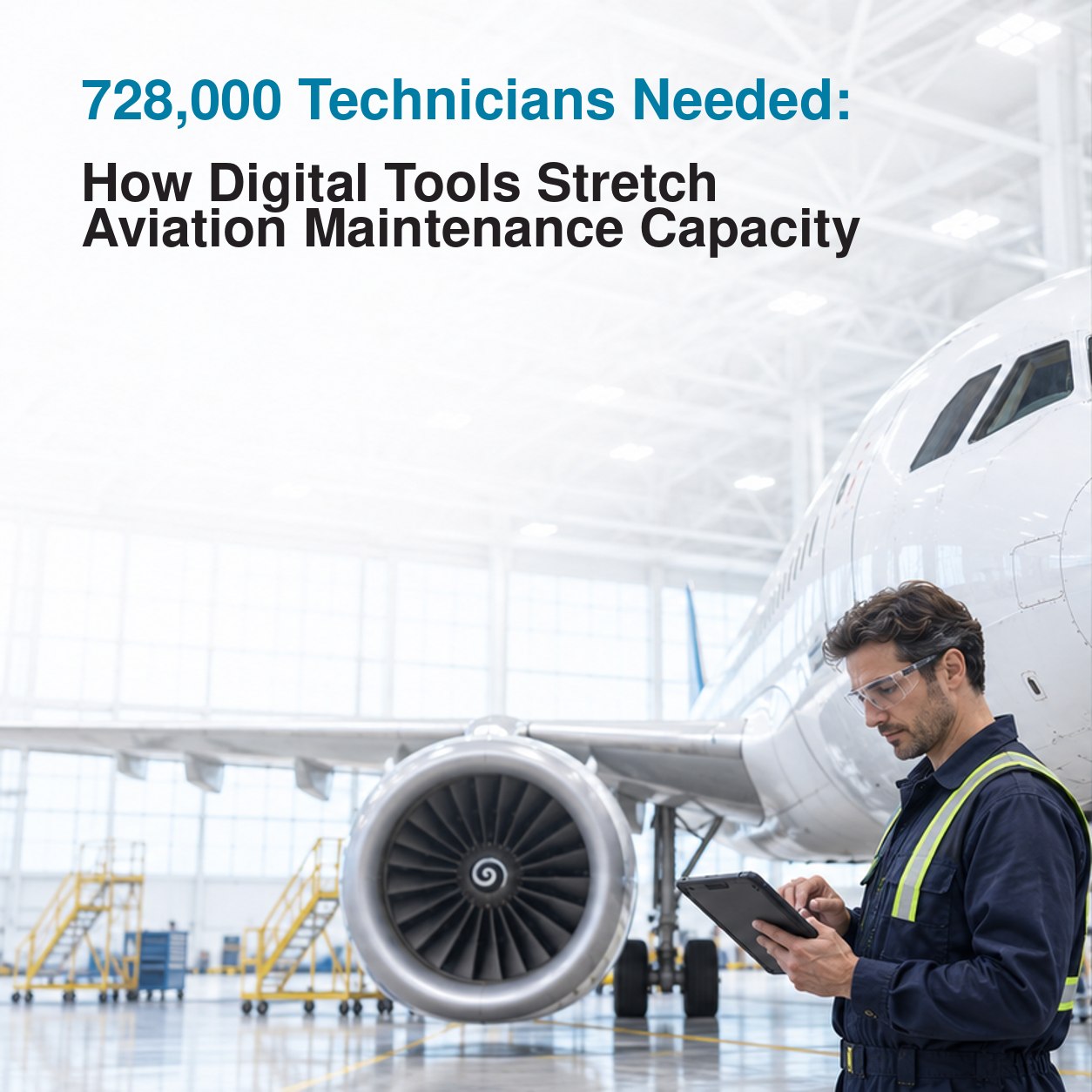
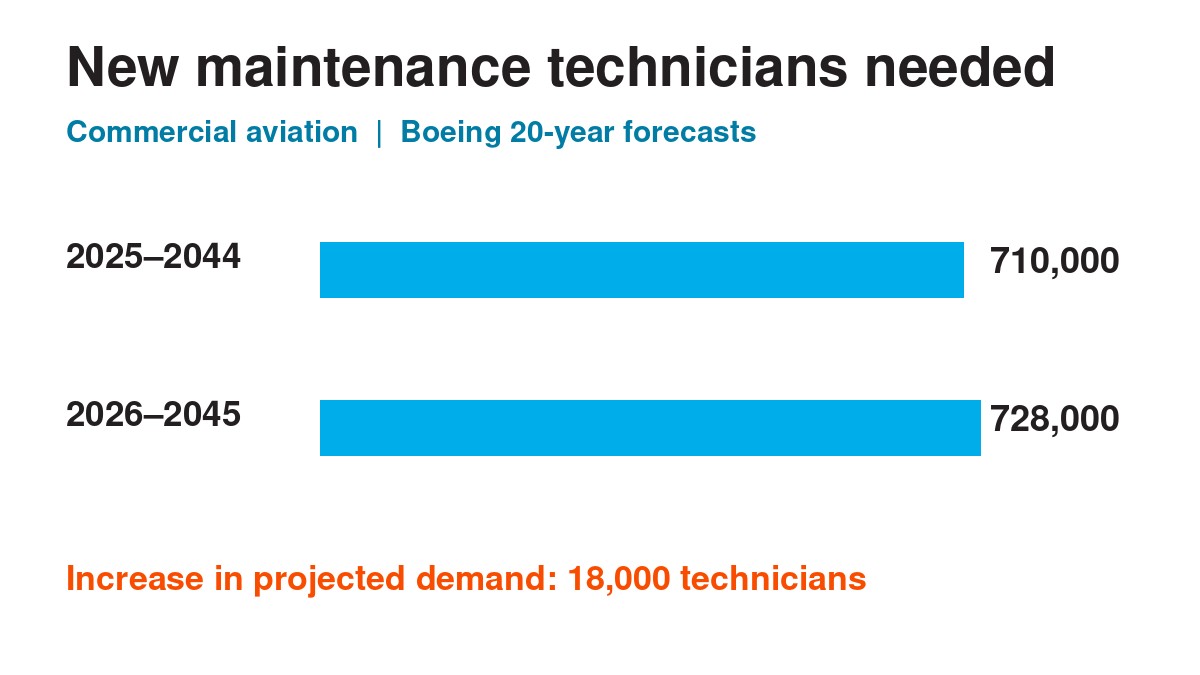
Boeing’s latest Pilot and Technician Outlook projects that commercial aviation will need 728,000 new maintenance technicians over the 2026 to 2045 period, up from the 710,000 it projected a year earlier for 2025 to 2044. That is a demand projection, not a headcount gap, but the supply side is not keeping pace: two-thirds of aviation executives surveyed by Oliver Wyman say finding technicians is now moderately to very challenging, and labor rate inflation has settled at 5.5% to 6.0%. Training more people is necessary. It is not sufficient on its own. The operators, MROs and OEMs that stay ahead will be the ones that use digital maintenance tools to get more certified work out of every technician hour they already have.
The number is larger, and the workforce math has shifted
The aviation technician shortage is a structural issue, and Boeing’s own forecast keeps moving up. The 2025 Outlook put new technician demand at 710,000 through 2044. The 2026 edition, released in July 2026, raised that to 728,000 through 2045, alongside 674,000 pilots and 1,023,000 cabin crew. The forecast covers commercial passenger and freight aviation only. It excludes business aviation and civil helicopters, so the real requirement across the whole industry is larger.
The drivers matter as much as the total. Boeing’s 2025 release states that about two-thirds of the new personnel it forecasts will replace people leaving through attrition, and about one-third will support fleet growth, with single-aisle aircraft driving most of the demand.
- Most of the demand is replacement, not expansion. Every operator and MRO that loses a senior technician loses years of type experience along with the headcount.
- North America alone needs 125,000 technicians in the 2026 Outlook, according to AVweb’s coverage of the release. Boeing identifies Eurasia and China as the largest sources of new personnel demand overall.
- The aircraft are changing too. Boeing notes that aircraft systems are becoming more digitized, as AOPA reported. The technician of 2035 will spend more time with data and diagnostics than the technician of 2015.
The pipeline is growing, and it still trails demand
Training output is at a record, which is exactly why the remaining gap is worth taking seriously. The FAA issued 11,103 new mechanic certificates in 2025, the highest annual total since it began publishing the data and up 23.2% on 2024. Enrollment at FAA-certificated maintenance schools rose 13.5% to 27,740.
That progress sits against a demographic reality. The same ATEC Pipeline Report, drawing on Oliver Wyman analysis, projects a North American shortage of about 9,100 certificated mechanics in 2026, rising to roughly 20,000 (12% of anticipated demand) by 2030. It notes that 44% of certificated mechanics are over 60 and that more than 39,000 retirements are expected over the next decade. Only 62% of available A&P program seats were filled.
- New hires arrive without tribal knowledge. A record class of newly certificated technicians still needs years on the floor to reach the judgement of the people retiring.
- Hiring costs are rising fastest where skills are scarcest. Oliver Wyman’s 2026 MRO Survey found labor rate inflation stayed “stubbornly high for engines and components,” while line and airframe work came in slightly below expectations. More than half of respondents expect attrition to worsen in 2026.
- This hits every part of the industry. Airlines running in-house maintenance, independent MROs, engine and component shops, and OEM service networks all compete for the same certificated talent pool.
Where digital maintenance tools create capacity
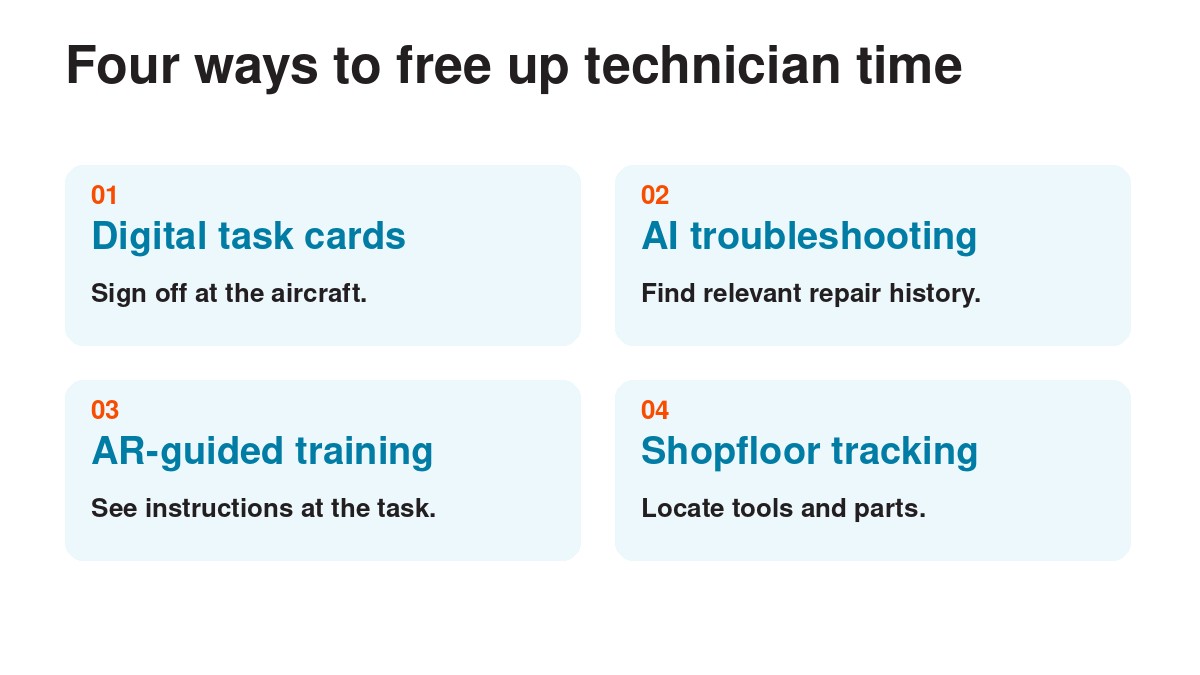
The forward move is to treat technician hours as the constrained resource and remove everything that is not skilled work. Digital tools do not replace a certificated signature. They shorten the path to it. Four categories carry the most weight for MRO workforce capacity.
1. Digital task cards and electronic records
Paper task cards, manual sign-offs and re-keyed data consume technician time that produces no airworthiness value. Digital task cards put the current approved data, the sign-off and the record in one place, at the aircraft or the bench.
- Records work is where the time sits. flydocs reports on its Aero NextGen profile that its Digital Records Management software supports operators in saving up to 75% of daily records management workload (vendor-reported).
- Regulatory support exists for paperless signatures. Vista-Suite by Ambry Hill Technologies lists FAA digital recordkeeping and signatures under AC 120-78B, kiosk mode and Android and iOS apps for Part 145 shop management and labor recording (vendor-reported).
- Digital task cards are now standard functionality across most modern M&E platforms listed on the Aero NextGen marketplace, including Impresa, whose profile also lists training management.
2. AI-assisted troubleshooting and knowledge management
The fastest way to protect tribal knowledge is to capture it in a system before the people who hold it retire. AI applied to historical defect and repair data turns decades of write-ups into searchable guidance for a less experienced technician.
- The results are measurable. Southwest Airlines’ AutoCoder, described in Aircraft IT MRO (Q4 2025), classifies all of its defects and non-routines in real time at 95% accuracy or higher, and saved the equivalent of three full-time employees on day one.
- Purpose-built technician AI assistants are available now. AVIATAR, part of Lufthansa Technik’s digital portfolio, supports airlines and tech ops with troubleshooting, predictive maintenance, planning and execution (vendor-reported). CAMP Aviate lists a technician AI assistant, digital task cards and tech pubs revision automation, and is designed to run alongside an existing ERP before full adoption (vendor-reported).
- Data quality decides the outcome. Oliver Wyman found 58% of respondents are still at the experimental stage of AI, the same share as in 2025, and links stalled scaling to poor data quality and availability. AI-assisted maintenance only works on clean, structured records.
3. AR-guided maintenance and immersive training
AR-assisted MRO puts step-by-step instructions in the technician’s field of view, which shortens the learning curve on unfamiliar tasks. Boeing’s own training leadership has stated that “immersive technologies will enhance training” as part of its 2026 Outlook.
- Early results favor newer technicians. In a time trial presented at MRO Americas 2025, FTAI tested entry-level technicians unfamiliar with an inspection process and found AR-guided visual inspections were “significantly faster than FTAI’s current standard”.
- E-learning shortens time to qualification. 2MoRO, whose Aero-Webb platform covers Part M and Part 145 operations, also publishes OLATU, an e-learning and hands-on practice environment for aeronautical maintenance teams (vendor-reported).
- Onboarding friction is a selection criterion. AirNxt lists “no training cycles” and multi-device access among its design pillars, along with AI agents and digital task cards (vendor-reported). Software that a new hire can use on day one adds capacity on day one.
4. Automated compliance and shopfloor visibility
Technicians lose time searching for tools, parts and approvals. Location and compliance data, captured automatically, gives that time back and strengthens the audit trail at the same time.
- Real-time location closes the gap between plan and execution. Synapses BlueGPS tracks tools, ground support equipment, parts, work zones and technician maintenance activities in one live view, and its rules engine verifies that the right people, tools and materials are present (vendor-reported).
- Compliance automation protects the signature, not just the schedule. When the system checks currency of data, tool calibration and qualifications before a task starts, errors are caught upstream rather than in a records audit.
Where the industry is heading
The winning maintenance organizations will measure capacity in productive technician hours, not headcount. Three shifts are already underway.
- Knowledge capture becomes a formal program. Retirement curves are known years in advance. Recording the expertise of senior technicians in searchable systems is a planning decision, not an IT project.
- Onboarding time becomes a KPI. With a record pipeline of new certificate holders entering the workforce, the operator that brings a new hire to productive, independent work fastest gains a direct cost and turnaround advantage.
- Data foundations come first. Oliver Wyman’s finding that half of respondents plan to invest in AI but only a third in IT infrastructure points to the next priority: clean records, digital task cards and integrated M&E data are the prerequisite for every AI tool that follows.

The Aero NextGen take
The 728,000 figure is not a reason for alarm. It is a planning input. Boeing has published the demand curve, the FAA and ATEC have published the supply curve, and Oliver Wyman has published the cost curve. The gap between them is a capacity question, and capacity can be engineered.
Every aviation business that maintains aircraft, engines or components should now be asking three questions. How many of our technician hours are spent on non-technical work? How much of our senior technicians’ knowledge exists only in their heads? How long does it take a new hire to work independently? The answers point directly to the right category of digital maintenance tools, whether that is digital task cards, a technician AI assistant, AR-guided work instructions, records digitization or shopfloor tracking.
Aero NextGen exists to make that selection fast and evidence-based. The platform maps 150+ aviation pain points to 600+ vetted solution providers across 60+ solution categories, so airlines, MROs, OEMs and operators get a shortlist built for their environment, not a generic list.
“The industry will not train its way to 728,000 technicians fast enough on its own, and it does not have to. Every hour a technician spends searching for data, re-keying records or waiting for an answer is capacity that can be recovered. The organizations that digitize their knowledge and their workflows now will set the standard for turnaround, safety and cost for the next twenty years.”
Monica Badra, Founder & CEO, Aero NextGen
Find your fit in 3 minutes: Take the Aero NextGen Solution Finder quiz, list your workforce and maintenance priorities, and receive a custom shortlist of vetted aviation solutions purpose-built for your operation.
Sources
- Boeing, Pilot and Technician Outlook 2026 to 2045: boeing.com/pto
- Boeing, news release on the 2025 Pilot and Technician Outlook (July 22, 2025): boeing.mediaroom.com
- AVweb, “Boeing Forecasts Need For 674,000 New Pilots” (July 20, 2026): avweb.com
- AOPA, “Pilot demand ticks up in Boeing forecast” (July 21, 2026): aopa.org
- AVweb, “FAA Issues Record Number of Mechanic Certificates,” on the ATEC 2026 Pipeline Report (September 25, 2026): avweb.com
- Aviation Pros, “ATEC Shares 2026 Pipeline Report” (October 1, 2026): aviationpros.com
- Oliver Wyman, “The new MRO supply paradigm,” 2026 MRO Survey (April 13, 2026): oliverwyman.com
- Aircraft IT MRO, Issue 66 (Q4 2025), Southwest Airlines case study: aircraftit.com
- Scope AR, FTAI time trial at MRO Americas 2025 (April 11, 2025): scopear.com
- Vendor information (vendor-reported): Aero NextGen marketplace profiles for flydocs, Vista-Suite, Impresa, AVIATAR, CAMP Aviate, 2MoRO, AirNxt and Synapses BlueGPS at aero-nextgen.com