

Most ERP projects in maintenance environments do not fail because the software is wrong. They fail because the rollout is treated as a technical event instead of an operational one. Discrete manufacturing, the segment MRO shopfloors most resemble, posts the highest ERP implementation failure rate of any industry studied, and the root causes are the same six or seven items on every failure report: change management, data migration, training, scope, and executive ownership. None of that is a software problem. All of it is a project-design problem, and it is fixable before go-live, not after.
For an MRO, a repair station, or an airline’s internal maintenance organization, the stakes are higher than in general manufacturing. Every work order, serialized part, and FAA 8130-3 or EASA Form 1 record has to survive the transition with its traceability intact. A rollout that would be a rough quarter for a discrete manufacturer can be a compliance exposure for a Part-145 shop. The patterns below are what separate the implementations that hold up from the ones that don’t.

THE FAILURE MATH IS NOT A VENDOR PROBLEM
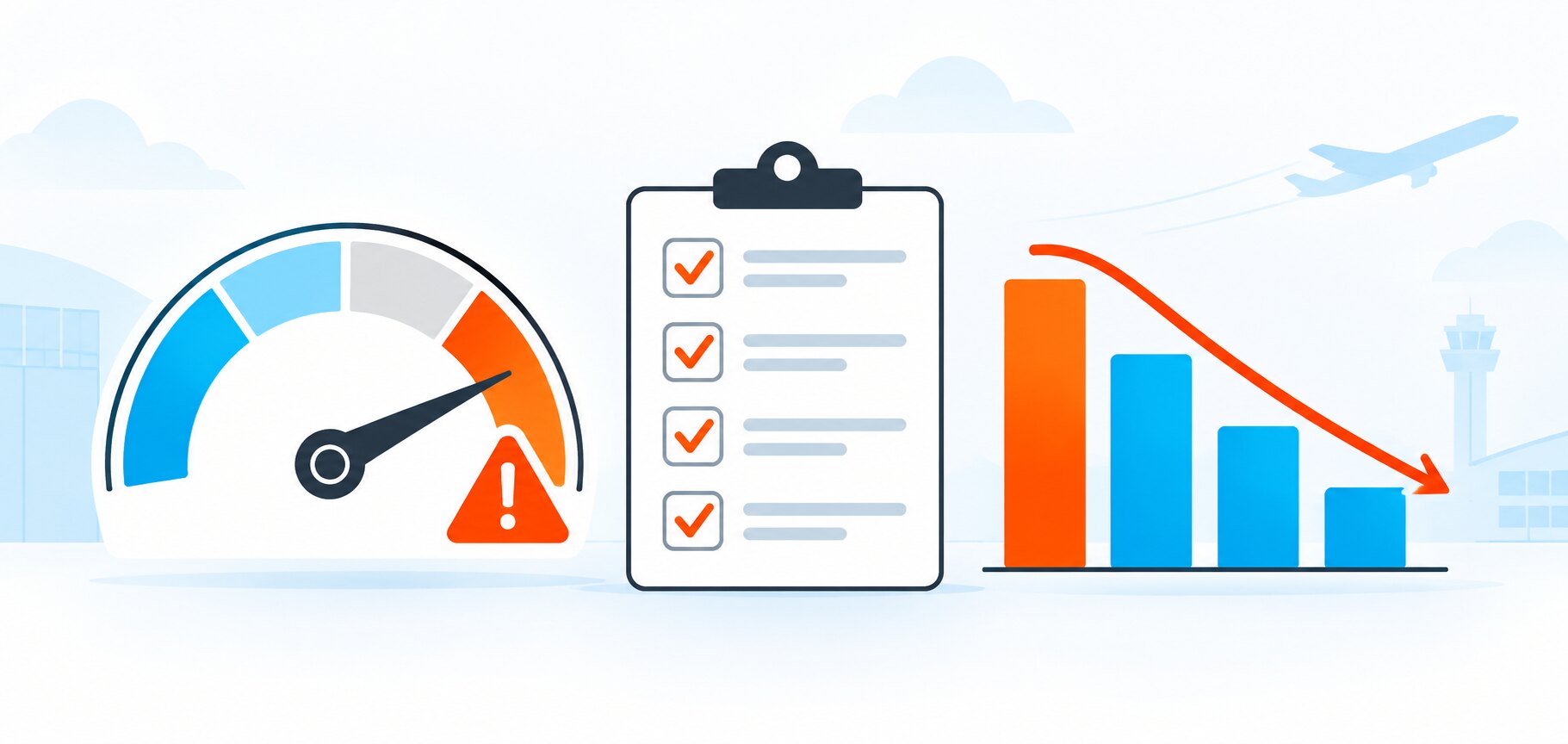
Panorama Consulting Group’s 2026 ERP Report puts industry-wide ERP implementation failure at 68%, rising to 73% in discrete manufacturing, the highest of any segment the firm tracks, with average cost overruns of 215%. Godlan’s analysis of more than 2,400 discrete-manufacturing implementations between September 2025 and January 2026 breaks down why:
- Inadequate change management, 42% of failures
- Poor data migration, 38% of failures
- Inexperienced implementation teams, 35% of failures
- Lack of executive sponsorship, 31% of failures
- Insufficient end-user training, 29% of failures
- Scope creep, 26% of failures
- Over-customization, 23% of failures
- Vendor selection errors, 19% of failures
The top three causes alone account for more than three-quarters of all failures, and Godlan’s own read is that all three are preventable with structured pre-engagement planning, not better software. That is the point maintenance leaders keep missing when they shop for ERP: the selection decision matters less than the implementation discipline around it.
MAINTENANCE ENVIRONMENTS CARRY A COMPLIANCE LAYER MANUFACTURING DOESN’T
A generic ERP failure means a bad quarter. An MRO ERP failure means broken traceability. Smart 145’s 2026 guidance on aviation ERP replacement is direct about what has to move without gaps in a Part-145 transition: work order history, serialized parts records, FAA Form 8130-3 documentation, shelf-life data, and compliance attachments. Lose the link between a serialized component and its certification history, and the shop hasn’t just had an IT problem, it has an audit problem.
This is also why treating data migration and forms configuration as separate, sequential phases is a mistake specific to maintenance operators. A completed work order package tests the database and the forms at the same time: it shows what data the shop actually needs, which fields matter, and where sign-offs happen. Building the two in parallel, and validating migrated data against real forms before scheduling a go-live date, catches the gaps a “clean-looking” database will hide until week two of production use.
The regulatory backdrop makes this urgency non-negotiable, not aspirational. EASA’s Part-IS information security rules took effect October 16, 2025 for airports, apron control services, and manufacturing organizations, and extend to airlines, maintenance organizations, and CAMOs from February 22, 2026. That mandate requires a structured information security management system wrapped around the same operational systems this article is about, meaning MROs and CAMOs replacing or hardening their ERP now are doing two projects at once: a functional migration and a compliance one.
DATA MIGRATION IS WHERE MRO PROJECTS ACTUALLY DIE
Godlan’s 38%-of-failures figure for poor data migration undersells how it plays out on a hangar floor. Legacy MRO systems typically hold two decades of workarounds: custom fields nobody remembers creating, part-number logic that lives in one planner’s head, and quarantine records tied to purchase orders that no longer reconcile. None of that shows up as “dirty data” until it’s mid-migration.
The de-risking pattern that works:
- Separate operational data from accounting data before scoping the project. Work order history, part movement, and inspection records are not the same category as invoices and reconciliation, conflating them is the most common scoping error cited in aviation ERP transition guidance.
- Decide migration depth by data maturity, not vendor default. A shop with clean, limited history may need only customers, vendors, and inventory carried forward; a shop with years of serialized parts history may need a full historical migration. Following the same template for both is how timelines blow out.
- Validate data against forms in a test environment before any go-live date is set. A clean database tested against broken forms is still a failed go-live, and the reverse is equally true.
CHOOSE THE CUTOVER MODEL ON PURPOSE, NOT BY DEFAULT
Panorama Consulting frames the big-bang-versus-phased decision as a question of where you’re willing to carry risk: big-bang concentrates it into a single cutover moment and can be faster and cheaper when it works; phased spreads risk across stages at the cost of running two systems, and two sets of training, in parallel for longer. Neither is automatically correct. A single-site repair station with modest data complexity is a reasonable big-bang candidate. A multi-site MRO group or an airline’s maintenance division, where compliance exposure compounds across locations, is a phased candidate almost by default.
Whichever model is chosen, dual-run validation, running the new system alongside the legacy one for a defined window before fully retiring the old one, is the control that catches logic errors before they touch a certified aircraft record. Skipping it to hit a go-live date is the single most common “big bang” mistake maintenance software vendors report seeing in the field. A practical sequence for maintenance operators:
- Start dual-run in the operation with the most time-sensitive data, commonly line maintenance, where real-time status and fast turnaround make discrepancies visible fast.
- Prove the system there before extending to heavy maintenance or a second site.
- Keep the legacy system in read-only mode for a defined period post-cutover as a documented fallback, not an informal habit.
CHANGE MANAGEMENT IS THE ACTUAL PRODUCT BEING DELIVERED
At 42% of failures, inadequate change management outranks every technical cause combined. In a maintenance environment this shows up as technicians reverting to paper travelers, buyers keeping a shadow spreadsheet “just in case,” and QC inspectors distrusting a digital sign-off they weren’t part of designing. Training timing matters as much as training content: run it too early and the details are forgotten before go-live; run it too late and the team enters cutover week with no confidence. Aviation ERP transition practice generally splits this into two sessions, system familiarity, then full workflow execution, rather than one long session close to go-live.
The first 48 hours after cutover set the tone for adoption more than any other window in the project. What to monitor is specific, not general: are open work orders moving through the correct steps, are serialized records staying connected to the right jobs, are 8130-3s and equivalent documents accessible where users need them, and are technicians able to document work without leaving the system. A team that feels supported in that window keeps using the new system. A team that feels alone starts rebuilding the workarounds the project was supposed to eliminate.

WHERE THIS IS HEADING
Global MRO spend is set to reach roughly $119 billion in 2025 and grow at a 2.7% CAGR toward $156 billion by 2035, according to Oliver Wyman’s Global Fleet and MRO Market Forecast, driven in part by a global fleet aging to an average of 13.4 years. More volume moving through more systems, layered onto Part-IS compliance obligations landing in the same window, means the operators who treat ERP replacement as a one-time IT project rather than a recurring operational discipline will keep showing up in next year’s failure statistics. The ones who build data governance, change management, and validation into the operating model, not just the go-live plan, are the ones who compound the advantage.
THE AERO NEXTGEN TAKE
An ERP rollout in a maintenance environment is not a software purchase, it’s a change to how technicians, buyers, and QC interact with every certified record in the building. The vendors that succeed in this segment are the ones that show up with a migration methodology, a change-management plan, and a training sequence before they show up with a features list. That is what separates a real implementation partner from a license sale.
“An ERP failure in a machine shop costs a quarter. An ERP failure in an MRO costs traceability on a certified part. That difference should show up in how operators select and structure every implementation, not after go-live, in the scoping conversation before a contract is signed.”
, Monica Badra, Founder & CEO, Aero NextGen
Aero NextGen doesn’t recommend a single platform for every operator, the right ERP or MRO software depends on fleet type, shop size, data maturity, and compliance scope. Find your fit in 3 minutes: complete the Solution Finder quiz, to get matched with vetted providers built for your specific implementation risk profile.
SOURCES
- Godlan, “ERP Implementation Failure Statistics: 2026 Research”
- Gartner, “What IT Leaders Must Do to Avoid Disappointing ERP Initiatives”
- Panorama Consulting Group, “Big Bang Implementation vs. Phased Implementation Approach in ERP”
- Smart 145, “Aviation ERP Replacement: Transitioning Without Disruption”
- SOMA Software, “MRO Software Implementation Checklist for Aviation Teams”
- Oliver Wyman, “Global Fleet and MRO Market Forecast 2025-2035”
- Jones Day, “Civil Aviation Cybersecurity: EASA Part-IS Sets New Information Security Obligations”