Business aviation just posted its busiest year on record — 3.9 million departures in 2025, up 5% year-over-year and 36% above 2019 levels, according to WingX. Yet the software infrastructure underneath that growth looks nothing like what airlines and MROs have access to. Airlines run on decades of PSS and MRO-software investment; component and airframe MROs now have a maturing vendor market built specifically for their workflows. FBOs and charter operators — the ground-services and flight-operations layer moving that record volume — have a fraction of the purpose-built vendor options, and almost no dedicated industry commentary pointing them toward the right ones. This is a structural gap, not a demand problem, and it is closing more slowly than the traffic curve it needs to support.

THE SEGMENT IS GROWING FASTER THAN ITS SOFTWARE MARKET
The scale of what FBOs and charter operators now manage has outpaced the tools historically built for it. WingX recorded 3.9 million global business jet departures in 2025 — the highest annual total on record — with Part 91K and Part 135 operations alone logging just over 2 million departures, a 5% increase over 2024 (Business Air News). North America carried 72% of that global traffic. On the ground, the FAA’s certificated Part 135 operator list stood at 1,821 active charter certificate holders as of April 2025 (Private Jet Card Comparisons) — a large, fragmented base of independent operating businesses, most without the IT budget or in-house engineering of a Part 121 airline.
Capital has noticed the infrastructure side of this gap before software has caught up. Apollo Global Management moved to take a controlling stake in Atlantic Aviation at a valuation near $10 billion in 2026, with KKR retaining a position (Flying Magazine); Atlantic’s chief rival, Signature Aviation, was taken private for roughly $4.7 billion in 2021 by a consortium that included Blackstone and Global Infrastructure Partners. Private equity is consolidating the physical FBO networks at multi-billion-dollar valuations while the software those networks run on remains dominated by a handful of long-standing, narrowly-scoped vendors. That mismatch — infrastructure-grade capital chasing a segment still running on operations-grade software — is exactly what “underserved” looks like in practice.
WHAT MAKES FBO AND CHARTER TECH STRUCTURALLY DIFFERENT FROM AIRLINE OR MRO SOFTWARE
The reason FBOs and charter operators have fewer purpose-built vendors isn’t neglect — it’s that the workflow doesn’t map cleanly onto either an airline PSS or an MRO ERP.
An MRO’s software problem is fundamentally about parts, work orders, and certifications moving through a shop floor. An airline’s is about seat inventory, crew pairing at massive scale, and network-wide irregular-operations recovery. An FBO or charter operator’s problem is a different shape entirely:
- Fuel is a physical, metered, real-time transaction, not a scheduled resupply. Fuel trucks now support full automation — capturing tail number, fueler ID, and load volume directly from the meter to eliminate manual entry errors and sync straight to billing (World Fuel / Avfuel Technology; X-1FBO Fuel Management) — but that requires hardware-software integration most MRO or airline systems never touch.
- Scheduling is trip-based and irregular, not route-based and recurring. A charter operator dispatches a different aircraft, crew, and passenger group on nearly every flight, with no fixed schedule to plan against — closer to on-demand logistics than airline network planning.
- Customer experience is white-glove and per-transaction, not loyalty-tier and app-based. FBOs personalize ramp-side service, catering, and lounge experience per tail number and per passenger, and the 2025 AIN FBO Survey found the strongest guest experiences trace back to safe, predictable, well-integrated back-office systems, not front-of-house extras alone (Autonoma). Network fuel programs like Avfuel’s AVTRIP now layer loyalty economics on top of that experience across independently-owned locations, adding another system that has to reconcile with local operations.
- Compliance runs on a dual track. Part 135 certificate holders answer to the FAA’s baseline requirements and, separately, to voluntary but commercially essential third-party audits — ARGUS, WYVERN, and IS-BAO — that brokers and corporate flight departments now treat as a condition of doing business (Schubach Aviation). Layered on top, the FAA’s 2025 transition from WebOPSS/OAPS to its new Safety Assurance System reset how Part 135 operators document and prove operational control (AeroMind). None of that documentation burden looks like an airline’s regulatory stack or an MRO’s airworthiness paperwork — it’s its own compliance shape, and most general aviation software wasn’t built to carry it.
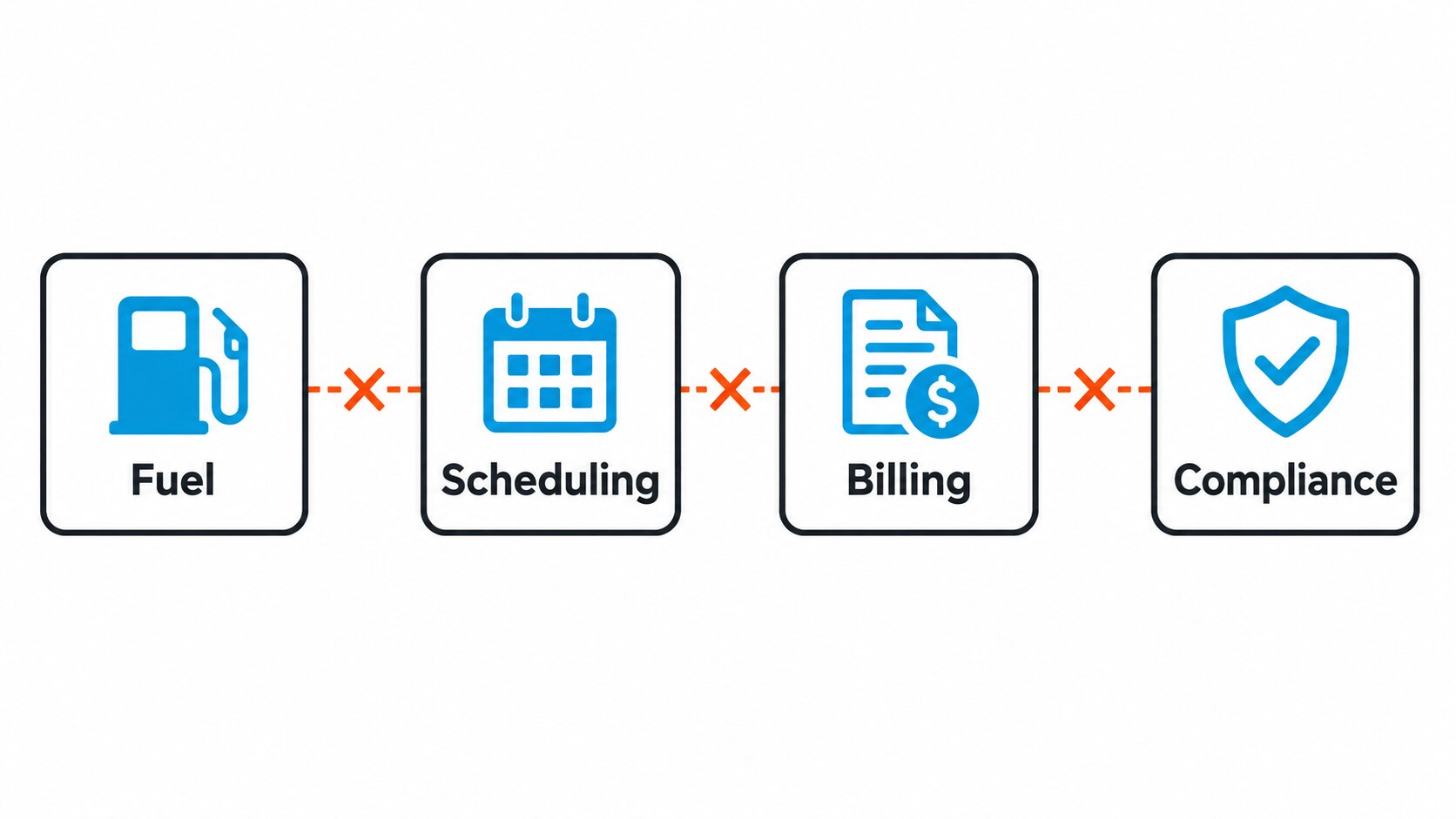
Each of those four workflows — fuel, scheduling, experience, compliance — needs software built around the transaction, not adapted from a system designed for a different one. That’s the core reason this segment has stayed underserved: the closest adjacent software categories (MRO ERP, airline PSS, generic field-service tools) all miss the shape of the problem.
FRAGMENTATION COMPOUNDS THE GAP
Operators report the predictable result of a market with too few purpose-built options: a patchwork of spreadsheets, single-purpose booking tools, and systems that don’t talk to each other. Every handoff between disconnected fuel, scheduling, and billing systems is a point where data re-entry, delay, or a blind spot gets introduced — and charter-specific commentary is now explicit that generic scheduling or business-management software will not hold up against the regulatory complexity and operational tempo of Part 135 work (FL3XX).
The vendor landscape reflects that gap rather than closing it. A small number of established, FBO-specific platforms — among them Total FBO (World Fuel/Avfuel), X-1FBO, and FuelerLinx on the fuel and back-office side, and FL3XX and myairops on the charter-operations side — cover the core functions. But compared to the dozens of point solutions and platforms competing for airline and MRO budgets, this is a shallow bench for a segment moving 3.9 million departures a year. Few of these vendors are household names even inside aviation, and fewer still have anyone writing accessible, buyer-side guidance about how to evaluate them. That’s the second half of the “underserved” problem: not just a thin vendor market, but almost no independent voice helping FBOs and charter operators navigate it.
WHERE THIS IS HEADING
Three forces are converging on this segment at once, and each pushes toward the same outcome: software built specifically for FBO and charter workflows, not adapted from somewhere else.
First, the compliance bar keeps rising — the FAA’s SAS transition and tightening ARGUS/IS-BAO standards mean operators need systems that produce audit-ready evidence continuously, not paperwork assembled after the fact. Second, the capital now sitting inside FBO networks (Apollo, Blackstone, GIP) will eventually demand the same operating leverage from software that it demands from real estate and fuel margins — multi-billion-dollar owners do not stay indefinitely patient with fragmented back offices. Third, record flight volume is not slowing: WingX logged 1.95 million departures in the first half of 2026 alone, up 4% year-over-year, with North America still carrying the largest share of growth (WingX Advance). Volume at that scale does not run indefinitely on spreadsheets and disconnected point tools.
The direction of travel is toward integrated, purpose-built platforms that treat fuel automation, trip-based scheduling, white-glove customer data, and continuous compliance evidence as one connected system — not toward another generic operations tool adapted after the fact from an airline or MRO product.

THE AERO NEXTGEN TAKE
FBOs and charter operators are not a smaller version of an airline or an MRO — they’re a distinct operating model with distinct software requirements, and treating them as an afterthought to those larger segments is exactly why the vendor market here has stayed thin. The operators moving fastest right now are the ones who stop looking for a generic aviation tool and start evaluating platforms built around fuel transactions, trip-based dispatch, and continuous compliance evidence as their core requirements — not as add-ons.
FBOs and charter operators run on a completely different operational clock than airlines or MROs — every transaction, every fuel load, every trip is its own event. Software built for someone else’s clock will always be a compromise. The operators who win the next five years will be the ones who demand tools built for theirs.
— Monica Badra, Founder & CEO, Aero NextGen

Find your fit in 3 minutes: if you’re an FBO or charter operator evaluating fuel management, scheduling, or compliance software, take the free Solution Finder quiz to get matched to vetted platforms built for this segment.
SOURCES
- WingX / Business Air News — “2025 was strongest ever year for global business jet activity”
- WingX Advance — “Bizjet demand strong despite tariff concerns” (H1 2026 data)
- Private Jet Card Comparisons — FAA Part 135 operator count, April 2025
- Flying Magazine — Atlantic Aviation valued near $10B, Apollo investment
- World Fuel / Avfuel — Total FBO fuel truck automation technology
- X-1FBO — Fuel Management
- Autonoma — “Why the Best FBO Experiences Are Built on Safety, Systems, and Predictability”
- Schubach Aviation — “Aviation Safety Ratings Explained: IS-BAO, WYVERN & ARGUS”
- AeroMind — “How the FAA’s SAS Transition Is Reshaping Part 135 Compliance Operations”
- FL3XX — “Why Aviation Software Integrations are the Backbone of Charter Ops”
- NBAA — “NBAA’s FBO Partnership Network Achieves Major Milestone with 50 Participating Locations”