
Aviation is spending more on technology than ever, yet much of the industry still relies on the fragmented, paper-heavy systems that defined the last two decades. Airline technology integration spend hit $27.4 billion in 2025 and is projected to reach $31.34 billion in 2026, a 14.4% jump in a single year, yet 42.8% of airlines still describe themselves as early-stage on data strategy, and over 70% of AI proofs of concept never leave the pilot phase. The pattern repeats across MROs, OEMs, lessors, and parts distributors: capital is flowing into aviation software, but operational, end-to-end adoption is not keeping pace. The real blocker is the gap between buying technology and making it work across the operation.
The spend-adoption gap is now the industry’s defining inefficiency
The numbers say aviation is investing. Aerospace & Defense digital transformation spend is forecast to climb from $9.9 billion in 2025 to $20.5 billion by 2030, a 15.7% CAGR, and McKinsey’s work with the Aerospace Industries Association puts the unrealized value at $20 billion in annual EBITDA if the sector closes its digital gap. IT spend across airlines hit $37 billion in 2025, the highest absolute level since 2019.
But spend and adoption are not the same metric, and aviation keeps conflating them:
42.8% of airlines rate themselves early-stage on data strategy despite the investment surge, per IATA’s 2025 Data, Technology and Cybersecurity Adoption Survey.
Over 70% of AI proofs of concept in aviation stall before scaling, the money gets spent, the pilot runs, and the tool never reaches the operational floor.
More than 70% of aviation organizations cite organizational resistance and a shortage of digital expertise, not technology availability, as the primary obstacles to digital transformation in MRO operations.
The forward move is not more budget. It is closing the distance between purchase and adoption, the same distance that turns a funded pilot into a shelved one.
Legacy systems and fragmented tooling are the operational core of the problem
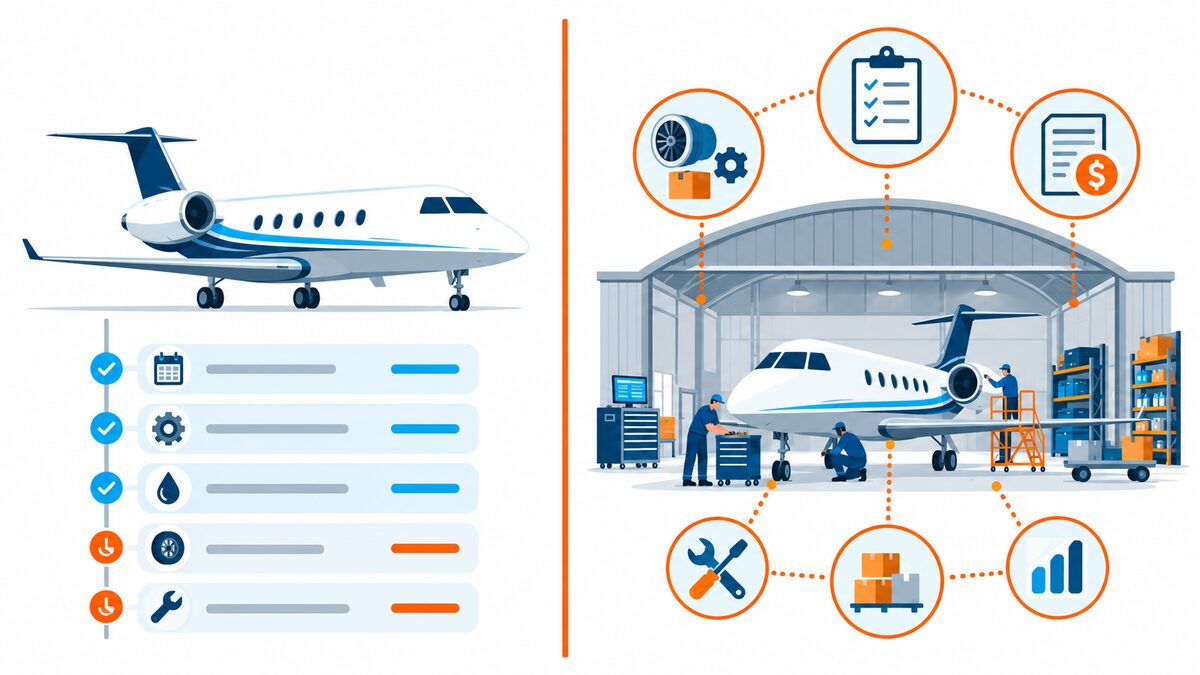
Most aerospace organizations, airlines, MROs, and parts trading companies alike, still run on a patchwork of outdated MRP platforms, heavily customized legacy tools, spreadsheets, and paper processes that trap data in silos: isolated quality modules, disconnected planning systems, unsupported point solutions bolted on over years. The result is not a single failure point but a structural one: engineering, planning, and execution systems don’t talk to each other, so technicians spend measurable time each shift searching for documentation, parts data, and compliance records across disconnected platforms instead of on the aircraft.
This is not an MRO-only problem. Legacy scheduling and reservation architecture at the airline level has already produced headline-scale failures, Southwest’s $825 million disruption event and Alaska Airlines’ $50 million loss both trace back to the same root cause: aging, siloed systems that couldn’t handle scale or connect to modern operations tooling. OEMs and lessors face a parallel version of the same issue on the asset-management and technical-records side, where fragmented systems make it harder to track configuration, maintenance history, and compliance status across a fleet that moves between operators and jurisdictions.
The aircraft aftermarket parts market alone is projected to grow from roughly $53 billion in 2025 to $78.5 billion by 2030, more volume moving through the same quoting, inventory, procurement, and logistics systems that were never built for this scale. Fragmentation doesn’t stay flat while the business grows; it compounds.
Compliance friction is accelerating, not easing
FAA and EASA requirements are tightening at the same moment operators are being asked to modernize, and the two pressures collide directly in software adoption decisions. EASA’s Part-IS information security framework became applicable to design, production, and aerodrome organizations on October 16, 2025, and extends to all other operators, including maintenance and continuing airworthiness management organizations, commercial and non-commercial, from February 22, 2026, with an additional 18-month runway to reach full “Operational” and “Effective” compliance. Cybersecurity is no longer a standalone IT concern in aviation; Part-IS requires it to be embedded into existing safety management systems, with governance, detection, and reporting built in.
That regulatory shift raises the bar for any software an operator adopts: a system has to be defensible under a safety-management audit, not just functional on the shop floor. Manual, spreadsheet-based, or on-premise record-keeping, still common across smaller MROs and parts distributors, now carries direct regulatory exposure on top of the operational cost it always had. Compliance isn’t a reason to delay adoption; it’s a forcing function for it.
The workforce shortage is a software-adoption problem, not just a hiring problem
Aviation needs 1,465,000 new professionals over the next decade, including 416,000 aircraft maintenance technicians, according to Boeing and McKinsey workforce analysis, with roughly 30% of the current technician workforce nearing retirement and the average mechanic age around 51. That shortage is arriving at the same moment maintenance operations need new skill sets entirely: data analysts to run predictive maintenance schedules, technicians fluent in digital work packages, and staff who can operate integrated systems rather than tribal, paper-based knowledge passed hand to hand on the floor.
This is where software adoption and workforce strategy converge. McKinsey’s research indicates that deploying the right technology can unlock 15% to 35% more maintenance capacity from the technicians already on staff, without a single new hire. Aviation cannot hire its way out of the technician shortage on the current timeline. It can, however, close a meaningful share of that gap by giving the workforce it already has tools that eliminate the manual documentation burden, the tribal-knowledge dependency, and the hours lost searching for parts data and BOMs by hand.
Budget cycles, ROI uncertainty, and change management are where adoption actually dies
Even when the technology and the business case are sound, aviation-specific digital transformation still fails at a high rate, consistent with the broader finding that 70% of digital transformation projects fail to meet their goals in 2025. Aviation’s version of that failure has specific fingerprints:
ROI is asymmetric and hard to prove. It’s straightforward to cost a delay or an AOG event after the fact. It is far harder to prove the revenue saved by a failure that never happened, which makes it difficult to secure, and sustain, executive buy-in in a capital-intensive, cyclical industry.
The real cost shows up after the purchase order. Training staff, validating migrated data, and running parallel systems through cutover consume budget and organizational effort that rarely make it into the original business case, which is why funded projects stall mid-implementation.
Change management is the actual differentiator. Organizations that invest seriously in change management, not just the technology rollout, see markedly higher success rates than those pursuing a tech-only implementation.
None of this is a technology problem. It’s a planning and change-management problem wearing a technology disguise, and it is the single most fixable barrier on this list.
Where the industry is heading
The direction is already set: cloud migration, AI-driven predictive maintenance, and unified data platforms are moving from pilot to expectation. The aviation MRO software market is projected to grow at an 8.0% CAGR from 2026 to 2034, driven specifically by the shift to cloud-based platforms and unified systems that replace point solutions. Deloitte reports that 90% of airlines are now adopting enterprise-wide data platforms rather than department-level tools, a direct response to the fragmentation problem. The operators, MROs, and lessors that move first on integrated systems, before Part-IS deadlines force the issue and before the next generation of talent finishes retiring out the door, will be running on infrastructure that scales. The ones that wait will be modernizing under regulatory and workforce pressure simultaneously, which is the most expensive way to do it.
The Aero NextGen take
Aviation doesn’t have a technology-availability problem. The tools to fix touch-time, compliance tracking, inventory accuracy, and technician capacity already exist and are proven in adjacent industries. What aviation has is a matching and change-management problem: operators don’t know which of the hundreds of available systems fits their specific operational reality, and internal teams aren’t equipped to drive adoption once a tool is purchased. Solving the adoption gap starts with solving the matching problem, getting the right system in front of the right operator with a realistic implementation plan, instead of another generic software list.
“Aviation isn’t behind because the software doesn’t exist. It’s behind because operators are matched to the wrong systems, or no system at all, and then asked to absorb the failure as a lesson in caution. Close the matching gap and the adoption numbers change fast.” , Monica Badra, Founder & CEO, Aero NextGen
Find your fit in 3 minutes: Airlines, MROs, OEMs, lessors, and parts distributors can get matched with vetted software providers built for their specific operational reality, no generic vendor list, no guesswork. Take the Solution Finder quiz: https://www.aero-nextgen.com/erp-finder-quiz
Sources
- The Business Research Company, Airline Technology Integration Global Market Report, $27.4B (2025) to $31.34B (2026) market, 14.4% CAGR
- Mekari, Airline Digital Transformation Playbook, $37B airline IT spend (2025); Southwest $825M and Alaska Airlines $50M legacy-system incidents; IATA 42.8% early-stage data strategy; 70%+ of AI PoCs stall
- Straits Research, Aviation MRO Software Market, 70%+ of organizations cite organizational resistance/digital expertise shortage; 8.0% CAGR 2026–2034
- ABI Research, Why and How the Aerospace Industry Is Embracing Digital Transformation, A&D digital transformation spend $9.9B (2025) to $20.5B (2030), 15.7% CAGR; McKinsey/AIA $20B annual EBITDA opportunity
- EASA, Part-IS regulation published, completing regulatory framework for cyber-resilient aviation, Part-IS applicability dates (Oct 16, 2025 / Feb 22, 2026) and scope
- McKinsey, Addressing the shortage of aviation maintenance technicians, 1,465,000 new aviation professionals needed over the decade, incl. 416,000 AMTs; technology can unlock 15–35% more technician capacity
- Godlan, Best ERP for Aerospace Manufacturing: 2025 Rankings, legacy MRP platforms and data silos across aerospace manufacturers
- SomaSoftware / market data via aftermarket parts research, aircraft aftermarket parts market $53B (2025) to $78.5B (2030)
- MeltingSpot, Digital Transformation Failure Rate 2025, 70% of digital transformation projects fail to meet goals in 2025; change-management investment linked to higher success rates
- Exploring Digital Aviation, Implementation Headwinds: Digital Aviation ROI Challenges, ROI asymmetry and hidden implementation costs in aviation digital projects
- Deloitte, Technology Trends in the Airline Industry, 90% of airlines adopting enterprise-wide data platforms