
The global aviation crew management software market is valued at roughly USD 3.4-4.0 billion in 2025 and is forecast to grow at a 6.2%-8.9% CAGR through 2033, according to multiple market research firms. That growth is not driven by novelty – it is driven by three converging pressures: tightening fatigue-risk regulation, disruption costs that compound in real time, and crew payroll/HRIS systems that can no longer tolerate manual reconciliation. This piece sets out a factual, criteria-based framework for evaluating crew management and crew scheduling software in 2026, built on verified regulatory and market data rather than vendor marketing claims.

Why crew software decisions carry more operational weight in 2026
Crew costs are typically the second-largest line item on an airline’s operating statement after fuel, and crew-driven irregular operations (IROPS) are one of the most visible failure points to passengers. In December 2025, IndiGo cancelled nearly 4,500 flights over ten days after its rostering systems and planning underestimated the crew required to comply with India’s DGCA Phase-2 Flight Duty Time Limitation (FDTL) rules, which cut permitted night landings per crew member from six to two per week. The DGCA’s own review attributed the collapse to over-optimized rosters with minimal recovery margins, inadequate regulatory preparedness, and software/systems deficiencies – a direct illustration of how rostering-system readiness, not just aircraft or airport capacity, determines whether an airline can execute a regulatory schedule change without collapsing operations. Airlines evaluating crew management software in 2026 are not buying a scheduling tool; they are buying the system that determines whether a regulatory change, a weather event, or a crew shortage becomes a controlled adjustment or a cascading cancellation event.
Criterion 1: Fatigue Risk Management (FRMS) is now baseline, not differentiator
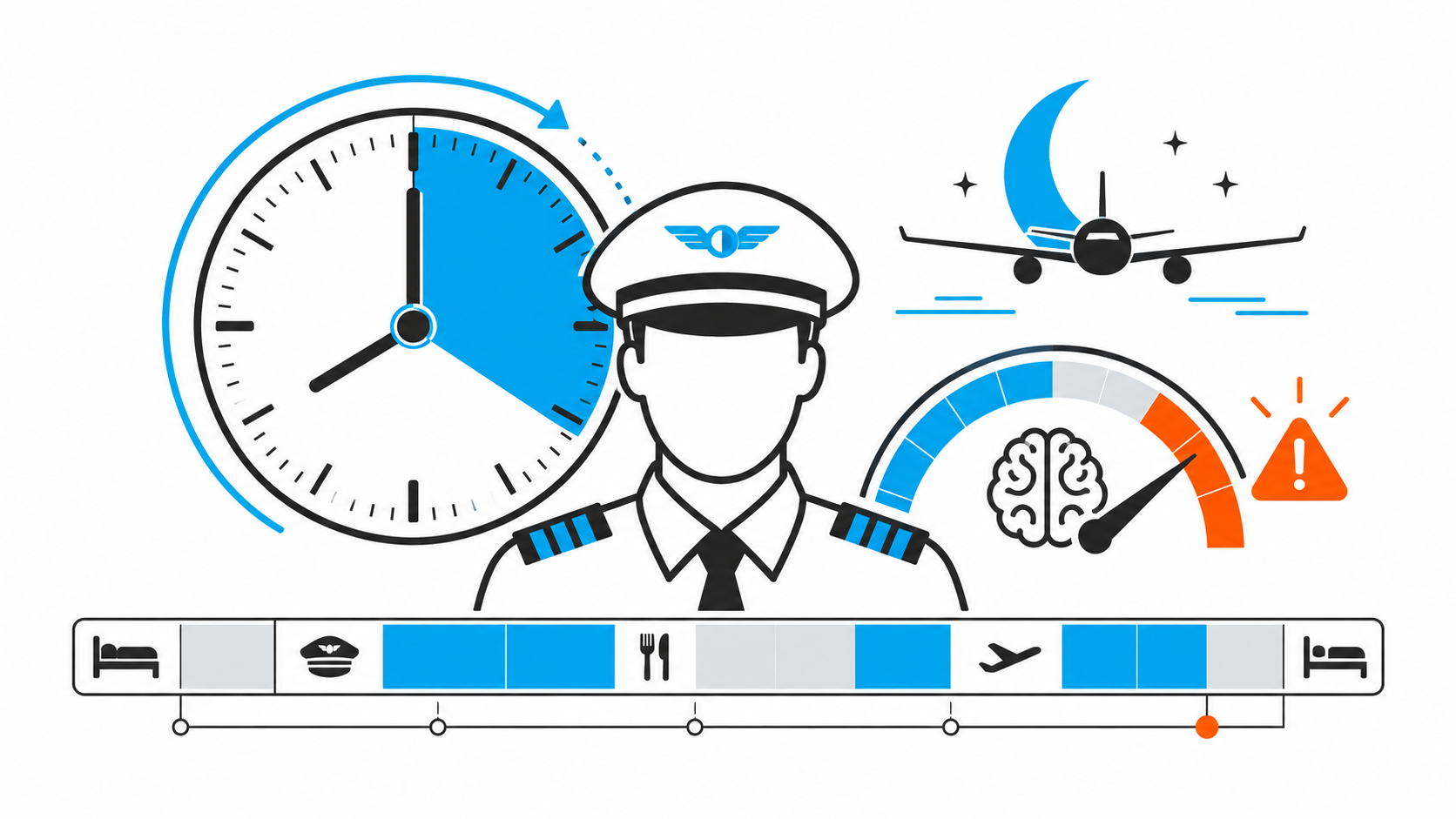
The International Civil Aviation Organization (ICAO) defines a Fatigue Risk Management System as “a data-driven means of continuously monitoring and managing fatigue-related safety risks, based upon scientific principles, knowledge and operational experience.” Under ICAO Standards and Recommended Practices, once a regulator has established FRMS rules, an operator has three compliance paths: full compliance with prescriptive flight/duty-time limitations, an approved FRMS applied fleet-wide, or a hybrid of both. The joint ICAO-IATA-IFALPA Fatigue Management Guide for Airline Operators is the reference document underpinning most FRMS implementations globally, and it is explicit that FRMS only functions where a genuine Safety Management System and open reporting culture already exist – software cannot substitute for either.
For buyers, this means the evaluation question is not “does it have an FRMS module” but:
- Does it run validated bio-mathematical fatigue models (not a generic duty-time counter) against actual rosters before publication, not after?
- Can it flag fatigue risk at the pairing-construction stage, before a roster is built, rather than as a post-hoc compliance check?
- Does it maintain an audit trail connecting fatigue-risk decisions to the SMS reporting loop, since regulators increasingly expect FRMS data to feed safety reporting, not sit in a silo?
Criterion 2: Multi-jurisdiction duty-time and rest-rule compliance
Airlines operating across FAA and EASA airspace – or bidding for both – need a platform that natively encodes both regimes, not one retrofitted with a second rule set. FAA 14 CFR Part 117 governs flight and duty limitations and rest requirements for flightcrew members in U.S. commercial operations. EASA’s equivalent sits in Regulation (EU) No 965/2012, Part-ORO Subpart FTL, which is structurally different from Part 117 even though both share the same fatigue-science foundation – a distinction rule engines must model correctly, not approximate. A platform that cannot demonstrate live, auditable compliance logic for both frameworks – including the split-duty, WOCL (Window of Circadian Low), and standby provisions specific to EASA FTL – creates regulatory exposure the moment an airline adds a route or a wet-lease arrangement across regimes.
Buyers should ask vendors for evidence of a rule-engine update cadence: how quickly the platform incorporated the most recent EASA FTL revisions, and whether compliance updates are pushed as configuration changes or require a new software release. The former is a maintenance cost; the latter is an operational risk window.
Criterion 3: Rostering automation and re-crew speed under disruption
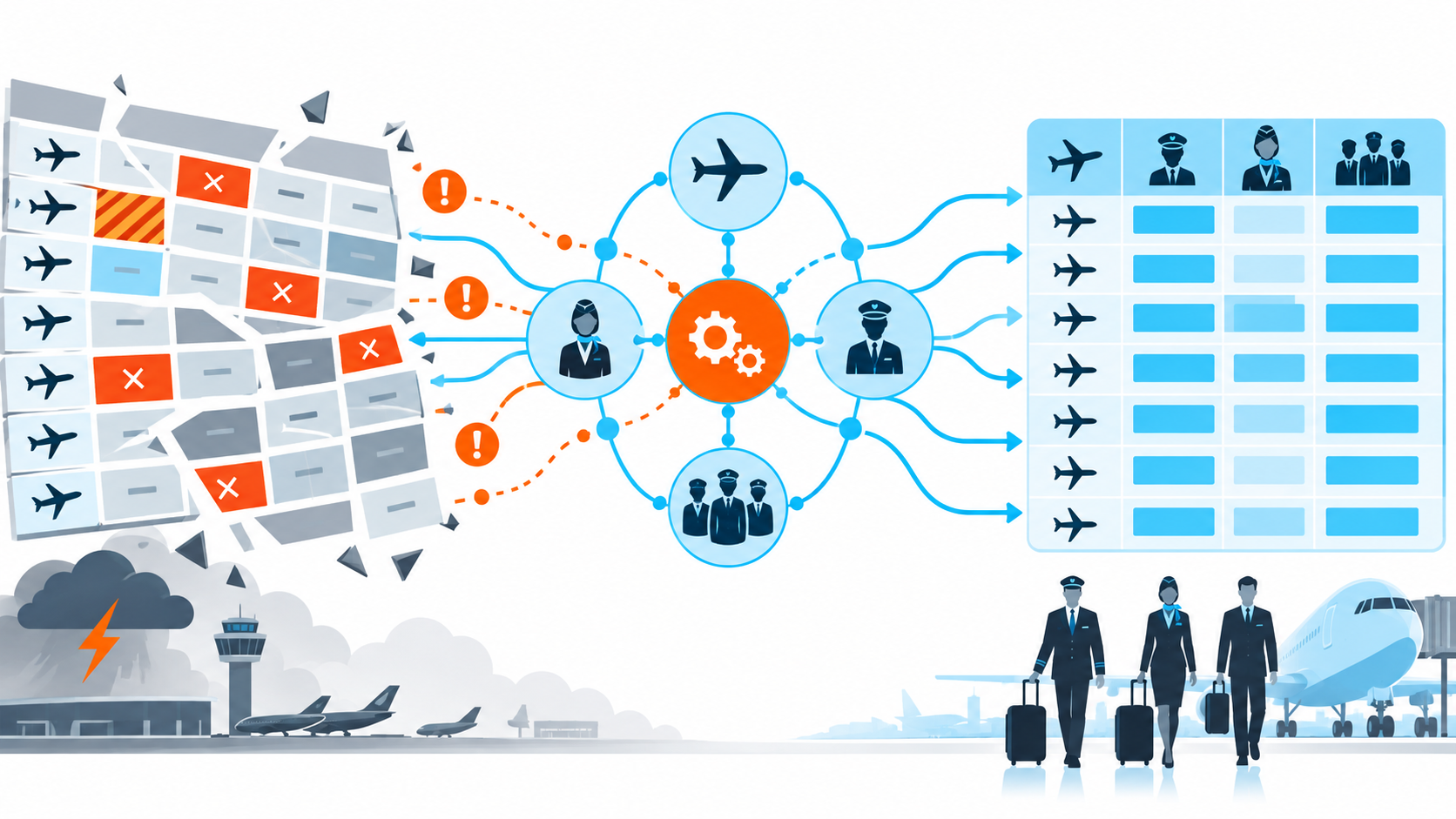
Modern crew platforms use optimization algorithms to solve pairing and rostering as constraint-satisfaction problems – qualification, currency, domicile, duty limits, union rules, and cost – simultaneously, a task that historically consumed dispatcher-hours. Lufthansa Systems relaunched its NetLine crew platform with a renewed pairing optimizer in 2025, positioned explicitly around faster schedule rebuilds during irregular operations. Industry reporting on disruption-recovery software describes AI-driven scheduling engines that produce recovery rosters “in minutes, not hours,” evaluating every available, qualified crew member against the live operational picture.
The evaluation question for this criterion is quantitative, not qualitative: ask each vendor for a benchmark time-to-recover-roster figure under a defined disruption scenario (e.g., a hub closure affecting 200 crew pairings), and ask for a reference customer who can confirm that number in production – not in a sales demo environment. The IndiGo case above – nearly 4,500 cancelled flights in ten days – shows what happens when planning and recovery capability is untested at scale before a regulatory shift takes effect.
Criterion 4: Mobile crew app depth
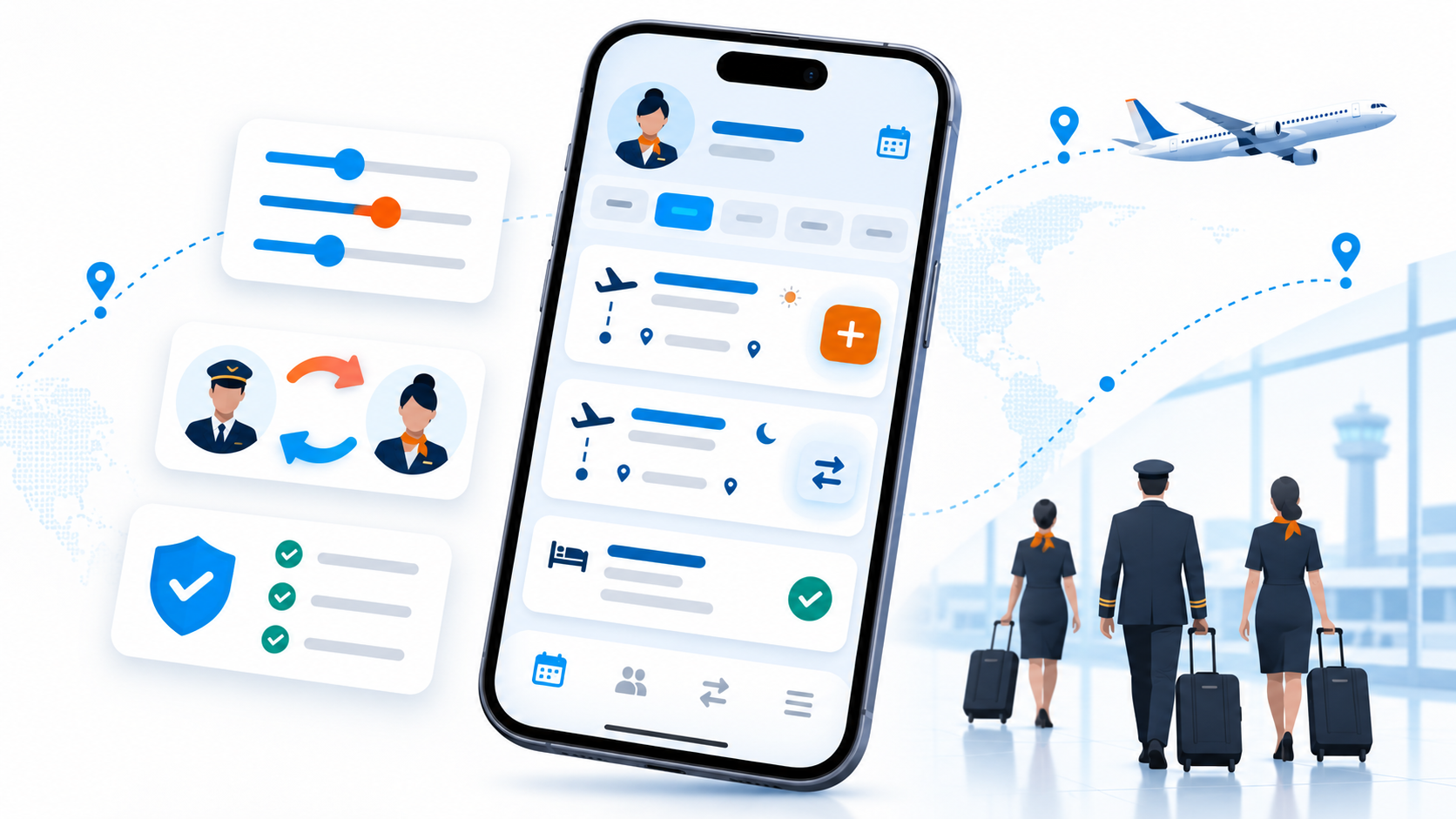
Crew self-service is now expected functionality, not a premium add-on. Mobile crew apps in the market handle bidding, shift trading, PTO requests, and duty-swap marketplaces, with some platforms offering peer-to-peer swap posting and search. This matters operationally for two reasons: self-service bidding and trading reduces crew-scheduling desk call volume, and a transparent, rules-aware trade/bid engine reduces grievances in unionized crew groups, since every award and override carries an audit trail.
Evaluation criteria here should include: does the app enforce legality checks in real time on trade requests (rejecting a swap that would breach duty-time rules before it is submitted, not after), and does it give crew visibility into pay impact at the moment of a bid or trade – a feature increasingly expected given complaints about “black box” payroll outcomes from schedule changes.
Criterion 5: Integration with dispatch/OCC and payroll
A crew platform that cannot pass clean, audit-ready data to payroll and cost reporting creates downstream manual reconciliation work that erodes the labor savings the software was bought to deliver. Airline crew-staffing platforms are increasingly built to export timekeeping and pay-code classifications directly into HRIS and payroll systems, replacing manual data transfer between scheduling and finance teams. On the operations side, integration with the Operations Control Center (OCC) and dispatch systems is what allows a disruption event detected in flight-ops systems to trigger crew re-optimization automatically, rather than requiring a phone call between departments.
Buyers should map every existing system the crew platform must talk to – OCC/dispatch, payroll, HRIS, training/qualification records, and any union-specific reporting requirements – and require the vendor to demonstrate a live integration (API or file-based) for each, not a roadmap commitment.
Criterion 6: Total cost of ownership
TCO for crew management software extends well beyond license fees. Buyers should model:
- Implementation timeline – rule-engine configuration for multi-jurisdiction compliance is typically the longest phase; ask for a realistic go-live timeline based on comparable fleet size and route network, not a generic estimate.
- Per-seat/per-crew-member pricing at current headcount and at 20% growth, since crew scheduling software often uses tiered per-user pricing that changes the economics as an airline scales.
- Integration and API costs for OCC, payroll, and HRIS connections, which are frequently quoted separately from the core license.
- Change-management cost – union consultation and crew training on a new bidding/trading interface is a real, budgeted cost airlines routinely underestimate.
- Documented cost savings from pairing optimization. Improved pairing optimization, reduced overnight layovers, and minimized deadheading are commonly cited efficiency levers in crew-cost reduction; any vendor claim on this should be validated against a comparable-fleet reference customer, not accepted as a category-wide average.
Relevance to MRO and technician scheduling
Crew management software as defined above is airline flight-operations scoped – it manages pilots and cabin crew against flight-time regulations that do not apply to MRO technicians. The genuine overlap for MRO organizations is narrower: shift-based fatigue management for night-shift heavy maintenance crews, technician qualification/currency tracking analogous to crew qualification tracking, and skill-based shift allocation replacing seniority-only assignment. MROs evaluating workforce software should treat this as an adjacent but distinct category from airline crew rostering, with its own vendor landscape.
Where to find vetted providers
A live, vetted shortlist of crew management software providers is available through the Solution Finder quiz – a ranked vendor list could not be pulled from Aero NextGen’s provider database in this run.
The Aero NextGen take
Crew management software has moved from a scheduling convenience to a regulatory and financial control system. The vendors worth evaluating in 2026 are the ones that treat FRMS as a live risk model feeding safety data, not a compliance checkbox, and that can prove re-crew speed with a customer reference rather than a demo script. Airlines that buy on integration depth and disruption-recovery evidence rather than feature-list length will see the TCO difference within the first irregular-operations event.
“Airlines don’t get hurt by a rule they didn’t know about – they get hurt by a rostering system that can’t rebuild a schedule fast enough when that rule, or a storm, or a strike hits. Evaluate crew software on recovery speed and integration depth, not on the feature list.”
Monica Badra, Founder & CEO, Aero NextGen
Find your fit in 3 minutes: complete the Solution Finder quiz to get matched with vetted aviation software providers: https://www.aero-nextgen.com/erp-finder-quiz
Sources
- Fortune Business Insights – Commercial Aviation Crew Management Systems Market: https://www.fortunebusinessinsights.com/commercial-aviation-crew-management-systems-market-103523
- ResearchAndMarkets – Aviation Crew Management Software Market, Global Forecast 2026-2032: https://www.researchandmarkets.com/reports/5887644/aviation-crew-management-software-market
- IATA – Fatigue Risk Management Systems (FRMS) White Paper, 2025: https://www.iata.org/contentassets/5f976bb3ca2446f3a40e88b18dd61fbb/frms_white-paper_2025.pdf
- IATA/ICAO/IFALPA – Fatigue Management Guide for Airline Operators: https://www.iata.org/contentassets/39bb2b7d6d5b40c6abf88c11111fcd12/fatigue-management-guide_airline20operators.pdf
- eCFR – 14 CFR Part 117: Flight and Duty Limitations and Rest Requirements: https://www.ecfr.gov/current/title-14/chapter-I/subchapter-G/part-117
- Aviatize – EASA Flight Time Limitations (FTL) Glossary: https://www.aviatize.com/glossary/easa-ftl
- Dreamix – Airline Crew Rostering: Capturing Business Value in 2026: https://dreamix.eu/insights/airline-crew-rostering-software-solution/
- ARCOS – Automate Airline Crew Staffing for On-Time Performance & Profit: https://www.arcos-inc.com/industries/airlines
- Press Information Bureau, Government of India – IndiGo Flight Disruptions December 2025: Findings, Enforcement Action and Systemic Reforms: https://www.pib.gov.in/PressReleasePage.aspx?PRID=2215709®=3&lang=2
- Wikipedia – 2025 IndiGo scheduling crisis: https://en.wikipedia.org/wiki/2025_IndiGo_scheduling_crisis