Aviation’s AI conversation has changed quickly. Through 2024 and 2025, most of the industry was talking about AI that advised: dashboards, predictions, and recommendations that still required a person to act. In 2026, the conversation is increasingly about AI that acts.
Agentic AI systems can sense a disruption, choose a recovery plan, and carry it out. That might mean rebooking passengers, reallocating crews, or reshuffling cargo. A person still reviews what happened, but no longer has to approve every individual step.
Research published this year by WSP, OAG, and other industry organizations helps separate real operational progress from marketing language. So, what does “agentic” actually mean in practice? Where is it already being used? And what should MRO and airline operations leaders ask before signing a contract with a vendor that uses the label?
What Agentic AI Actually Means, and What It Doesn’t
Advisory AI ends at a human decision point. A predictive maintenance model might flag a likely component failure, or a dashboard might surface an operational bottleneck, but someone still needs to decide what to do next.
Agentic AI closes that loop. It detects a change, evaluates possible responses against a policy, takes action in a live system, and checks the result without requiring a person to approve that specific action.
WSP’s 2026 report on agentic AI in airport and airline operations, written by Digital Aviation Director Kevin McLoughlin and Sophia Ros of WSP Human Centred Architecture, describes this as a move “from dashboard-driven oversight toward autonomous, policy-aligned orchestration.” In practical terms, the software does not simply warn that passengers will miss a connection. It rebooks them within limits the airline has already defined.
Those limits matter. Credible discussions of agentic AI consistently come back to guardrails, not unrestricted autonomy. WSP, for example, describes controls such as hotel and rebooking spending caps, loyalty-based authorization tiers, and geographic or regulatory limits. OAG approaches the same shift from a transactional angle. Its June 2026 analysis is titled “AI Stops Talking and Starts Transacting.” The milestone is not a more sophisticated chatbot. It is software that can complete a transaction inside an operational system.
For MRO and operations leaders, there is a simple test. If a supposedly agentic system still requires a person to click “approve” for every action, it is essentially advisory AI with a different interface. If it can operate within a defined policy and escalate only the exceptions, it is genuinely agentic.
Which Workflows Are Ready Today?
Four aviation workflow categories have moved beyond general pilots into named, in-production use cases in 2026. Adoption is not universal, and the systems still operate within strict guardrails, but the deployments are real.
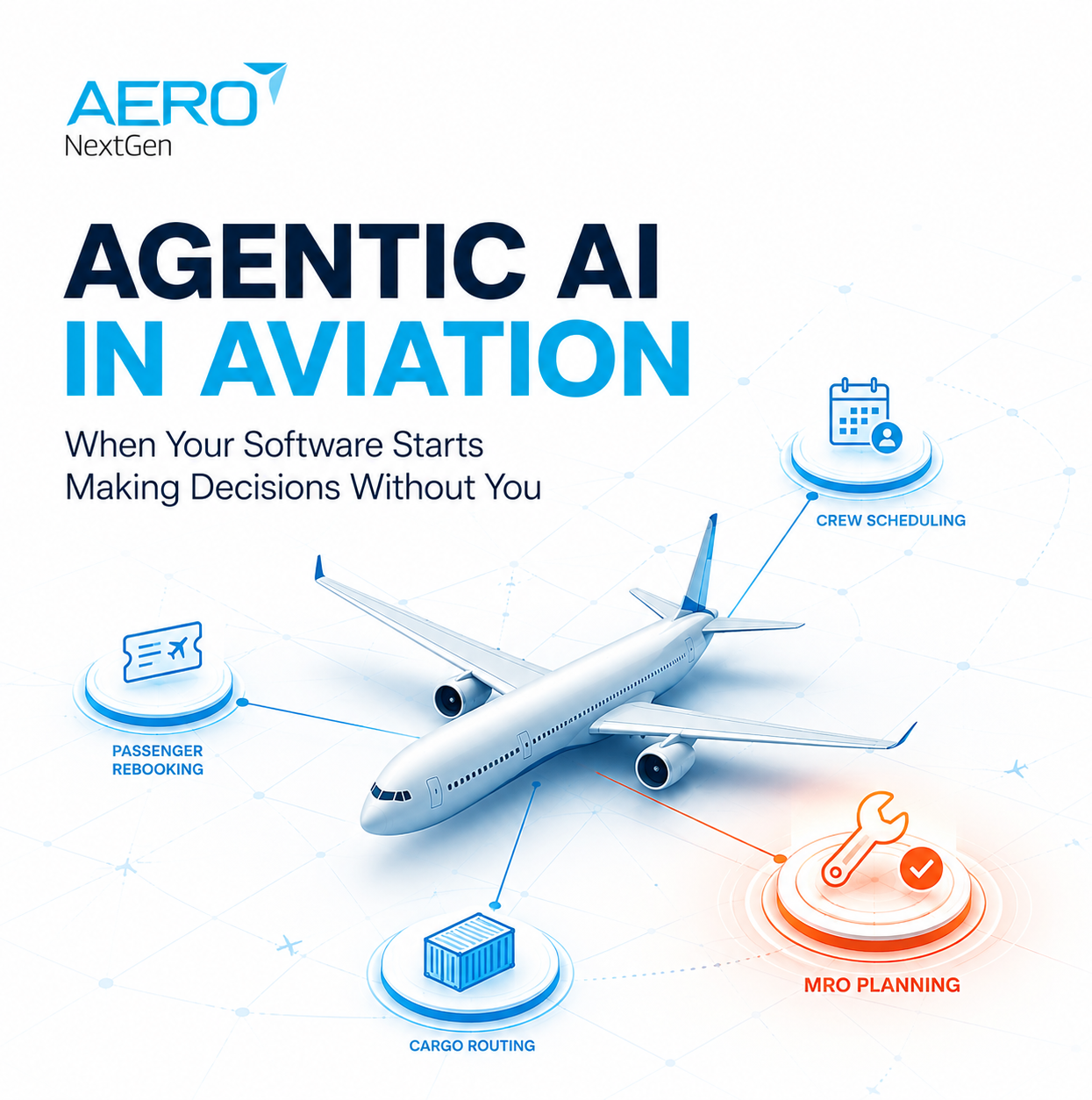
Disruption recovery (IROPS). This is the most mature use case. According to Tech Mahindra’s 2026 analysis, flight disruptions cost the global airline industry an estimated $60 billion each year. The company describes agentic recovery as a four-stage loop: sensing, reasoning, executing, and learning. Work that once required hours of manual coordination can potentially happen in minutes.
WSP and OAG both identify airlines using related technology in production. United Airlines is using predictive and agentic disruption management. Southwest Airlines and Icelandair are applying agentic planning to aircraft turnarounds. Southwest has also named AWS as its preferred cloud provider as it works toward an agent-enabled operating architecture by 2028.
Cargo routing and freight coordination. Adoption here is earlier, but the freight technology layer is moving quickly. In 2026, 5U AI raised $3.2 million in pre-seed funding to expand a platform that places autonomous “AI Workers” into daily freight-forwarding operations across air, ocean, and road.
TIACA has not published a dedicated agentic AI report as of this writing. Still, its 2026 Air Cargo Sustainability Insights Report and public comments from Director General Glyn Hughes place AI firmly within the industry’s digitalization and workforce agenda. For now, much of the application layer is emerging through cargo technology vendors rather than association-led research.
Commercial retailing. Future Travel Experience’s May 2026 analysis, “How agentic AI will transform airline retailing,” describes a move away from fragmented offer management. Instead, AI agents can construct, price, and negotiate offers in real time.
This is happening on both sides of the transaction. Airlines can use agents to build offers, while travelers may rely on consumer AI agents to shop and compare on their behalf. FTE has called 2026 “the year of agentic retailing in air travel.” As machine-to-machine negotiation becomes more common, getting an airline’s offers surfaced by autonomous shopping agents may become a new competitive variable.
MRO planning and non-routine findings. A 2026 SAE International technical paper, “Transforming Aircraft MRO with Agentic AI and Context Engineering,” discusses the use of agentic systems for work-package compilation, damage-pathway selection, and supplier coordination. Technical actions still require human sign-off before execution.
That “propose, don’t execute unsupervised” model reflects the most credible MRO deployments today. An agent may recalculate a schedule or anticipate non-routine findings, but a certifying technician remains responsible for airworthiness decisions.
This also matches what Aero NextGen sees in component MRO shops. The problem is rarely a lack of data. It is the combination of siloed systems and manual work-package assembly that consumes technician touch-time. An orchestration layer can help reclaim that time, but only when it is properly integrated rather than added as one more disconnected point solution.
The Procurement Questions Ops and MRO Leaders Should Ask
A May 2026 Forbes Technology Council article made the issue clear: enterprise buyers now need to evaluate “agentic governance” with the same seriousness they once applied to uptime SLAs. Agentic systems can write to systems of record and take action even when no one is actively watching a dashboard.
When an MRO or airline operations leader evaluates an agentic vendor, these questions belong in the conversation:
Decision boundary: Which actions can the agent take without human approval, and which situations require escalation? Ask for this in writing, not only in a demonstration.
Policy configurability: Can the operations team set and change guardrails such as spending caps, authorization tiers, or regulatory limits without submitting an engineering request to the vendor?
Auditability: Is every action recorded with a traceable rationale? Can the quality or compliance team retrieve those records for an audit or incident review?
Failure mode: What happens when confidence is low, data is unreliable, or a connected system becomes unavailable? Does the agent pause and escalate, or continue acting?
System dependencies: Which systems require read or write access? Does that access fit the existing system-of-record architecture, or will the implementation require another integration layer?
Certification and airworthiness ownership: For MRO tools, who remains accountable for any output related to an airworthiness decision? The final authority must remain a licensed person, never the agent.
Regulatory exposure: Under frameworks such as the EU AI Act, deployer obligations may apply even when the organization bought the system from a vendor. Does the vendor provide enough documentation to support the operator’s compliance responsibilities?
Security baseline: Does the vendor hold certifications such as SOC 2 Type II, ISO 27001, or ISO 42001? Can the team clearly explain how the system is protected against prompt injection and unauthorized tool use?
This is not extra due diligence simply because AI is involved. It is the same level of rigor MRO procurement already applies to an ERP or CMM system, extended to software that can now take action on its own.
Where This Goes Next
Deloitte’s 2026 Aerospace and Defense Industry Outlook describes 2026 as the year agentic AI begins moving from pilots to scaled deployment across decision-making, procurement, planning, logistics, and maintenance. This is not a prediction about a distant future. The shift is already underway.
The next step for MRO and airline operations is unlikely to be full autonomy across every workflow. A more realistic pattern is already visible in disruption recovery and work-package planning: agents handle high-volume, rules-based decisions, while people manage exceptions and remain accountable for final sign-offs.
The operators best positioned for this shift will not necessarily be the ones buying the product with the boldest “agentic” label. They will be the ones that have already addressed the fragmented data and disconnected systems that any orchestration layer depends on.
The Aero NextGen Take
Agentic AI does not fix a fragmented technology stack. It exposes one.
An agent that needs to reallocate crews, reroute cargo, or recalculate a repair schedule can only move as quickly and safely as its connected systems allow. For many MRO and airline operations teams, the immediate question is not whether to adopt agentic AI. It is whether the underlying ERP, MRO, and data infrastructure is integrated well enough for an agent to act with confidence.
“Agentic AI is only as good as the system it’s wired into. Buy the integration discipline first, the autonomy second. Otherwise, you’re just automating the chaos faster.”
Monica Badra, Founder & CEO, Aero NextGen
Aero NextGen connects MRO and airline operations leaders with vetted software providers across ERP, MRO, data, and orchestration. These are the foundational layers agentic AI depends on. Before evaluating an agentic vendor, understand what is already in your technology stack and where the gaps remain.
Find your fit in 3 minutes: Take the Solution Finder quiz
Sources
WSP, “Agentic Artificial Intelligence in Airport and Airline Operations” (2026), https://www.wsp.com/en-us/insights/agentic-artificial-intelligence-in-airport-and-airline-operations
WSP, full report PDF, https://www.wsp.com/-/media/insights/global/documents/2026/wsp-agentic-artificial-intelligence-in-airport.pdf
OAG, “June 2026: AI Stops Talking and Starts Transacting”, https://www.oag.com/blog/ai-stops-talking-starts-transacting
OAG, “March 2026: The Month Agentic Travel Gets Real”, https://www.oag.com/blog/march-2026-the-month-agentic-travel-gets-real
OAG, “Three Airline-Tech Innovations Defining Early 2026”, https://www.oag.com/blog/three-airline-tech-innovations-defining-early-2026
TIACA, 2026 Air Cargo Sustainability Insights Report (coverage via AJOT), https://www.ajot.com/news/tiaca-releases-2026-air-cargo-sustainability-insights-report
Cargo Newswire, “5U AI Raises $3.2 Million to Expand Agentic AI Platform for Freight Forwarding Operations” (2026), https://cargonewswire.com/5u-ai-raises-3-2-million-to-expand-agentic-ai-platform-for-freight-forwarding-operations/
Future Travel Experience, “How agentic AI will transform airline retailing: From fragmentation toward customer-facing commercial orchestration” (May 2026), https://www.futuretravelexperience.com/2026/05/how-agentic-ai-will-transform-airline-retailing-from-fragmentation-toward-customer-facing-commercial-orchestration/
Future Travel Experience, “Top ancillary & retailing trends to watch in 2026”, https://www.futuretravelexperience.com/2026/02/top-ancillary-retailing-trends-to-watch-in-2026/
Tech Mahindra, “Transforming Airline Disruption Recovery with Agentic AI” (2026), https://www.techmahindra.com/insights/views/the-architecture-of-resilience/
SAE International, “2026-26-0788: Transforming Aircraft MRO with Agentic AI and Context Engineering”, https://saemobilus.sae.org/papers/transforming-aircraft-mro-agentic-ai-context-engineering-2026-26-0788
Forbes Technology Council, “The New Vendor Due Diligence: Why Your Enterprise Buyer Will Ask About Agentic Governance” (May 19, 2026), https://www.forbes.com/councils/forbestechcouncil/2026/05/19/the-new-vendor-due-diligence-why-your-enterprise-buyer-will-ask-about-agentic-governance/
Deloitte, 2026 Aerospace and Defense Industry Outlook, https://www.deloitte.com/us/en/insights/industry/aerospace-defense/aerospace-and-defense-industry-outlook.html