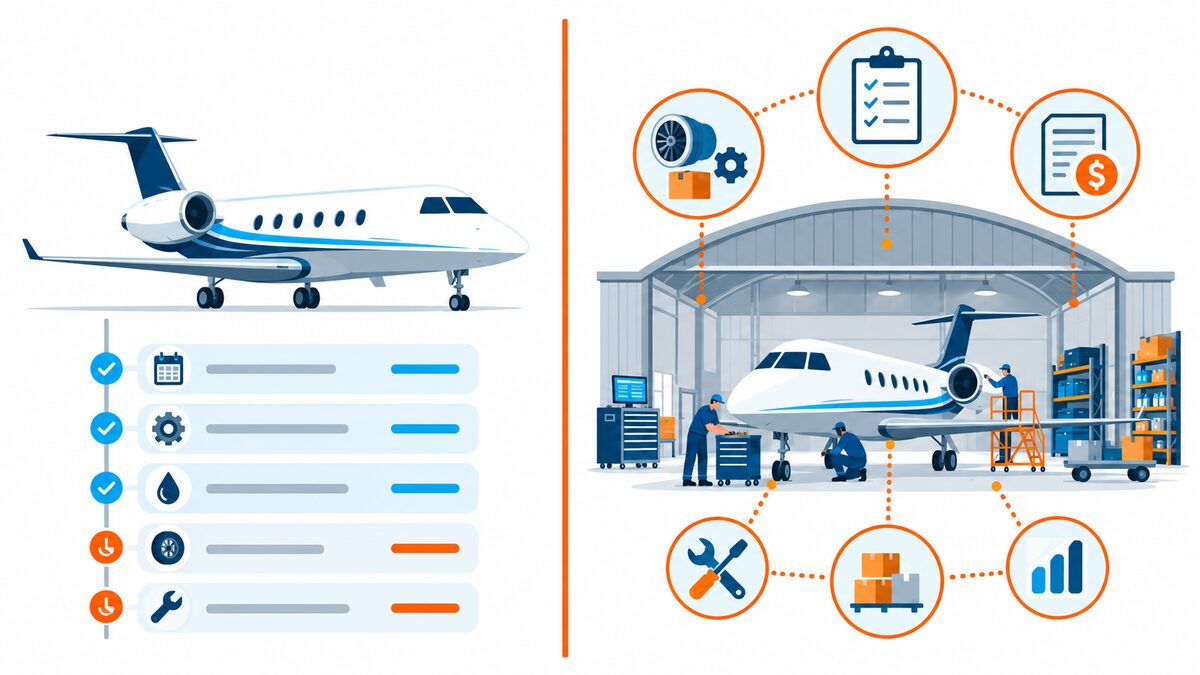
Businesses generate information across finance, purchasing, inventory, sales, maintenance, and daily operations. When each department uses separate systems, employees can spend too much time entering the same data or comparing conflicting records. If you are asking what does an ERP system do, it connects important business processes through one integrated software environment so departments can share information more efficiently.
ERP stands for Enterprise Resource Planning. An ERP system can manage accounting, procurement, inventory, operations, reporting, and many other activities. Aviation-focused ERP platforms may also support MRO work orders, maintenance planning, parts, repair management, labor, and compliance. The exact functions depend on the system and the organization using it.

An ERP System Connects Business Departments
The main purpose of an ERP system is to connect information that would otherwise remain spread across different departments. Finance, purchasing, inventory, sales, human resources, and operations can use modules within the same system. When one department updates a record, other authorized teams can access the relevant information without recreating it.
The U.S. Government Accountability Office describes ERP as software designed to integrate information and business processes across an organization. Its ERP guidance explains that information entered into the system can then support several business functions. This shared structure can reduce information silos and improve coordination between departments.
ERP Manages Financial Information
Financial management forms a major part of what does an ERP system do in most organizations. ERP platforms can support general ledger activity, accounts payable, accounts receivable, budgeting, expenses, assets, and financial reporting. Transactions created elsewhere in the organization can flow into financial records instead of requiring another team to enter them again.
This connection helps managers understand where costs originate. For example, a maintenance department may order parts for a work package. The ERP can connect that purchase with inventory records and financial accounts. Managers can then review operational activity and its financial impact together instead of manually combining several spreadsheets.

ERP Controls Inventory and Procurement
ERP systems can help organizations track what materials they have, where those materials are stored, and what they need to purchase. Inventory functions may include stock quantities, warehouse locations, supplier records, purchase orders, material movement, and reorder requirements. Industry-specific platforms can add serial numbers, repairable parts, exchanges, and other specialized controls.
Aero Next Gen’s aviation ERP capabilities overview includes inventory management, purchase orders, repair orders, logistics, work orders, labor recording, and planning. Connecting purchasing with inventory and operations can help aviation teams prepare materials according to real maintenance demand rather than treating procurement as a separate process.
ERP Supports Aviation Maintenance and MRO Workflows
In aviation, what does an ERP system do can extend well beyond standard accounting and purchasing. MRO organizations may need work orders, task cards, shop planning, component tracking, labor recording, customer billing, technical records, quality controls, and parts management. An aviation ERP can bring many of these workflows into the same operating environment.
Aero Next Gen’s Cloud Computing & ERP for Aviation & MRO coverage explains how ERP technology can connect finance, procurement, maintenance, and wider operations. This type of integration can help an MRO see how shop-floor activity affects materials, labor, costs, and customer work without relying on several disconnected systems.
ERP Reduces Repetitive Data Entry
Separate software systems often require employees to enter the same information more than once. A buyer may create a purchase record, finance may enter the transaction again, and operations may maintain another copy in a spreadsheet. This duplication takes time and creates more opportunities for inconsistent information.
An ERP can allow one transaction to support several related workflows. It does not remove the need for accurate data or employee oversight. However, it can reduce repetitive administrative work and give teams more time to focus on analysis, customer needs, maintenance planning, or other tasks that require human judgment.
ERP Improves Reporting and Operational Visibility
Managers need reliable information to understand performance. An ERP can combine data from finance, inventory, procurement, operations, and other functions. This can make reporting faster because teams do not need to manually combine separate spreadsheets before reviewing results.
NIST notes that ERP systems can provide a centralized location for business data and increase transparency into operations. Its system integration guidance also describes ERP as a way to collect, store, manage, and analyze information from different areas of a business. Connected data becomes especially useful when managers need to compare costs, schedules, inventory, and operational performance.
ERP Integrates With Other Business Software
Understanding what does an ERP system do also requires recognizing that one platform may not replace every application. Aviation organizations may still use flight operations software, maintenance tracking systems, customer portals, payroll tools, warehouse applications, or specialized technical platforms. The ERP may need to exchange data with these systems.
The National Institute of Standards and Technology discusses the challenges of connecting independently developed software systems around common business processes. Organizations should define data ownership and integration requirements before implementation so connected applications do not create conflicting records.
ERP Helps Organizations Plan Resources
ERP systems can support planning by connecting information about materials, employees, costs, orders, and operational requirements. Managers can review what resources they have and what future work may require. This can help purchasing teams prepare inventory, finance teams plan budgets, and operations teams allocate people and equipment more effectively.
In aviation, resource planning can become especially important when maintenance events require technicians, parts, tools, and facility capacity at the same time. A connected system can give managers a wider view of these requirements. Better visibility does not make planning automatic, but it gives decision-makers more reliable information to work with.
Choosing an ERP Depends on the Operation
Companies researching what does an ERP system do should not assume every platform provides the same capabilities. A system designed for a general business may handle finance and purchasing well but lack aviation-specific maintenance, component, or repair workflows. Organizations should define their requirements before comparing vendors.
Teams should review required modules, integrations, reporting needs, security, user roles, implementation support, and future growth. The right ERP should fit important workflows without forcing employees to create excessive workarounds. For aviation organizations, this often means evaluating both traditional business functions and specialized MRO or maintenance requirements.
Conclusion
What does an ERP system do? It connects business processes and information so departments can work from a shared system. ERP platforms can support finance, procurement, inventory, operations, reporting, resource planning, and integration with other software. Aviation ERP systems can extend these functions into MRO, maintenance planning, work orders, parts, labor, and repair management.
Aero Next Gen helps aviation organizations compare ERP, MRO, maintenance, fleet, and operational technology solutions. Its vendor-neutral approach helps companies evaluate systems according to their actual workflows and requirements. Selecting an ERP that fits the operation can improve data visibility, reduce disconnected processes, and create a stronger foundation for managing aviation business activities.