
Home / Technologies / Audit and Compliance Management
Aviation compliance management keeps track of every regulation, approval, audit, finding and corrective action your organization is responsible for. Instead of preparing for audits, you stay ready for them. We help airlines, MROs, CAMOs, airports and suppliers find compliance tools and advisors that fit their approvals.

Illustrative dashboard, sample values
Aviation compliance management is the process and software for identifying the regulatory and customer requirements that apply to your organization, mapping them to your procedures, scheduling audits and inspections, recording findings and tracking corrective actions to closure. It produces the evidence regulators, customers and accreditation bodies need to see.
Every aviation organization answers to multiple masters: the national authority, foreign authorities for any approvals held abroad, customer audit programs, accreditation bodies and its own manuals. Requirements change, audits arrive on their own schedules and findings from one audit can repeat in the next if actions are not closed properly.
Compliance management software turns that into a controlled process. Requirements are captured and linked to the procedures that meet them. Audit programs are planned for the year. Findings are logged with evidence, root causes and corrective actions, and nothing closes until it is verified. When regulations change, the impact is reviewed and assigned. The result is an organization that is always ready, not one that scrambles every time an auditor calls.
Always audit-ready: requirements, findings and actions tracked in one place, all year.
These six capabilities keep compliance continuous instead of a pre-audit scramble.
A current library of regulations and customer requirements mapped to your procedures.
Annual programs for internal, supplier and customer audits, with auditors and checklists.
Findings recorded with evidence, classification and root cause, linked to the requirement.
Actions assigned, tracked, escalated and verified before closure.
Alerts when regulations change, with impact reviews assigned to owners.
Organized evidence and reports for regulators, customers and accreditation bodies.
More rules, more audits and fewer experienced people to manage them.
Regulators continue to expand requirements, such as the FAA’s extension of SMS rules to Part 135 operators by May 28, 2027. Customers run their own audit programs, and supply chain scrutiny has increased since falsified parts paperwork was uncovered in 2023.
Meanwhile, the quality and compliance professionals who carried this knowledge are retiring. A compliance system captures what they know and makes it repeatable for the next generation.
Deadline for US Part 135 and 91.147 operators to have an FAA Part 5 SMS in place.
Engines found worldwide with parts sold under falsified paperwork by a single supplier in 2023.
Share of certified US aviation mechanics who are over 60.
These are the improvements quality and compliance teams report most often.

“Compliance is not an event before the audit. It is how you work every day.”
The Aero NextGen advisory principle
Evidence and status are current every day, so audits become routine instead of emergencies.
Root causes and verified actions stop the same finding returning at the next audit.
Changes are identified and assessed promptly, not discovered during an audit.
Organized evidence impresses customers and supports contract renewals.
Teams stop spending weeks assembling documents before each visit.
Requirements and decisions are documented, so knowledge survives staff changes.
Each organization faces a different mix of rules and audits. Pick yours.

MROs hold multiple approvals and face customer audits constantly. Compliance tools map requirements across approvals and keep findings under control.

Operators and continuing airworthiness organizations manage compliance across operations, maintenance and vendors, alongside their SMS.

Airports and handlers manage certification, security and safety compliance across many on-site organizations.

Distributors and manufacturers maintain AS9100 or AS9120 accreditation and customer requirements across sites and suppliers.
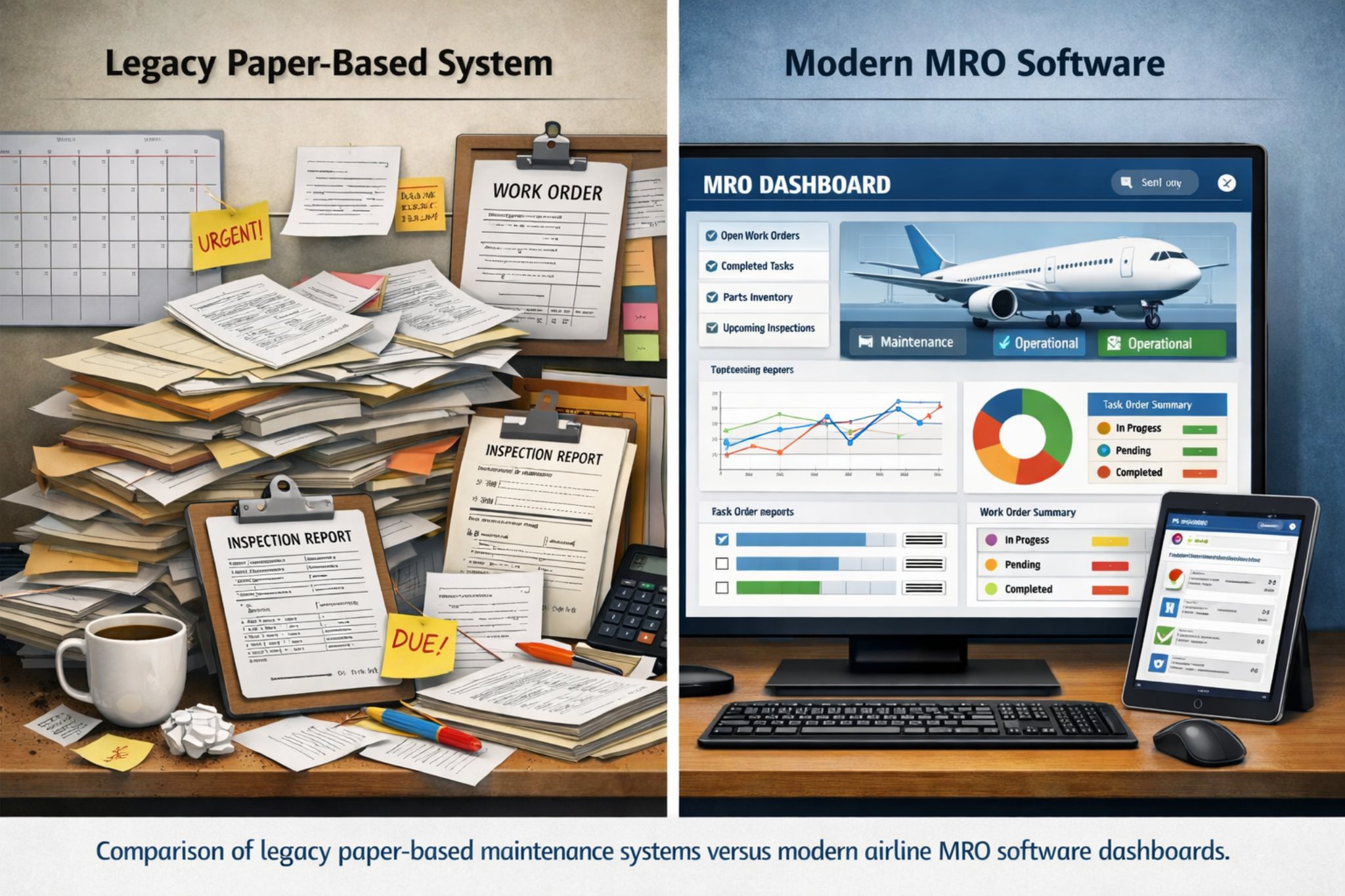
Here is what changes when compliance moves from spreadsheets and folders to a managed system.
| Area | Spreadsheets and folders | Compliance management |
|---|---|---|
| Requirements | ✕ Known by a few experts | ✓ Mapped in a shared library |
| Audit planning | ✕ Reactive to each visit | ✓ Annual, planned program |
| Findings | ✕ Scattered across files | ✓ Tracked with evidence |
| Actions | ✕ Closed on paper, not in practice | ✓ Verified before closure |
| Regulatory change | ✕ Found during audits | ✓ Monitored and assessed |
| Preparation | ✕ Weeks before each audit | ✓ Always ready |
The fix: root cause analysis and verified corrective actions make sure fixes address the cause and actually stick.
The fix: a planned audit program and organized evidence keep the organization ready every day of the year.
The fix: regulatory change monitoring flags updates and assigns impact reviews to the right owners.
The fix: a documented requirements library and audit history capture that knowledge for the whole team.
Compliance tools pay back through preparation time saved and findings avoided.
Audit preparation is the easiest cost to see. Use the calculator to estimate it across all the audits you face each year.
These five steps turn compliance into a continuous process.
List every regulation, approval and customer requirement that applies to you.
Link each requirement to the procedure and evidence that meets it.
Schedule internal, supplier and customer audits for the year.
Record findings with root cause and track actions until verified.
Set up regulatory monitoring and assign impact reviews.
Not sure which compliance tools fit your approvals? The Solution Finder scopes it in about three minutes and matches you with vetted vendors.
Compliance support comes as software, advisory services or both. Use these criteria to compare.
Confirm familiarity with your authorities, approvals and standards.
Ask whether regulatory content is included and how it is kept current.
Some tools use AI to find and summarize relevant regulations. Check how sources are cited.
Compliance works best connected to quality and safety systems.
Evidence should be easy to attach, find and present to auditors.
Compare software, content subscriptions and advisory fees.
Consultants can help with gap analyses, audits and authority liaison.
A sample of providers listed under audit and compliance management, shown alphabetically. A listing is not an endorsement; the Solution Finder matches you on fit.

Monica Badra
Founder and CEO, Aero NextGen
Aero NextGen was founded by Monica Badra, who has spent more than a decade inside aviation translating real business needs into the right technology. That experience shapes how we approach aviation compliance management: know every requirement you answer to, and keep the evidence ready every day.
We are vendor-neutral. We do not resell software, and our matching is based on your operation, your systems and your budget. Our perspective on digital MRO and aviation technology has been featured across the industry press.
The questions aviation leaders ask us most before they start. Have one we did not cover? The Solution Finder routes it to the right expert.

It is the process and software for identifying applicable requirements, mapping them to procedures, running audits and tracking findings and corrective actions to verified closure.
A QMS manages how quality work is done. Compliance management focuses on requirements, audits and evidence. Many platforms combine both.
Yes. Good tools map requirements from several authorities and standards to shared procedures, avoiding duplicate work.
Regulatory monitoring flags changes and assigns impact reviews, so procedures are updated before an audit finds the gap.
AI tools can search and summarize regulations quickly. Always verify against the official source before relying on the result.
Small teams often benefit most, because the same few people do the work and prepare every audit.
It tracks SMS requirements and evidence alongside your other obligations. See safety management system.
Start with the free Solution Finder. It maps your approvals and audit pain points and matches you to the right compliance tools.

Standardize quality, CAPA and audits across every station.

Report, assess and manage safety risk with ICAO-aligned workflows.
Scan, index and search aircraft records for audit-ready retrieval.

Plan, deliver and track crew and technician training in one system.
Map every requirement, plan every audit and close every finding with evidence. Start with the free Solution Finder to find the right aviation compliance management tools.