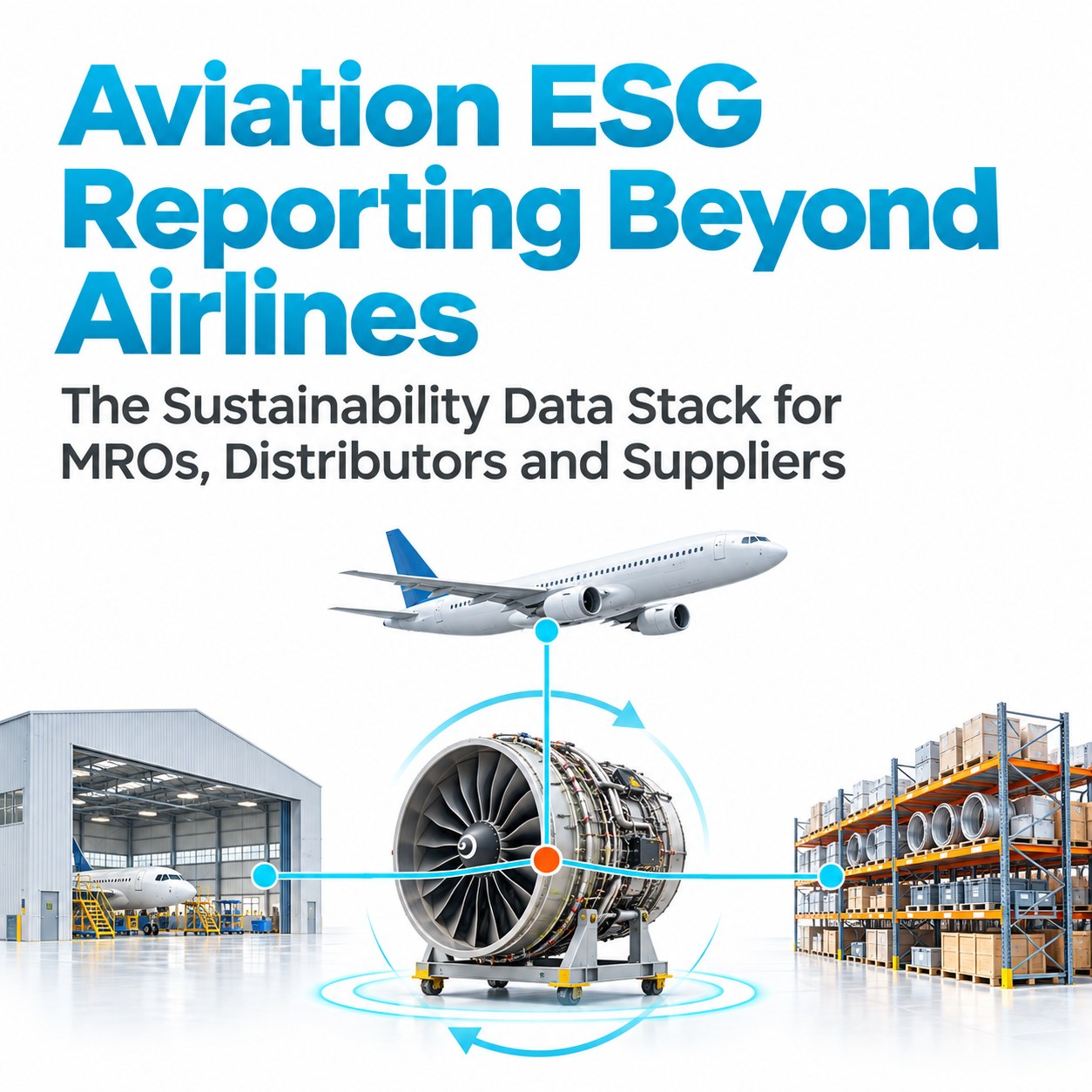

Aviation ESG reporting is no longer an airline-only exercise. Large airlines, OEMs and lessors that disclose value-chain (Scope 3) emissions need data from the MROs, parts traders, component distributors and repair shops they buy from. The regulatory picture changed significantly in 2025 and 2026: the EU narrowed the Corporate Sustainability Reporting Directive (CSRD) to the largest companies, California’s first climate disclosures come due on 10 November 2026, and CORSIA offsetting extends to all international flights, with defined exemptions, from 2027. The forward move for the rest of the supply chain is clear. Build a clean, traceable operational data foundation now, so that answering a customer’s Scope 3 request becomes a report, not a project.
The obligations are real, and most of them arrive through customers
Few non-airline aviation companies are directly regulated for ESG reporting. Most are indirectly in scope because their customers are. That distinction matters, because it determines what data you need and who will ask for it.
The EU settled the CSRD question in 2026. Directive (EU) 2026/470, the “Omnibus I” simplification package, was signed on 24 February 2026, published in the Official Journal on 26 February and entered into force on 18 March 2026 (Latham & Watkins). The current position:
- Scope: CSRD now applies to EU companies with more than 1,000 employees and net turnover above €450 million, a threshold agreed by the Council and Parliament in December 2025 (Council of the EU). Listed SMEs are out of mandatory scope (Euronext).
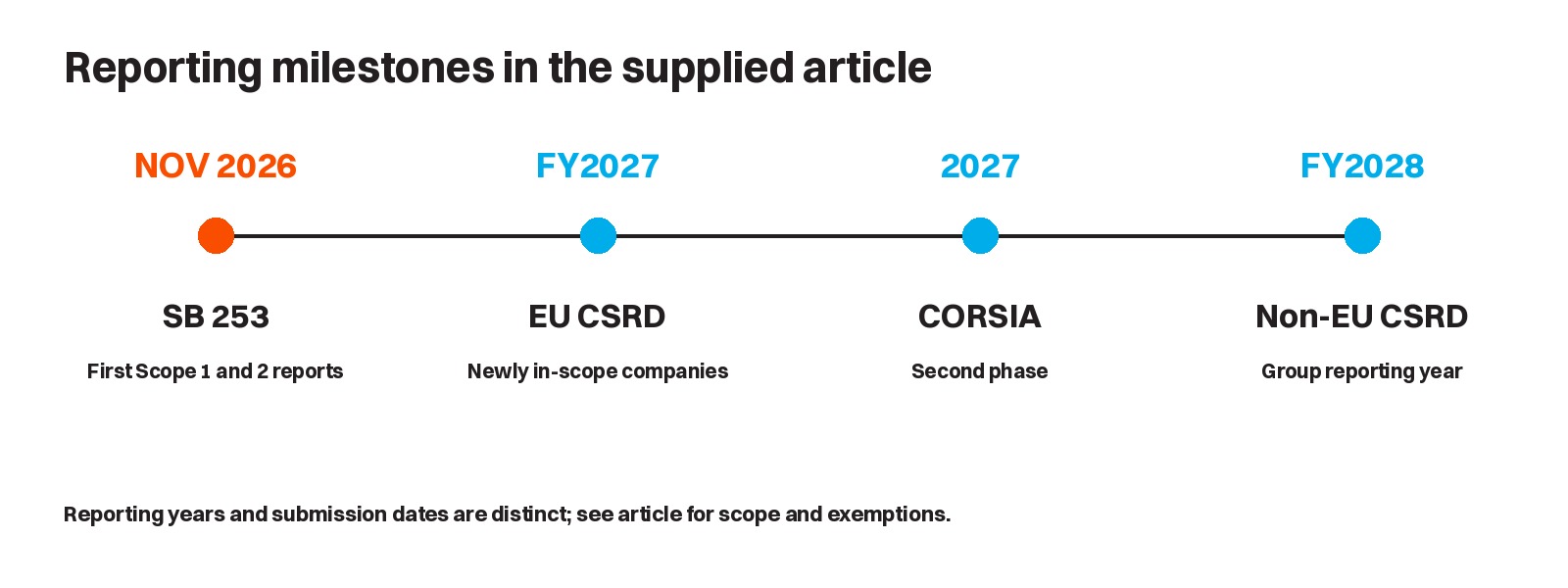
- Timing: The April 2025 “stop-the-clock” Directive (EU) 2025/794 postponed the second and third reporting waves by two years. Newly in-scope EU companies report on financial year 2027, published in 2028. Non-EU groups with more than €450 million in EU turnover and an EU subsidiary or branch above €200 million report on financial year 2028, published in 2029 (Euronext). Member States must transpose the changes by 19 March 2027 (Latham & Watkins).
- Standards: The Commission adopted revised European Sustainability Reporting Standards (ESRS) on 3 July 2026, cutting mandatory datapoints by more than 60% (European Commission). They were published in the Official Journal on 21 September 2026 and apply to financial years beginning on or after 1 January 2027 (Rödl).
- Due diligence: The Corporate Sustainability Due Diligence Directive (CSDDD) now targets companies with more than 5,000 employees and €1.5 billion in net turnover, with compliance from July 2029 (Council of the EU).
The result: a mid-sized MRO or distributor is very likely outside direct CSRD scope. Its largest airline, OEM and lessor customers are not.
The value-chain cap sets the ceiling on what customers can ask for
The Omnibus package did not remove supply chain data requests. It standardised them. This is the most practical change for suppliers.
Under the revised framework, companies covered by CSRD may not demand more information from value-chain partners than a Commission-adopted voluntary reporting standard contains (European Commission). Companies with up to 1,000 employees can decline requests that go beyond it (Euronext). The Council framed the goal as limiting the “trickle-down effect of obligations on smaller companies” (Council of the EU).
- For suppliers, this is an opportunity. The voluntary standard defines a known, finite data set. A supplier that can produce it on request becomes easier to buy from.
- The cap protects against unlimited questionnaires, not against all questions. Customers still need supplier data to complete their own Scope 3 inventories.
- Commercial pressure is separate from legal pressure. A customer can still prefer the supplier with credible emissions data, whatever the legal minimum.
CORSIA and California: what applies to whom
CORSIA regulates aircraft operators, not MROs or distributors. Under ICAO’s scheme, every operator emitting more than 10,000 tonnes of CO2 a year on international flights has reported those emissions since 2019. The first phase (2024 to 2026) covers flights between volunteering states, and 130 States participate as of 1 January 2026. From 2027, offsetting applies to all international flights apart from defined exemptions, against a baseline of 85% of 2019 emissions (IATA).
CORSIA creates no reporting obligation for a repair station. The cascade is commercial. Operators paying for offsets have a direct financial reason to reduce fuel burn and weight, and the maintenance decisions behind those outcomes (engine performance restoration, component reliability, repair versus replace) sit with their maintenance partners.
California is the second front for North American suppliers:
- SB 253 requires companies doing business in California with more than $1 billion in global revenue to disclose emissions. CARB’s initial regulation was approved on 12 October 2026, and the first Scope 1 and 2 reports are due 10 November 2026 (Thompson Hine; Mayer Brown).
- Scope 3 under SB 253 starts in 2027. CARB has proposed a limited approach covering five of the fifteen GHG Protocol Scope 3 categories, still at the pre-rulemaking stage (Mayer Brown).
- SB 261 (climate risk reporting) remains paused under a Ninth Circuit injunction granted on 18 November 2025. CARB will set a new date once the appeal is resolved (Thompson Hine).
Beyond the EU and California, more than 40 jurisdictions have decided to use or are taking steps to introduce the ISSB’s IFRS sustainability standards, including the climate standard IFRS S2 (IFRS Foundation). The direction is consistent across regions: larger companies disclose, and they need supplier data to do it.
OEMs already run a common supplier assessment
The aerospace OEMs have built their own supplier ESG channel. The International Aerospace Environmental Group (IAEG) runs a single, sector-level supplier ESG assessment powered by EcoVadis. Its members include Airbus, ATR, Boeing, CAE, Howmet Aerospace, Leonardo, Lockheed Martin, Rolls-Royce, RTX, Safran and Thales (Safran).
- Scale: IAEG member companies represent more than 50% of the global aerospace and defense industry, and more than 8,000 suppliers have participated in the assessment. Lockheed Martin issued a fresh supplier invitation in October 2026 (Lockheed Martin).
- Safran tracks supplier targets. It reports that 71% of its top 400 suppliers have defined and communicated a Scope 1 and 2 reduction target, and 80% of its top 50 have committed to an emissions reduction action plan (Safran).
- Risk-based follow-up. Rolls-Royce asks suppliers flagged for significant ESG risk to complete a fuller assessment and put improvement plans in place where gaps exist (Rolls-Royce).
The assessment is voluntary. Its purpose is efficiency: a supplier completes one sector-level assessment instead of a separate one for each customer (Safran).
Circularity is turning traceability into sustainability data

For MROs, traders and teardown specialists, the strongest ESG asset is already on the shelf: documented, reusable parts. Aviation Week reported in June 2026 that executives see Scope 3 pressure gradually shifting the aftermarket from “use-and-dispose” toward repair-first work and used serviceable material (USM). Views differ on pace. GA Telesis CEO Abdol Moabery said Scope 3 has not yet materially changed the core economics of teardown decisions, while AerFin and Vallair described a directional shift toward life-cycle value (Aviation Week).
Either way, the data requirement is the same. A repaired or USM part only counts as a lower-carbon option if its provenance, condition and history are documented. That is a traceability problem first and a carbon accounting problem second. It also maps directly to two pain points in Aero NextGen’s library of 150+: siloed systems that block decisions, and track-and-trace documentation that absorbs technician touch-time.
Several vendors on the Aero NextGen marketplace address this traceability layer. Based on their vendor-reported profiles:
- SmartCert describes a document intelligence platform for aerospace supply chains that reviews certifications against compliance criteria and keeps them connected to the shipments and parts they belong to.
- ProvenAir generates back-to-birth trace timelines and exception reports for life-limited parts on engines, landing gear and APUs.
- SkyThread builds a cloud-based digital thread recording the status, history, condition, provenance and location of aircraft parts, on and off aircraft.
- Pentagon 2000 positions its aviation ERP around lifecycle traceability of parts, repairs, labor, certifications and documents.
- AMOS by Lufthansa Group lists a carbon optimization tracker among its solution categories, alongside its M&E core.
Dedicated carbon accounting platforms are a separate category. The evaluation question for them is how well they connect to the aviation systems that already hold your operational data.
How to build a compliance-ready data foundation
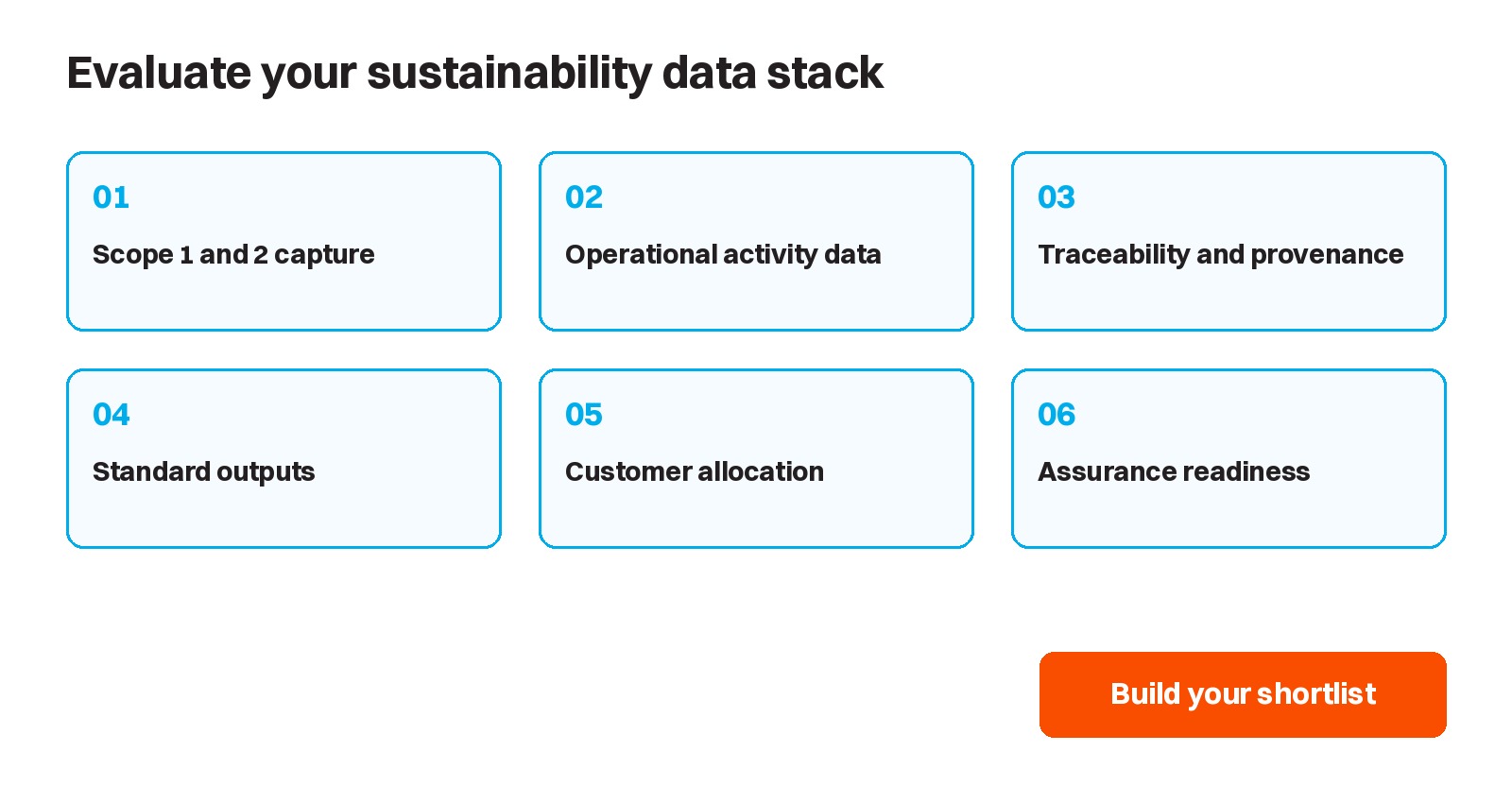
Start with the data you already own, then add the carbon layer. The GHG Protocol’s Scope 3 Calculation Guidance lists four methods for purchased goods and services, from supplier-specific data down to spend-based estimates, which it treats as the fallback when the other methods are not feasible. A supplier that can provide its own numbers gives customers an alternative to a generic spend-based factor. Use these criteria to evaluate a sustainability stack:
- Scope 1 and 2 capture. Can the system record energy, fuel and refrigerant use per facility, hangar and test cell, with audit-ready evidence?
- Activity data from operations. Does it pull shipments, work orders, materials and parts movements directly from your ERP or M&E system, instead of re-keying them into spreadsheets?
- Traceability and provenance. Can you prove the history of every repaired, overhauled or USM part you sell, down to back-to-birth records where required?
- Standard outputs. Does it produce the formats customers request: the EU voluntary standard, IAEG/EcoVadis assessment inputs, CDP responses and GHG Protocol-aligned inventories?
- Customer allocation. Can it allocate your emissions to a specific customer, contract or tail number when a Scope 3 request arrives?
- Assurance readiness. Does it keep an audit trail that a third-party verifier can follow?
The Aero NextGen take
The data that answers an ESG questionnaire is the same data that runs a good shop: clean parts records, connected systems, traceable documentation. Companies that build that foundation for operational reasons will meet their customers’ sustainability requirements as a by-product. Companies that treat ESG as a separate reporting exercise will build it twice.
Aero NextGen matches aviation companies, from airlines and fleet operators to MROs, OEMs, distributors and lessors, with vetted software and services from 600+ providers across 60+ solution categories. The match starts from your operation and your pain points, not from a vendor’s pitch.
“Sustainability reporting is now a supply chain data question. The companies that win preferred-supplier status will be the ones that can answer it in hours, with records they already trust. Our role is to match them with the platforms built for that.”
Monica Badra, Founder & CEO, Aero NextGen
Find your fit in 3 minutes: Take the Aero NextGen Solution Finder quiz, list your data and compliance priorities, and receive a custom shortlist of aviation solutions built for your type of operation.
Sources
- EUR-Lex: Directive (EU) 2026/470 of 24 February 2026
- Council of the EU: Council and Parliament strike a deal to simplify sustainability reporting and due diligence requirements (9 December 2025)
- Latham & Watkins: EU Sustainability Omnibus Published in the Official Journal (2026)
- Euronext Corporate Solutions: EU Omnibus Directive 2026/470, CSRD and CSDDD Changes (2026)
- European Commission: Commission adopts revised sustainability reporting standards (3 July 2026)
- European Commission: Corporate sustainability reporting
- Rödl & Partner: Revised ESRS published, an overview of the key changes (21 September 2026)
- IATA: CORSIA fact sheet (June 2026)
- Mayer Brown: California Climate Disclosure Laws, CARB Finalizes Its Initial Rulemaking (5 August 2026)
- Thompson Hine: CARB’s Final Climate Disclosure Rule Sets SB 253 Deadline, Leaves SB 261 Paused (14 October 2026)
- IFRS Foundation: Update on the ISSB’s activities (April 2026)
- Safran: Safran joins IAEG industry voluntary supplier ESG assessment initiative powered by EcoVadis (18 June 2024)
- Safran: A review of Safran’s climate action plan in four questions (2 April 2025)
- Lockheed Martin: Sustainability Assessment Invitation (October 2026)
- Rolls-Royce: Customers and suppliers
- Aviation Week: Split Emerges Over Scope 3’s Impact On Aftermarket Teardown Economics (16 June 2026)
- GHG Protocol: Technical Guidance for Calculating Scope 3 Emissions, Category 1