
Each month, Aero NextGen selects one solution provider from its marketplace for an editorial spotlight. The selection is based on buyer demand recorded in the Solution Finder, breadth of fit across aviation segments, and recent product momentum. For October 2026, the selection is Pentagon 2000, the aviation, aerospace and defense ERP founded in 1986. This spotlight explains why it was chosen, what operational problems it addresses, which operations it fits best, and how to tell whether it, or a comparable platform, belongs on your shortlist.
Why Aero NextGen selected Pentagon 2000 this month
Buyer demand selected it first. Pentagon 2000 has received 114 buyer matches through the Aero NextGen Solution Finder in 2026, placing it among the most-matched providers on the platform this year (Aero NextGen Solution Finder data, October 2026). Those matches come from operators, MROs and parts businesses whose quiz answers on operation type, size, region and required capabilities aligned with Pentagon 2000’s profile.
Three further factors drove the selection:
- Breadth across the aviation value chain. Pentagon 2000’s Aero NextGen profile covers all four buyer groups the platform serves: maintenance and repair (MRO), distributors, manufacturers and OEMs, and fleet operators. Few ERPs are configured for a parts broker, an engine shop and a cargo operator in the same product.
- Global support footprint. The company lists support across North America, Europe, Eastern Europe, the Middle East, Asia Pacific and South America on its Aero NextGen profile.
- Recent product momentum. In 2025 and 2026 Pentagon 2000 added AI-driven RFQ automation through a partnership with ePlane AI, and launched a browser-based cloud deployment called Pentagon UpStream (detailed below).
The operational problems it addresses
Pentagon 2000 targets the handoffs where aviation businesses lose time: RFQ to quote, part to record, and work order to invoice. The company describes the platform as an integrated ERP built for aerospace, aviation and defense, with more than 100 modules covering procurement, inventory, maintenance, manufacturing, teardown and financial operations (Pentagon 2000 vendor profile, Aero NextGen).
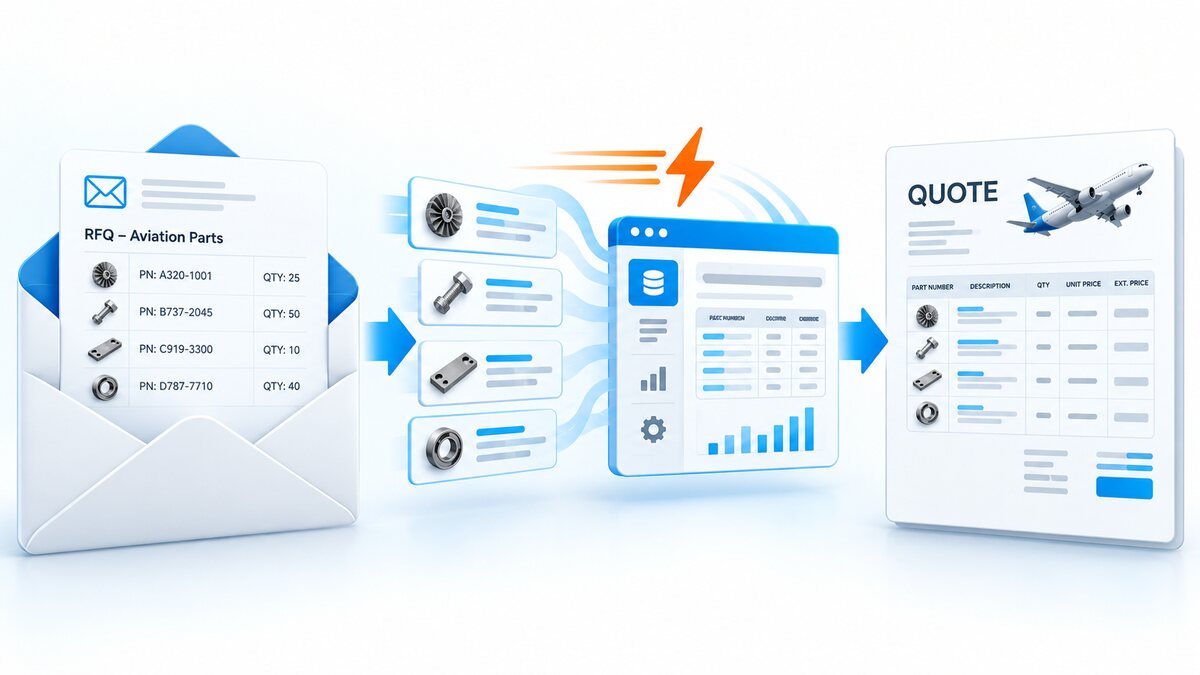
- Manual RFQ entry. Thousands of RFQs still arrive by email and are rekeyed into ERP systems. In July 2025, Pentagon 2000 and ePlane AI announced an integration that extracts RFQ details such as part numbers, quantities and urgency from incoming email and feeds them directly into the Pentagon 2000 ERP, aimed at faster quoting for AOG and other time-sensitive requests (ePlane AI).
- Traceability gaps. The company positions full lifecycle traceability as a core differentiator: parts, repairs, labor, certifications, users and documents tracked in one system. For distributors, lessors and MROs, that record is the asset value of the part.
- Disconnected commercial and maintenance data. Listed functionality spans quoting, sales orders, repair orders, exchanges, consignment, loan and borrow, part pooling, cost-by-the-hour management, billing and general accounting, alongside light and heavy aircraft maintenance, component maintenance, task cards and e-signoff.
- Data entering from outside the system. Listed integrations include ILS, PartsBase, ePlane, AeroXchange, The 145, QuickBooks and Salesforce. Buyers should confirm the exact connections they need in a demo.
These map to some of the most common needs Aero NextGen records across more than 150 aviation pain points: quote speed, parts traceability and the cost of double entry between commercial and maintenance systems.
Which operations it fits best
Pentagon 2000 is strongest where maintenance and parts trading meet. Its Aero NextGen profile lists the following segments:
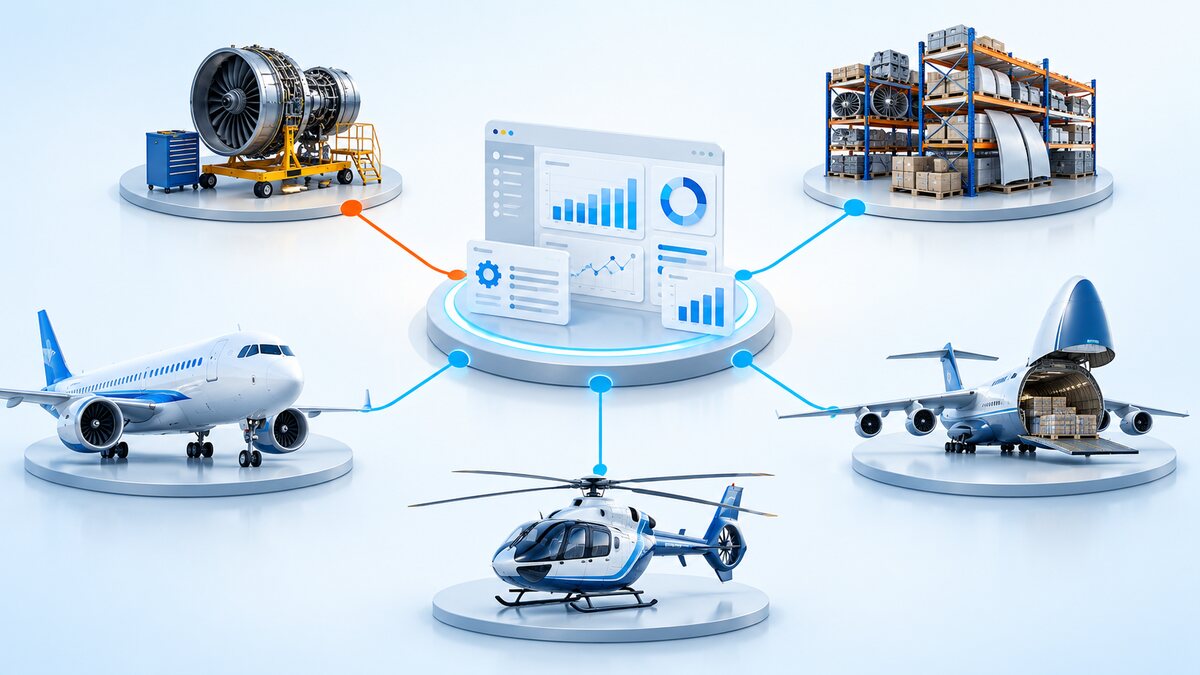
- MRO: line and base maintenance, engine MRO, component MRO, airline in-house MRO, specialized MRO (avionics, interiors, landing gear), teardowns and CAMO.
- Distributors: parts traders, brokers, parts suppliers, lessors, consumables and expendables suppliers, and warehouse and logistics operations.
- Manufacturers: OEMs and PMA manufacturers.
- Fleet operators: airlines, cargo operators and FBOs.
- Industries: commercial aviation, business and general aviation, helicopter, military and defense, and drones, eVTOL and UAM.
- Company size: organizations from fewer than 5 to 500 employees, per the profile’s supported size ranges.
The best-fit profile is a mid-size business that both maintains and sells: a component shop with an exchange pool, a distributor with repair management, or a teardown operation feeding an aftermarket parts business. The company states that the platform can also run inside divisions of large corporations that use SAP or Oracle at group level.
The likely buyers, according to the profile, include the ERP director, COO, VP of operations, director of maintenance, director of supply chain, procurement manager, CFO, CIO, and quality and compliance managers.
Deployment, security and implementation
Pentagon 2000 offers four hosting models and a new browser option. The profile lists on-premise, customer-provided cloud, Pentagon-provided cloud and browser delivery, with Windows desktop, web and mobile app interfaces.
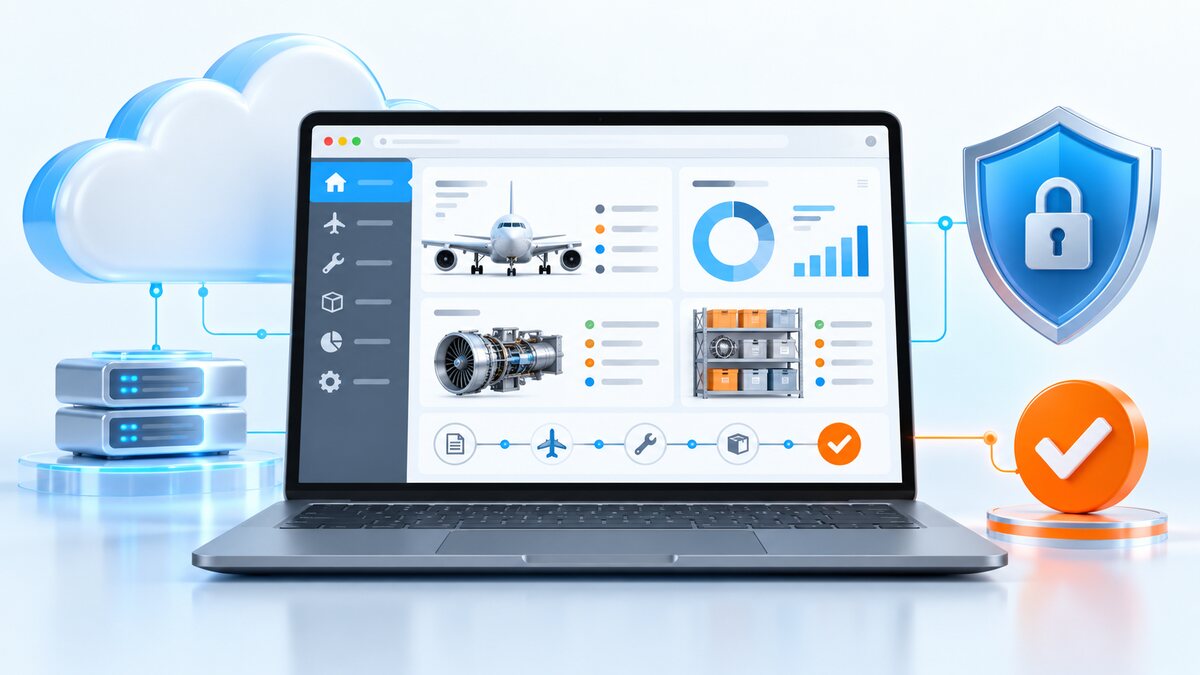
- Pentagon UpStream. In April 2026, Pentagon 2000 and RedNight Consulting announced Pentagon UpStream, which delivers the full Pentagon 2000 ERP in a standard web browser without VPN or remote desktop. It runs on AWS using Amazon AppStream, is hosted by Pentagon 2000, and the company states customers can go live in one to two days with no upfront infrastructure investment (Airframer press release).
- Installed base. The company reports more than 1,000 organizations using the platform worldwide (same source), and more than 1,000 deployments across North America, Europe and Asia (ePlane AI).
- Compliance frameworks. The profile lists SOC 2, GDPR, NIST/CMMC, CSA STAR and GAAP, which matters for defense suppliers and operators handling controlled data.
- Implementation timeline. The company cites a few weeks to a few months, and states that working within the standard application, rather than custom development, supports faster deployment and simpler upgrades.
These are vendor-reported figures. Buyers should validate timelines, module scope and total cost against their own data in a scripted demo.
How to evaluate Pentagon 2000 against comparable platforms
A spotlight is not a recommendation for every operation. Run the same five checks you would run on any ERP:
- Business model fit. Do you sell maintenance, parts or both? Pentagon 2000’s strength is combining the two.
- Module scope. With more than 100 modules available, define which you need on day one and which can wait.
- Hosting choice. Compare the total cost of UpStream browser delivery against on-premise or private cloud for your IT model.
- Integration proof. Ask for live references running your parts marketplaces and accounting platform.
- Peer references. Speak to customers with your operation type, size and region.
Comparable platforms on the Aero NextGen marketplace include AvSight, CorePilot and Vista-Suite by Ambry Hill Technologies for distributor and MRO workflows, and AMOS and AirNxt for operator-led maintenance and engineering.
The Aero NextGen take
Forty years in the market and a browser deployment in 2026 is the combination buyers are asking for: proven depth with a faster path to go-live. The aviation software market is valued at an estimated $12.5 billion in 2026 (Grand View Research), and buyers face more choice than ever. The Vendor Spotlight series exists to show, with data, which providers buyers are actually being matched to and why. Aero NextGen matches fleet operators, MROs, OEMs, parts distributors and lessors to vetted solution providers based on fit, not advertising spend.
“We select the Vendor Spotlight on evidence: buyer demand, segment fit and what the provider shipped this year. Pentagon 2000 earned October on all three. A platform that serves the engine shop, the broker and the operator in one system answers a question our buyers ask every week.”
Monica Badra, Founder & CEO, Aero NextGen
Find your fit in 3 minutes: Want to know whether Pentagon 2000, or a comparable platform, is right for your operation? Complete the Solution Finder quiz and get matched to the providers that fit your segment, size, region and integration needs.
Sources
- Pentagon 2000 vendor profile, Aero NextGen marketplace (self-reported by Pentagon 2000): aero-nextgen.com/vendors/pentagon-2000
- Aero NextGen Solution Finder match data, October 2026 (internal)
- ePlane AI, Pentagon 2000 and ePlane AI Team Up to Eliminate Manual RFQ Entry (July 22, 2025): eplaneai.com
- Airframer, RedNight Consulting and Pentagon 2000 Software announce the cloud partnership behind Pentagon UpStream (April 2026): airframer.com
- Grand View Research, Aviation Software Market Report, 2026-2033: grandviewresearch.com