A Thought Leadership Collaboration between Aero NextGen and Aircraft Maintenance Systems (AMS)
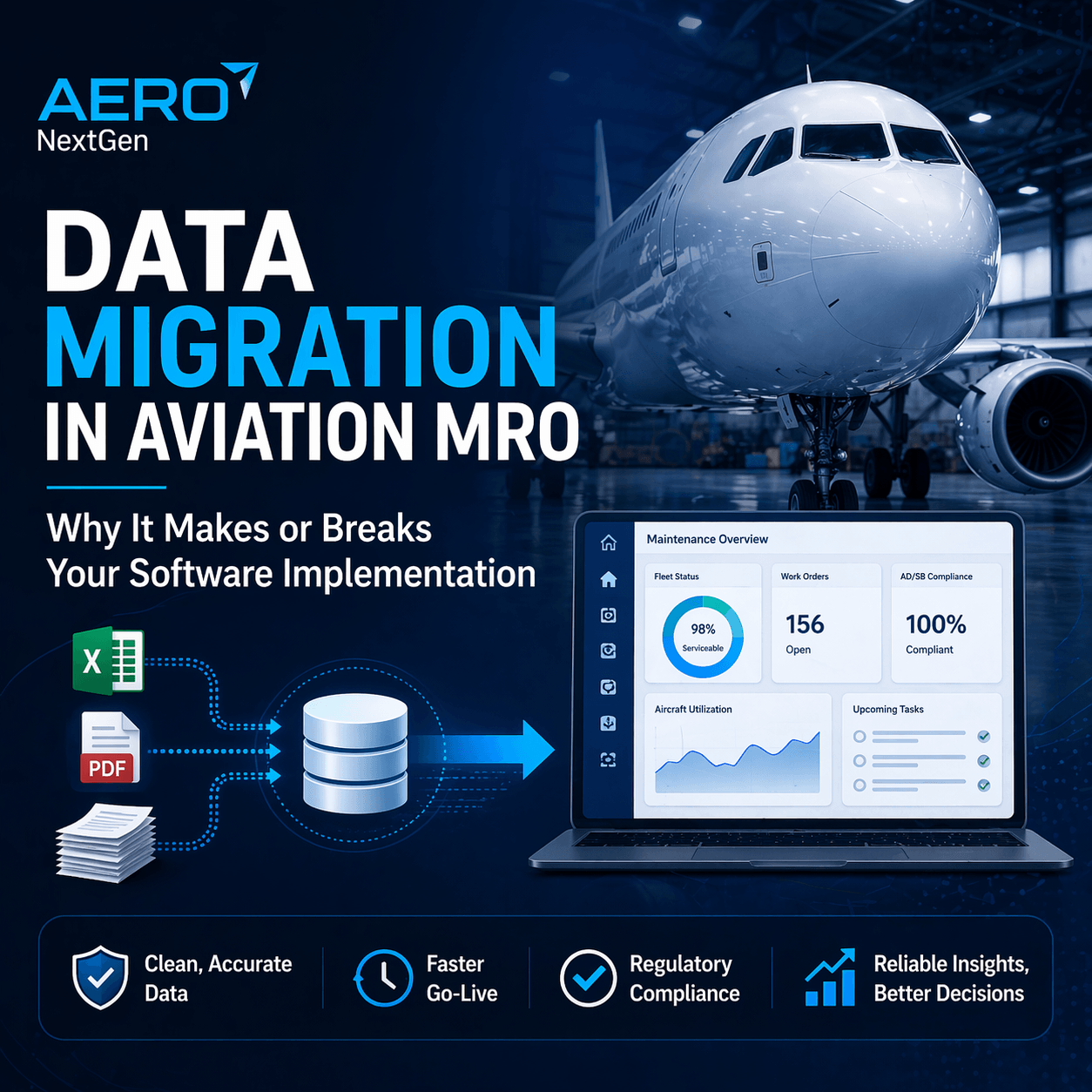
Selecting the right aviation maintenance software is a major decision. But for small and mid-sized operators, the selection itself is often not what determines success or failure, the data migration is.
McKinsey research found that only 16% of digital transformations successfully sustain change over the long term, and in traditional industries similar to aviation MRO, success rates drop to between 4% and 11%. More than 80% of MRO respondents in a separate McKinsey survey identified data limitations as the most significant barrier to digital adoption. When implementations fail, the root cause is almost always the same: the data foundation was not right before the new system went live.
Monica Badra, founder of Aero NextGen, sees this pattern across the operators she works with: “The vendors who succeed with small and mid-sized operators are the ones who treat data migration as a core service. When a provider shows up with purpose-built tools and hands-on migration support, the implementation timeline shrinks and the operator starts getting value from day one.”

Why Data Migration Is the Hardest Part of Any Aviation Software Implementation
Aviation maintenance data is not like typical business data. It is the airworthiness record of the fleet. Flight hours, cycles, component life limits, AD/SB compliance status, maintenance program intervals, every field must be accurate, complete, and traceable. A single discrepancy in accumulated flight hours or a missing AD compliance record does not just cause a software error, it can ground an aircraft.
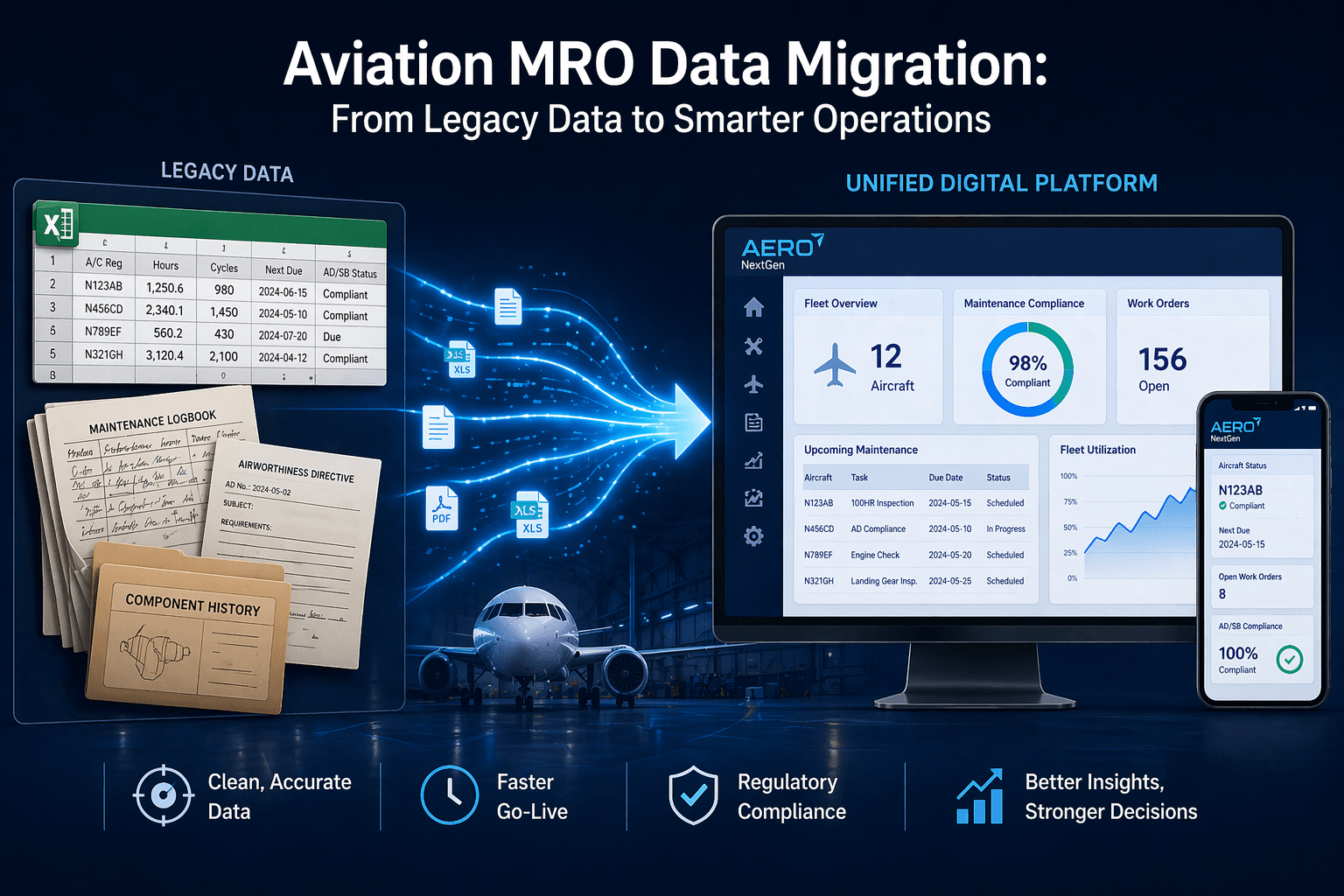
For small and mid-sized operators, the challenges are compounded by several realities. Many are migrating from spreadsheets, paper logbooks, or basic tracking tools that were never designed for structured data export. Records may be scattered across multiple formats, Excel files, PDF scans, handwritten entries, and legacy databases with proprietary schemas. The operator may not have dedicated IT staff, and the maintenance team responsible for the migration is the same team that needs to keep aircraft flying during the transition.
As EXSYN, a specialist in aviation data migration, describes it: data migration in this industry is like building a house, if the foundation is wrong, the walls will be unstable and the roof will collapse. The same principle applies to MRO software. If the opening balances, master records, and compliance data are not clean and correctly mapped before go-live, every downstream function, work order generation, parts tracking, regulatory reporting, produces unreliable output.
The Data Migration Gap for Smaller Operators
Enterprise-grade MRO platforms like AMOS and Ramco serve their market well, but their implementation models are typically designed for large airlines and MRO providers with dedicated IT departments, structured data environments, and multi-month project timelines. For a 10-aircraft helicopter operator, a regional airline with 15 fixed-wing aircraft, or a Part 145 repair station managing a mixed fleet, that model does not fit.
These operators face a different set of migration challenges. Their data lives in formats that require manual extraction and reformatting. They cannot afford months of parallel system operation. They need to go live quickly, often within weeks, not quarters, without compromising data integrity or regulatory compliance.
This is the gap that purpose-built migration tools and hands-on implementation support are designed to fill.
How AMS Approaches Data Migration for Small and Mid-Sized Operators
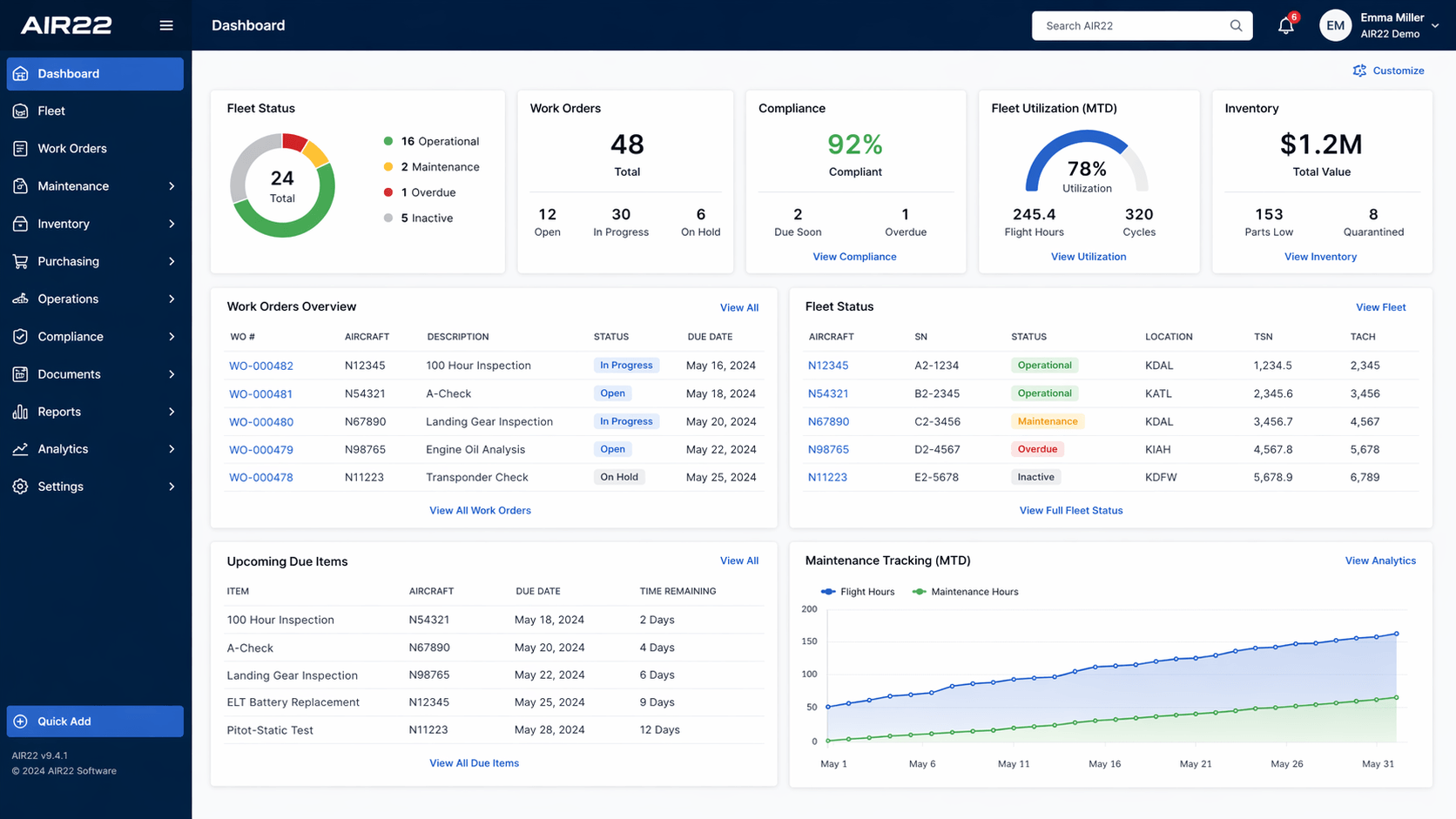
Aircraft Maintenance Systems (AMS), part of the Reactis Group, has spent over 20 years building aviation maintenance software specifically for this market segment. Their AIR22 platform serves more than 100 clients across 43 countries, covering fixed-wing, rotary-wing, and mixed fleets under Transport Canada, FAA, and EASA regulations.
What differentiates AMS in the data migration conversation is their approach to getting operators live quickly without cutting corners on data quality. AIR22 supports direct import of fleet maintenance programs, AD/SB documents, aircraft configurations, component history records, and historical data from standard file formats including XLS and CSV. This means operators migrating from spreadsheets or basic tracking tools do not need to restructure their data into a proprietary format before they can begin, the platform meets them where their data already lives.
Beyond structured data imports, AMS’s migration team is organized to support the full spectrum of aviation data sources commonly found in smaller operations. This includes structured exports from existing M&E systems, standard XLS and CSV files, and manual-entry environments built around paper-based records such as handwritten logbooks and scanned archives. For many small and mid-sized operators, these mixed-format environments are the norm and often the scenario least supported by generic migration models.
AMS’s published implementation timeline reflects this philosophy: a 2-day training program followed by a 10-day full fleet phase-in. For operators accustomed to hearing about 6-month or 12-month implementation timelines from enterprise vendors, this represents a fundamentally different value proposition, one built around the operational reality that smaller operators cannot afford extended periods of disruption.
Beyond the technology, AMS provides hands-on professional services that cover consulting, training, migration support, and feature customization. For an operator without a dedicated IT team, this end-to-end support model can be the difference between a successful go-live and an implementation that stalls.
A key differentiator in AMS’s migration capability comes from its own platform evolution. Over the years, AMS has migrated dozens of existing customers from its legacy platform (AMS v21) to AIR22 using proprietary extraction and import tools developed in-house. This hands-on experience gives the team practical migration expertise that goes well beyond standard implementation support, particularly when managing complex historical datasets and ensuring continuity across system generations.
What a Successful Aviation Data Migration Actually Looks Like
Regardless of the platform, the principles of a successful aviation data migration are consistent. Understanding these principles helps operators evaluate vendors and set realistic expectations.
Start with data audit and cleanup before migration begins. The most common mistake is attempting to migrate dirty data and hoping the new system will sort it out. It will not. Accumulated flight hours must reconcile with individual flight logs. Component life limits must match installed configuration records. AD/SB compliance status must be current and traceable. This cleanup work is best done before, not during, the migration.
Map data to the target system’s structure before loading. Every MRO platform has its own data model. Fields that existed in one system may map to multiple fields in another, or may not have a direct equivalent. A clear mapping exercise, ideally supported by the vendor’s implementation team, prevents the misalignment that causes errors in production.
Validate after loading, not just before. Post-migration validation is where many implementations fall short. Does the new system generate the correct next-due dates for all maintenance tasks? Do component life calculations match the source records? Are all regulatory documents linked to the correct aircraft and components? Systematic validation catches the errors that spot-checks miss.
Plan the cutover to minimize parallel operation. Running two systems simultaneously is expensive and error-prone. The best implementations define a clear cutover point, with a short period of parallel operation for validation, followed by a decisive switch. For smaller operators, the shorter this period, the better.
Data Migration as a Competitive Advantage
In an industry where digital transformation is accelerating, the global aviation software market is projected to grow from $13.13 billion in 2025 to $18.12 billion by 2030 according to Mordor Intelligence, with cloud-based solutions now accounting for nearly 50% of deployment revenue, the ability to migrate cleanly and go live quickly is a genuine competitive advantage.
For small and mid-sized operators, the right migration partner can compress what would otherwise be a multi-month, resource-intensive project into a focused, manageable transition. The result is not just a new software system, it is a clean, validated, digital foundation for airworthiness management, maintenance tracking, and inventory control that compounds in value over time.
The operators who get this right do not just upgrade their software. They upgrade their entire operational capability.

Looking for the right maintenance tracking solution for your operation? Aero NextGen’s Solution Finder Quiz matches you with vetted providers like AMS, tailored to your fleet size, regulatory environment, and operational needs, in under 2 minutes.
Sources & References
McKinsey & Company (2024), “Aircraft MRO 2.0: The Digital Revolution”: 16% digital transformation success rate; 4–11% in traditional industries; 80%+ cite data limitations as top barrier
EXSYN (2022), “MRO System Implementation and Data Migration: What You Need to Know”: Best practices for aviation data migration methodology
Mordor Intelligence (2025), Aviation Software Market: $13.13B (2025) to $18.12B (2030); cloud solutions held 49.80% of revenue in 2024
Aircraft Maintenance Systems (AMS), AIR22 platform: 300+ clients, 43 countries, 20+ years experience, 2-day training + 10-day fleet phase-in (aircraftms.com)
Aerospace Innovations (2024), Gartner data cited: 85% of data projects fail due to complexities in standardizing and unifying data sources