

MRO Inventory Software: Why 2026 Is the Year to Get This Right

The aviation supply chain is under more pressure than at any point in recent history. A joint study by IATA and Oliver Wyman estimated that supply chain bottlenecks will cost the airline industry more than $11 billion in 2025 — driven by excess fuel costs from operating older aircraft ($4.2 billion), additional maintenance costs ($3.1 billion), increased engine leasing ($2.6 billion), and surplus inventory holding costs ($1.4 billion). The commercial aircraft backlog reached a record 17,000 aircraft in 2024, and delivery shortfalls now total at least 5,300 aircraft.
For MROs and operators, this environment makes one thing clear: MRO inventory software is no longer a back-office tool — it is a strategic capability that directly impacts fleet availability, maintenance costs, and the ability to respond when supply chain disruptions hit.
%20(1)%20(1)%20(1)%20(3)%20(1)%20(1)%20(1).png)
The Business Case for Modern MRO Inventory Software
The financial impact of inventory management is well-documented. Boeing estimates that AOG situations cost airlines between $10,000 and $150,000 per hour depending on aircraft type and route. For widebody aircraft on international routes, a single day of unscheduled downtime can exceed $500,000 in lost revenue alone, according to OnFly Air’s 2026 analysis of AOG economics. With an average of 14 AOG events per aircraft per year in the U.S. (SkyThread), the cumulative cost of inventory-related delays adds up quickly.
Monica Badra, founder of Aero NextGen, works with MROs at every stage of this journey: “The operators who are investing in modern inventory platforms today aren’t just solving a parts tracking problem — they’re building the foundation for predictive maintenance, smarter procurement, and faster AOG resolution. The ROI is measurable and typically realized within the first year.”
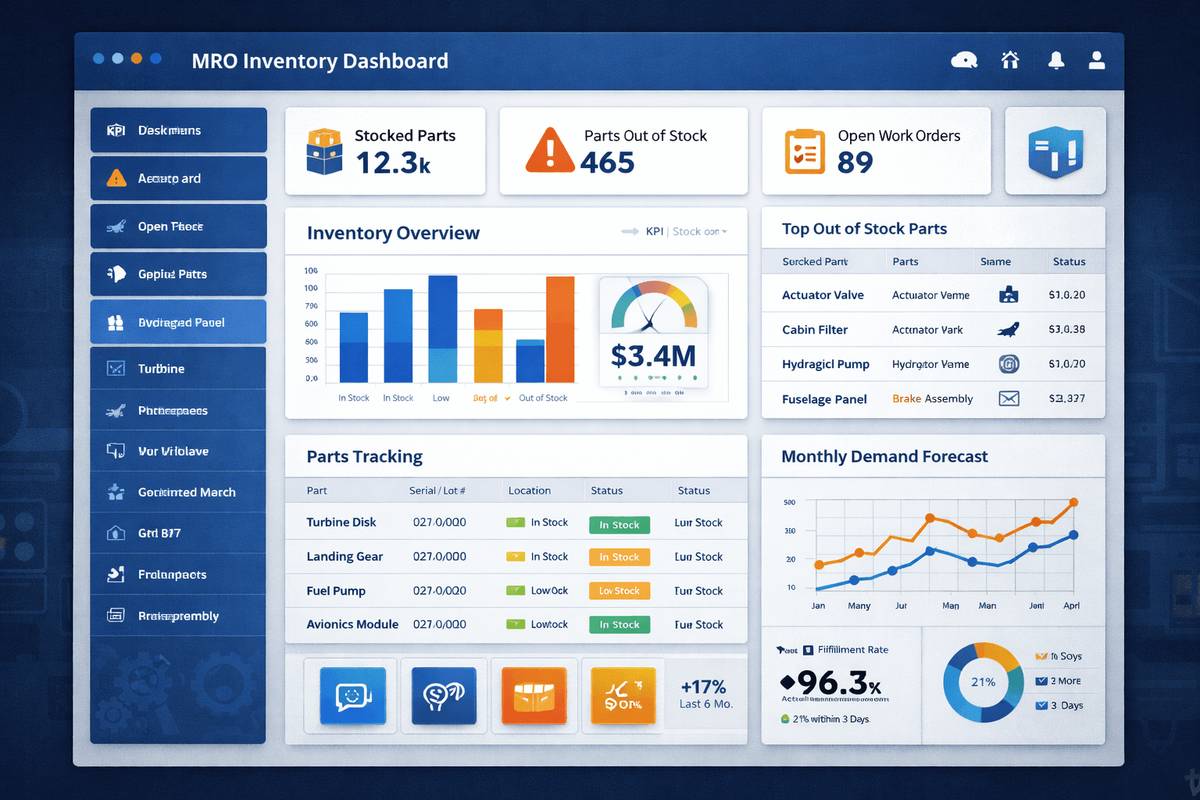
Modern MRO inventory software addresses the specific challenges that drive these costs: real-time visibility across multiple warehouses and locations, automated traceability and certification tracking for every serialized component, demand forecasting that connects historical usage with fleet schedules, integration between purchasing, maintenance planning, and financial systems, and audit-ready compliance documentation that reduces regulatory preparation time.
Evaluating MRO Inventory Software: What Matters Most in 2026
The market has matured significantly. Solutions available on the Aero NextGen marketplace represent the current state of the art, but choosing between them requires understanding your specific operational context.
The right question is not “which is best?” but “which solves our specific bottlenecks?” A small independent MRO serving general aviation has fundamentally different requirements than a multi-site heavy maintenance organization supporting widebody commercial aircraft.
.png)
MRO Inventory Software Implementation: The Success Factors
McKinsey’s 2024 research on digital MRO found that only 16% of digital transformations successfully sustain change over the long term, and more than 80% of MRO respondents identified data limitations as the most significant barrier to digital adoption. The implementations that succeed share consistent characteristics:
Data migration discipline. Your new MRO inventory software is only as good as the data you feed it. Organizations that succeed invest significant effort in cleaning, standardizing, and validating data before migration. Part numbers, serial numbers, location codes, and certification records must all be accurate and reconciled before go-live.
Process redesign before configuration. Software should optimize good processes, not automate inefficient ones. Leading MROs conduct comprehensive process mapping and redesign before configuring their systems.
Phased rollout with measurable milestones. Organizations that pilot with a single warehouse or aircraft type, measure results, refine processes, and then scale consistently outperform those that attempt simultaneous full-scope deployments.
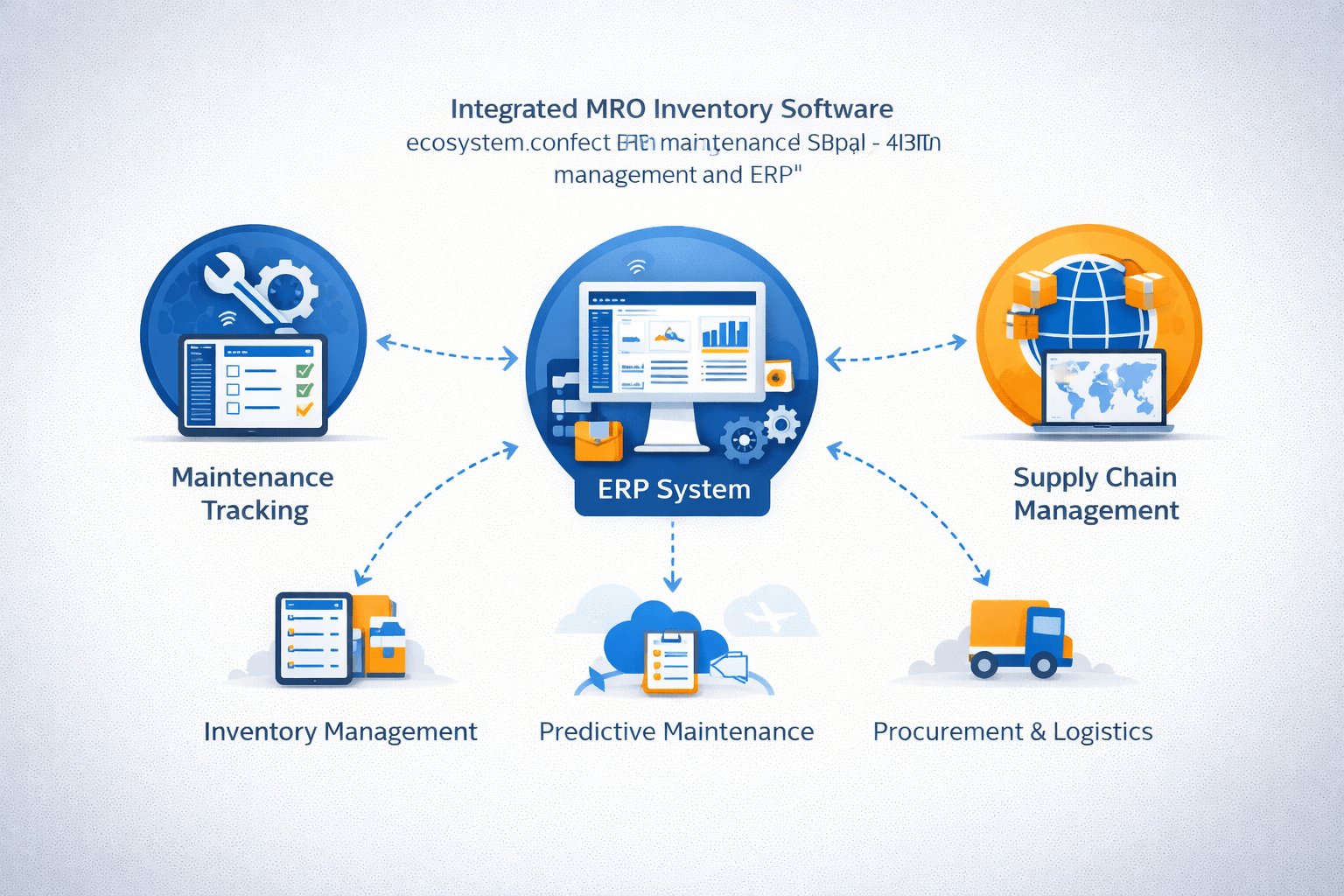
Integration planning from day one. Standalone inventory systems create data silos that undermine the visibility they are supposed to provide. Modern MRO inventory software must integrate with ERP systems, maintenance tracking platforms, and supplier portals. Planning these integrations upfront — not as an afterthought — is essential.
The 2026 MRO Inventory Software Landscape: Emerging Capabilities
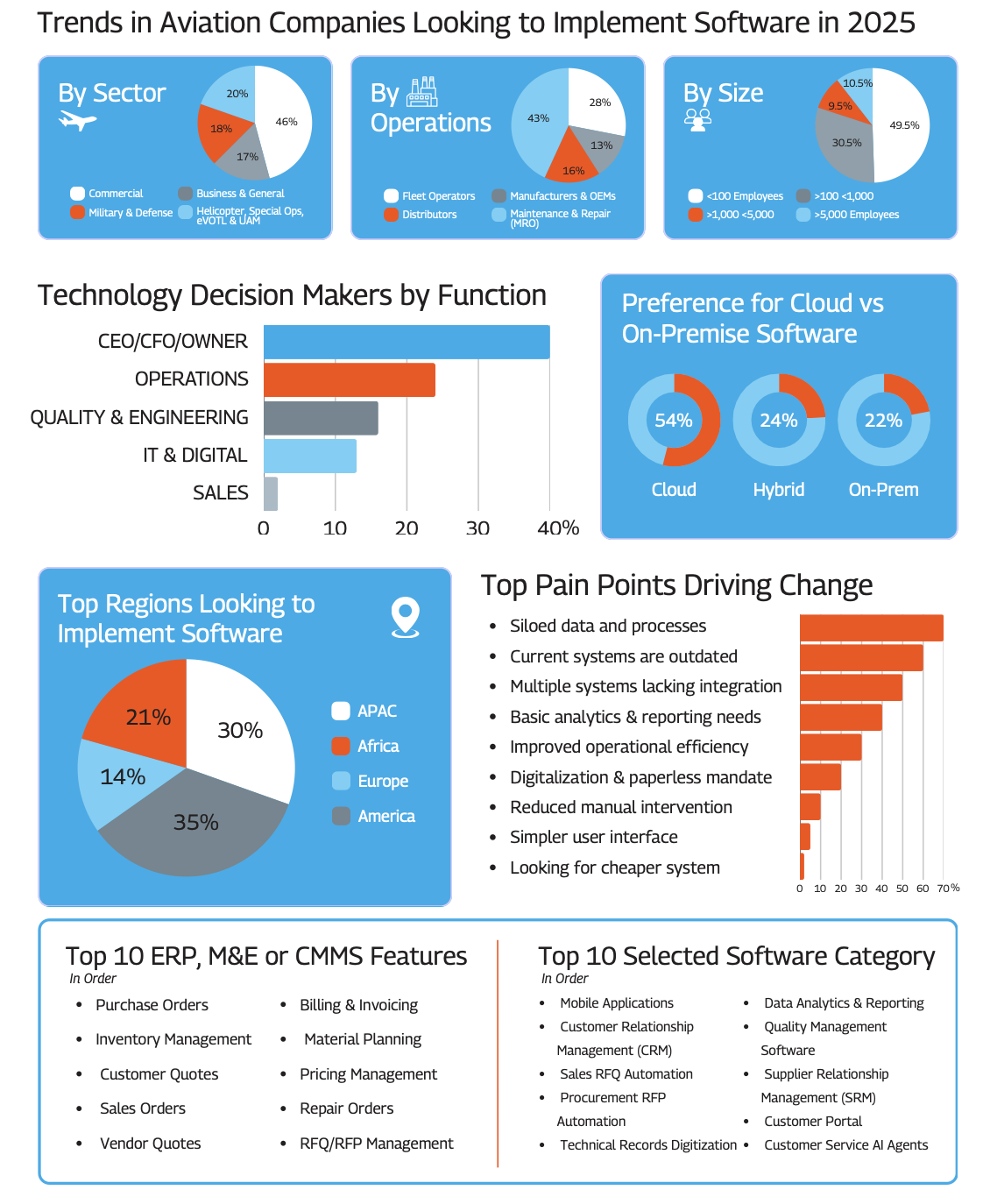
The market has consolidated around cloud-based platforms with mobile access, predictive analytics, and deep integration capabilities. According to Mordor Intelligence, cloud-based solutions accounted for nearly 50% of aviation software revenue in 2024, with the overall aviation software market projected to grow from $13.13 billion in 2025 to $18.12 billion by 2030.
Several emerging capabilities are reshaping expectations for MRO inventory platforms. AI-powered demand forecasting analyzes historical usage patterns, fleet age profiles, and maintenance schedules to optimize stock levels and reduce both overstocking and stockouts. Blockchain-based parts provenance tracking is moving from pilot projects to production deployments, particularly for high-value rotables where counterfeit risk is significant — a concern underscored by the AOG Technics fraud case, which cost operators an estimated $53 million according to the UK Serious Fraud Office. And mobile-first interfaces are enabling warehouse teams to update inventory status in real time from the hangar floor, eliminating the data entry delays that cause allocation errors and misquotes.
Making the Decision: Practical Next Steps
Choosing MRO inventory software requires matching capabilities to your operational reality. Start by documenting your current pain points with specificity — “reduce emergency purchase orders by 40%” or “achieve 99% inventory location accuracy” creates measurable success criteria that generic goals like “better inventory management” cannot.
Request demonstrations using your actual data and scenarios. Generic demos showcase features you may never use while missing capabilities critical to your operation. And evaluate vendor expertise in aviation specifically — inventory platforms adapted from other industries consistently underperform those purpose-built for the aerospace aftermarket.
The supply chain environment is not getting simpler. IATA projects that the structural mismatch between airline requirements and production capacity is unlikely to normalize before 2031–2034. MROs that invest in modern inventory infrastructure now will be best positioned to navigate the complexity ahead.
Not sure which platform fits your operation? Aero NextGen’s Solution Finder Quiz matches you with the right aviation inventory software for your specific needs — in under 2 minutes. Take the quiz and discover your ideal solution today.
Sources & References
IATA & Oliver Wyman (2025) — “Reviving the Commercial Aircraft Supply Chain”: Supply chain costs exceed $11B in 2025; commercial backlog reached 17,000 aircraft; delivery shortfalls total 5,300+ aircraft; normalization unlikely before 2031–2034
Boeing AOG Cost Estimates — $10,000 to $150,000 per hour depending on aircraft type and route (Boeing / Wikipedia)
OnFly Air (2026) — Widebody AOG daily cost can exceed $500,000 in lost revenue; narrowbody $150,000–$250,000/day
SkyThread — Average of 14 AOG events per aircraft per year in the U.S.
McKinsey & Company (2024) — “Aircraft MRO 2.0: The Digital Revolution”: 16% digital transformation success rate; 80%+ cite data limitations as top barrier
Mordor Intelligence (2025) — Aviation Software Market: $13.13B (2025) to $18.12B (2030); cloud solutions held 49.80% of revenue in 2024
UK Serious Fraud Office (2026) — AOG Technics fraud: $53 million estimated cost to operators








.webp)





.png)

.png)
.png)


%20(1).png)








.png)













.jpeg)



.png)













Aviation Solutions, Find your Match
Run the survey to get a shortlist of the systems that match your operational needs – fast, simple, free.
Related Posts


.jpg)



%20(1).png)
%20(1).png)
.png)
%20(1)%20(1)%20(1).png)
.png)
.png)


%20(1).png)
.png)







%20(1)%20(1)%20(1)%20(1).png)
.png)
%20(1).png)
.png)
%20(1).png)
.png)
%20(1)%20(1).png)
.png)
.png)
.png)
%20(1)%20(1)%20(1)%20(1).png)
%20(1).webp)
.png)
.jpeg)
%20(1).webp)

.webp)

%20(1).webp)

Aero NextGen matched us to the right solution providers that helped us standardize the data in such a way that we can now put it to use. Aero Nextgen’s ability to quickly understand the business needs and translate them into tangible solutions was impressive.


Aero NextGen matched us to the right solution providers that helped us standardize the data in such a way that we can now put it to use. Aero Nextgen’s ability to quickly understand the business needs and translate them into tangible solutions was impressive.
Aero NextGen matched us to the right solution providers that helped us standardize the data in such a way that we can now put it to use. Aero Nextgen’s ability to quickly understand the business needs and translate them into tangible solutions was impressive.
We generate a tremendous amount of data. Aero NextGen matched us to the right solution providers that helped us standardize the data in such a way that we can now put it to use. Aero Nextgen's ability to quickly understand the business needs and translate them into tangible solutions was impressive.


Aero Next Gen quickly identified our challenges and matched us with the right ERP solution. Their expertise saved us time, and transformed our MRO operations.


My experience working with Aero NextGen is extremely positive. We setup a battery shop in the middle of Brexit in under 6 months with their help. Thoroughly professional. Attention to detail is second to none with innovative and creative ideas.
.png)

We have been struggling to performance manage our shopfloors for ages. Aero NextGen has connected us to solution providers that solved this for us within weeks. We are now capable of tracking capacity, productivity, utilization, and operational efficiency with instantaneously. The level of expertise has made the engagement seamless for our internal teams.


Straight to Your Inbox.
Subscribe to receive the latest trends on aviation software and services.