

The aviation maintenance industry is in the middle of a generational technology shift. Cloud-native platforms, mobile-first interfaces, and predictive analytics are no longer emerging capabilities, they are production-ready tools that operators of every size can access today. For organizations still evaluating their options, 2026 is the year that aircraft maintenance tracking programs move from “nice to have” to essential operational infrastructure.
The business case is clear. McKinsey’s 2024 research on digital MRO found that operators who have integrated digital solutions at scale are seeing measurable improvements in efficiency, cost control, and maintenance quality. Airlines using AI-driven maintenance diagnostics are achieving 35–40% reductions in unscheduled maintenance events and pushing dispatch reliability above 99%, according to NBAA and multiple industry analysts. Deloitte reports that structured predictive maintenance programs deliver a 15% reduction in downtime and a 20% increase in labor productivity.
Monica Badra, founder of Aero NextGen, sees operators at every stage of this journey: “The platforms available today are dramatically more capable and more accessible than what existed even three years ago. The operators who are moving now aren’t just improving compliance, they’re building the digital foundation for predictive maintenance, better fleet utilization, and stronger competitive positioning.”

Why Aircraft Maintenance Tracking Programs Have Become Essential
Several converging forces are driving adoption. The regulatory environment is tightening, EASA Part-IS now mandates information security management systems for aviation organizations from October 2025 and February 2026, while the FAA’s bilateral safety agreement now requires SMS implementation for EASA-approved U.S. repair stations. These frameworks increasingly assume digital record-keeping as the baseline, not the exception.
The workforce reality adds urgency. Boeing’s 2025 Pilot and Technician Outlook projects the industry will need 710,000 new maintenance technicians through 2044. With experienced professionals retiring and new technicians entering the field, operators need systems that capture institutional knowledge, standardize procedures, and reduce the administrative burden on skilled personnel so they can focus on maintenance execution.
And the cost of unscheduled downtime remains a powerful motivator. Boeing estimates that AOG situations cost airlines between $10,000 and $150,000 per hour. Modern tracking programs that connect maintenance planning with real-time fleet health data help operators move from reactive to proactive maintenance, catching issues before they ground aircraft.
What Modern Aircraft Maintenance Tracking Programs Actually Deliver
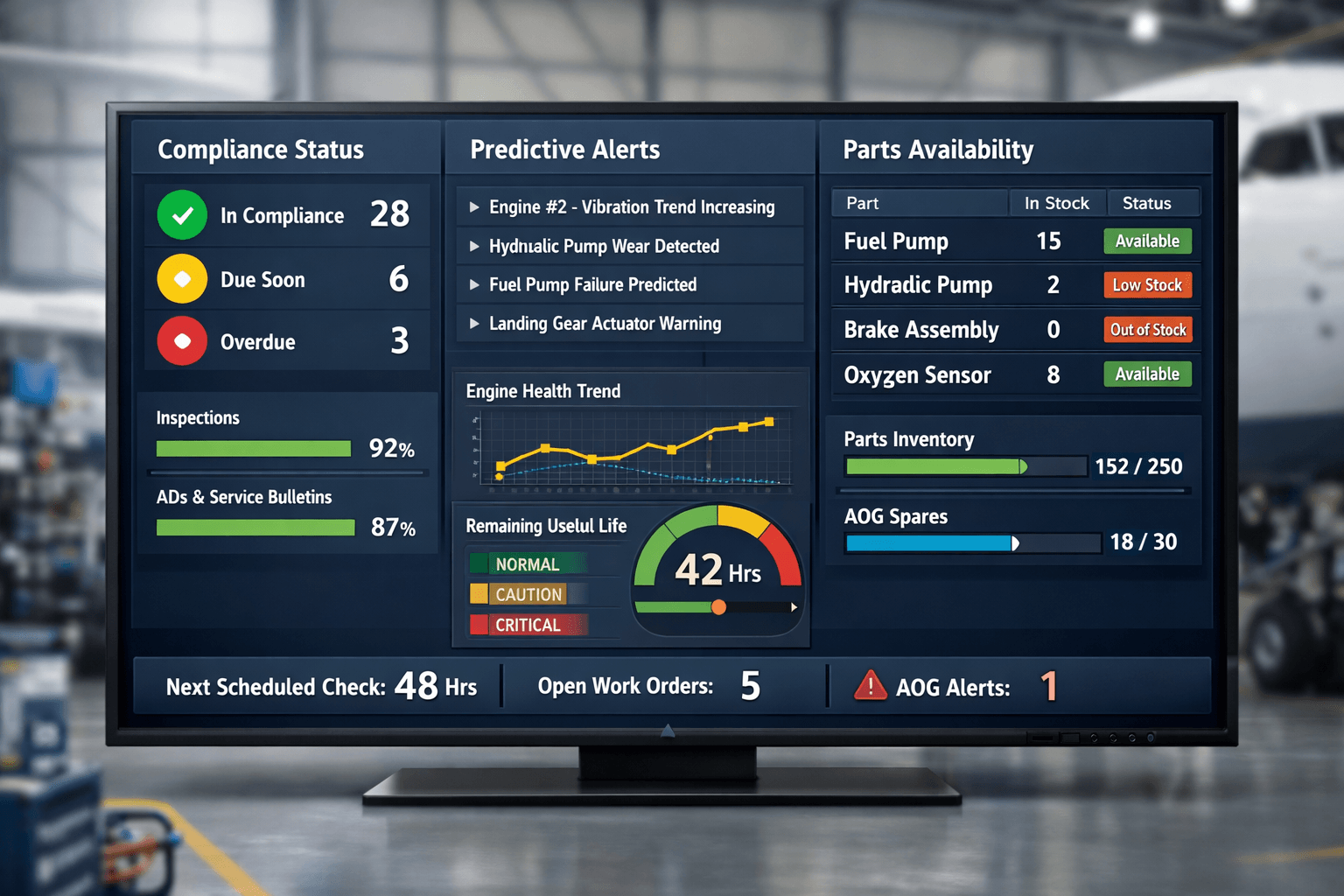
The market has matured significantly. Today’s leading aircraft maintenance tracking programs share several capabilities that directly impact operational performance:
Regulatory compliance automation is the foundation. FAA Part 145, EASA Part-M, and international variants demand meticulous documentation. As OASES, an aviation MRO software provider, notes: modern MRO software captures every activity, maintenance actions, inspections, and part changes, automatically creating comprehensive audit trails with timestamps, user records, and linked supporting documents. This transforms compliance from a manual documentation effort into an embedded operational output.
Predictive maintenance integration separates modern platforms from legacy systems. Research published in Applied Sciences (MDPI, 2025) found that operators using predictive solutions like AFI KLM’s Prognos report maintenance delays dropping by up to 35%. The key enabler is clean, connected data, and a tracking platform that can ingest and contextualize information from aircraft health monitoring systems, operational patterns, and historical maintenance records.
Mobile-first accessibility matters enormously. Technicians on the hangar floor need immediate access to work cards, parts information, and documentation. The best platforms deliver full functionality through tablet and smartphone interfaces, enabling digital task completion and electronic sign-off at the point of work rather than requiring trips back to desktop terminals.
Real-time parts integration closes the loop between maintenance planning and supply chain execution. When tracking programs connect directly with inventory systems and supplier networks, parts availability becomes a planning input rather than a discovery during execution. This is especially impactful for reducing AOG resolution times.
Selecting the Right Aircraft Maintenance Tracking Program
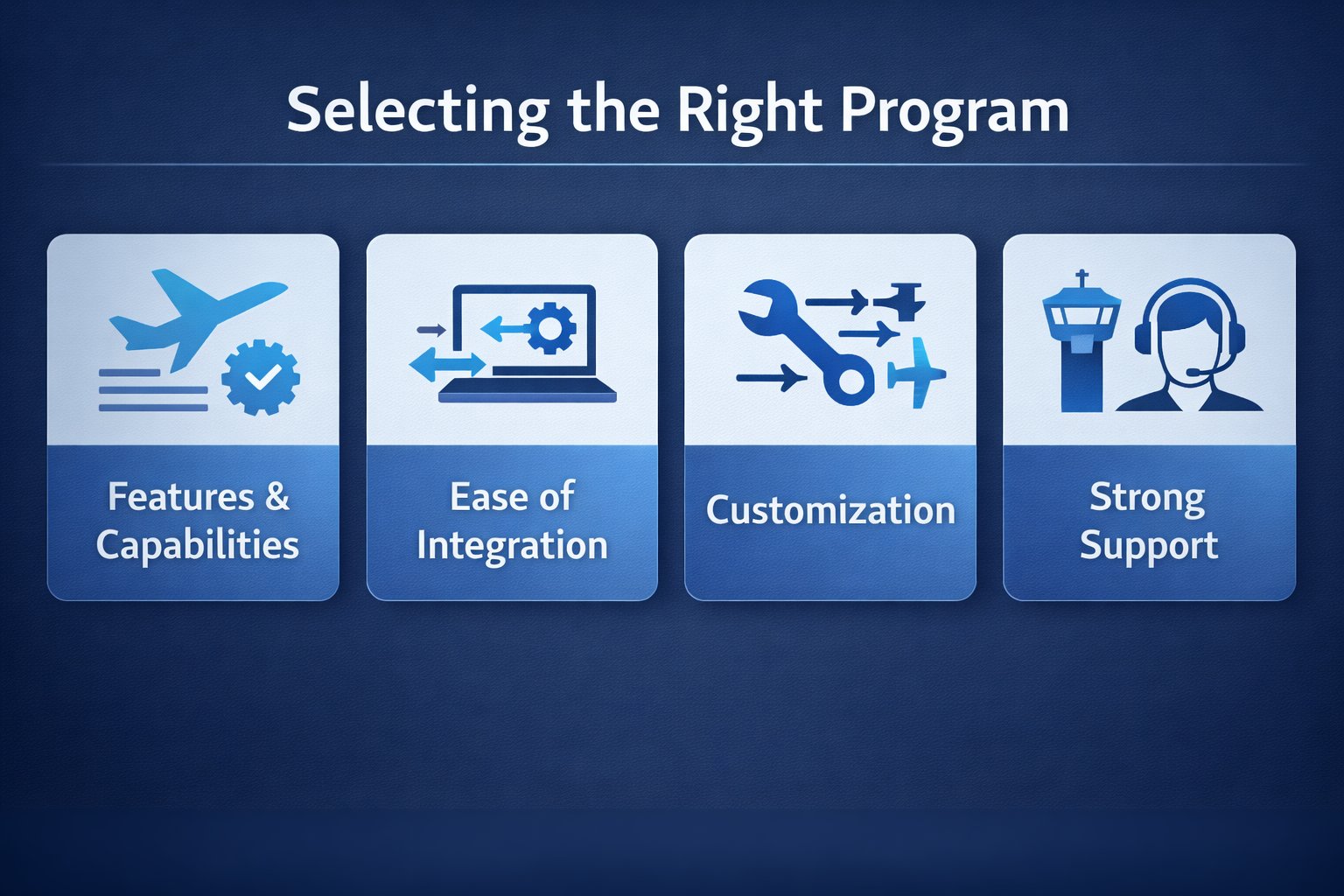
The most effective selection process starts with operational requirements, not feature checklists. A regional MRO specializing in turboprop aircraft needs fundamentally different capabilities than a widebody heavy maintenance provider. The selection framework that works best prioritizes four criteria:
Operational fit: Does the system align with your maintenance philosophy, line vs. heavy, predictive vs. scheduled, single-fleet vs. mixed?
Integration capability: Can it communicate with your existing ERP, inventory, flight operations, and finance systems? McKinsey’s MRO research emphasizes that more than 80% of operators identify data limitations as the most significant barrier to digital adoption, and disconnected systems are the primary cause.
Scalability: Does pricing and architecture support your three-year growth plan without requiring a platform change?
Vendor expertise: Is the provider financially stable with demonstrated aviation domain expertise? Purpose-built aviation platforms consistently outperform systems adapted from adjacent industries.
The Cloud-Native Shift: What It Means for Operators
The industry’s shift toward cloud deployment is now well-established. According to Mordor Intelligence, cloud-based solutions accounted for nearly 50% of aviation software revenue in 2024, with hybrid architectures growing at an 8.45% CAGR through 2030. The global aviation software market is projected to grow from $13.13 billion in 2025 to $18.12 billion by 2030.
For operators, cloud-native tracking programs deliver practical advantages: real-time multi-site collaboration, automatic regulatory updates, predictable subscription-based pricing, and enterprise-grade data security without dedicated IT infrastructure. For smaller operators and Part 145 repair stations, these capabilities were previously out of reach, cloud deployment has fundamentally changed the accessibility equation.
The talent implications are real as well. Airlines are increasingly evaluating maintenance partners on digital capability. Operators with modern, connected tracking systems have a measurable advantage in both winning contracts and attracting the next generation of maintenance professionals.

The Bottom Line: Tracking Programs as Strategic Investment
The technology has matured, the cost of entry has dropped, and the ROI case is well-documented. Aircraft maintenance tracking programs consistently deliver value through reduced compliance burden, improved asset utilization, lower inventory carrying costs, and decreased unscheduled downtime.
The operators who are leading in 2026 are the ones who recognized that the right tracking platform is not an IT expense, it is a strategic investment in operational capability, regulatory readiness, and competitive positioning.
Not sure which platform is right for your operation? Aero NextGen’s Solution Finder Quiz matches you with the right aviation software for your specific needs in under 2 minutes. Take the quiz and discover your ideal solution today.
Sources & References
McKinsey & Company (2024), “Aircraft MRO 2.0: The Digital Revolution”: 16% digital transformation success rate; 80%+ cite data limitations as top barrier to digital adoption
NBAA / AeroTechna Solutions (2026), Predictive maintenance delivers 35–40% reductions in unscheduled maintenance events; dispatch reliability improvements from 97.5% to 99.2%
Deloitte Aerospace & Defense Outlook, Predictive maintenance: 15% downtime reduction, 20% labor productivity increase
Applied Sciences / MDPI (2025), AFI KLM Prognos: maintenance delays reduced by up to 35% with predictive solutions
Boeing AOG Cost Estimates, $10,000 to $150,000 per hour depending on aircraft type and route
Boeing 2025 Pilot and Technician Outlook, 710,000 new maintenance technicians needed through 2044
Mordor Intelligence (2025), Aviation Software Market: $13.13B (2025) to $18.12B (2030); cloud solutions held 49.80% of revenue in 2024
EASA Part-IS, Information Security Regulations (EU) 2023/203 and 2022/1645, applicable October 2025 / February 2026
FAA-EASA Bilateral Safety Agreement, SMS requirement for EASA-approved U.S. repair stations from October 2025