
Touch-Time Is the Most Valuable Asset in MRO. Digital Documentation Is How You Reclaim It.

Aviation maintenance demand is at a record high, and the binding constraint is skilled technician hours.
The market exceeded $136 billion in 2025 and is projected to approach $140 billion this year, driven by an extended maintenance "super cycle". The supply of certified labor cannot expand at the same rate. That makes the productive use of each technician hour the single highest-leverage variable in the business — and the data is clear that a large share of those hours is currently spent on documentation, not on aircraft. Converting administrative time back into technical time is the most immediate capacity an MRO can add in 2026. Digital documentation is the proven mechanism for doing it. Consulting.us
The economics of technician hours
The workforce picture is well quantified. The 2025 ATEC/Oliver Wyman Pipeline Report finds the U.S. civil aviation maintenance workforce numbers more than 431,000 personnel, with demand outpacing supply by roughly 10% in certificated mechanics for 2025 even after the FAA issued more than 9,000 new certificates in 2024. The broader maintenance-workforce gap is forecast at 17,800 in 2025, widening to over 22,000 by 2027, and the average mechanic is now 54. Atec-amt + 3
Labor is also getting more expensive. Maintenance labor rates are settling into a persistent 5.5% to 6.0% annual growth rate — roughly double the pre-pandemic baseline of about 3%, and more than 40% of companies report rising direct-labor attrition over the past year. Every hour of skilled time therefore carries more value and more scarcity than it did three years ago. Consulting.usConsulting.us
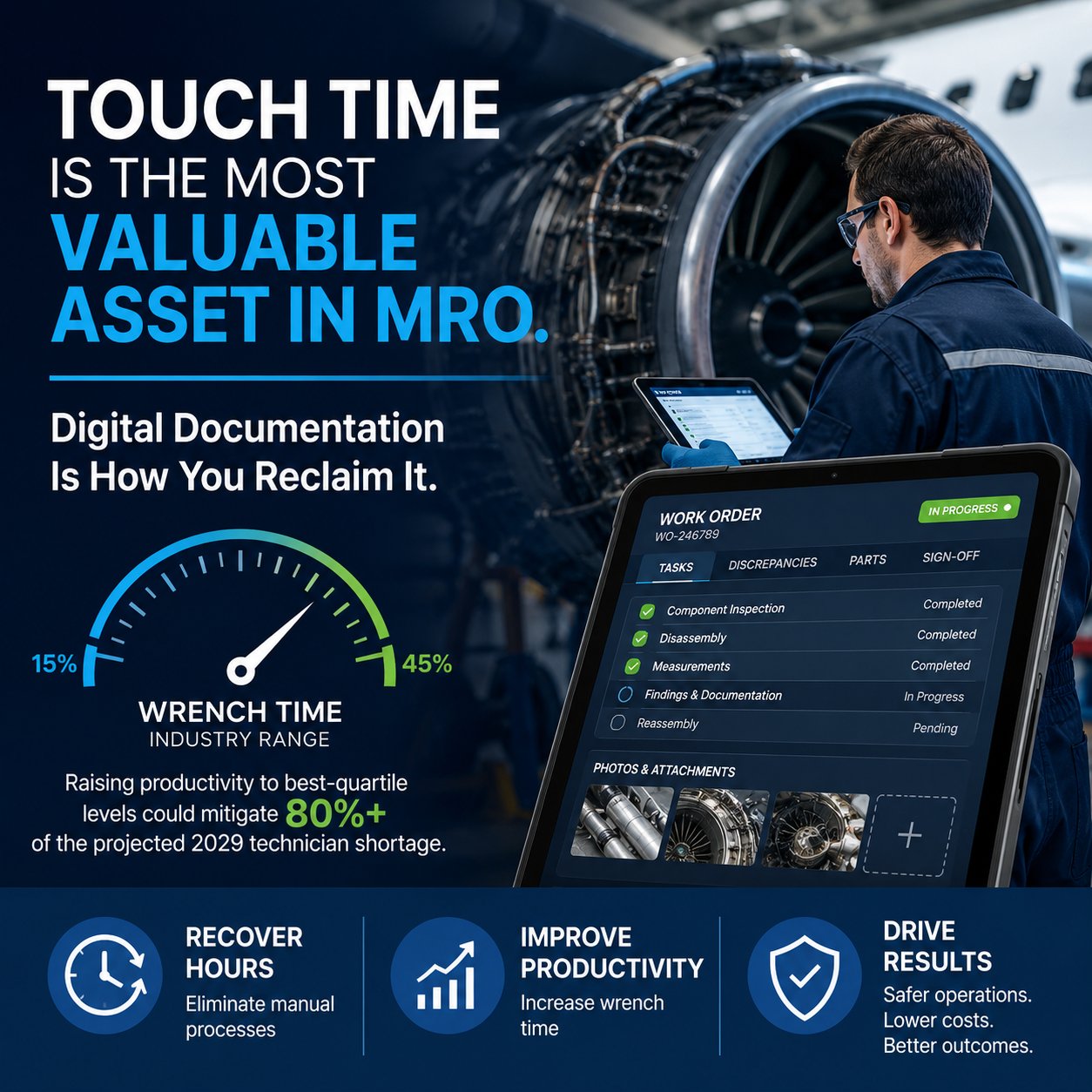
The decisive number is how those hours are spent today. McKinsey finds technician productivity — "wrench time," the share of hours spent on hands-on technical work — ranges between 15% and 45% across the industry. The variance is the opportunity: mckinsey
- Raising productivity to best-quartile levels could mitigate more than 80% of the projected 2029 technician shortage. mckinsey
- Improving fundamental operations alone can add ten percentage points or more of wrench time. mckinsey
- For context on the stakes, McKinsey projects the shortfall could reach roughly 60,000 technicians — about 20% below need — by 2029 at current trajectories. mckinsey
The conclusion follows directly: capacity gained by recovering existing hours is faster and lower-cost than capacity gained through recruitment alone.
Where recoverable hours sit: teardown, BOMs, and goods movement
Component and engine MRO workflows concentrate administrative time at predictable points. Teardown is one of the largest. After a technician evaluates a unit, a manual process begins: keying findings, task durations, and a first-time bill of materials off the component maintenance manual by hand. Shipping and receiving add more — manual ERP entry, weight and dimension capture, and photo documentation. These are exactly the operator pain points Aero NextGen catalogs in its proprietary library of 150+ MRO pain points: administrative burden and complex documentation, manual teardown report entry, manual BOM development, and manual data entry across goods-in and goods-out.
These tasks share three characteristics. They are performed by the highest-value, hardest-to-replace people. They are repeated on every induction. And they are structurally automatable. That combination is what makes documentation the clearest target for hour-recovery, and why the leading operators are addressing it first.
The evidence that digital documentation works
The performance data on digitization is specific and recent:
- One European engine MRO that moved to fully digital processes cut more than 25 hours per inspection cycle by eliminating paper-based processes and manual coordination. Veryon
- Digital work-order and CMMS systems typically recover 15–25% of total check duration that manual systems lose to administrative drag and turnaround-time creep. OXMaint
- Industry practitioners report that paperless systems enable real-time progress monitoring, faster documentation closure, and fewer administrative tasks, with measurable effects on turnaround time. Avitrader
The mechanism is straightforward. Data captured once, at the point of work, on a connected system does not need to be re-entered, reconciled, or chased. Status becomes visible without phone calls. Documentation closes in parallel with the work rather than after it. The recovered time returns to the technical task.

The regulatory and technology tailwinds are aligned
Adoption is no longer gated by regulation or tooling maturity. Regulators are actively enabling the shift: EASA is increasingly approving electronic technical logs and digital signatures, reducing technician administrative burden and removing lost-paperwork risk. On the technology side, the same connected-data foundation supports predictive maintenance, where sensor data is analyzed to anticipate component issues and schedule work before disruption occurs. Aviation TitansAviation Titans
Industry expectation reflects this maturity. Practitioners surveyed via AviTrader expect digital documentation to become standard practice across MRO within three to five years. The direction of travel is established; the open question for each operator is sequencing and selection, not whether to move. Avitrader
How forward-looking MROs are choosing
The operators converting this into advantage share a method. They start from a specific, named pain point rather than a generic "digital transformation" mandate. They quantify the hours at stake — teardown entry, BOM creation, status reporting — and they select a solution proven against that exact workflow, fleet type, and region. McKinsey frames the same logic at the portfolio level: productivity gains come from getting back to basics, improving planning, and applying the right tools, in that order. mckinsey
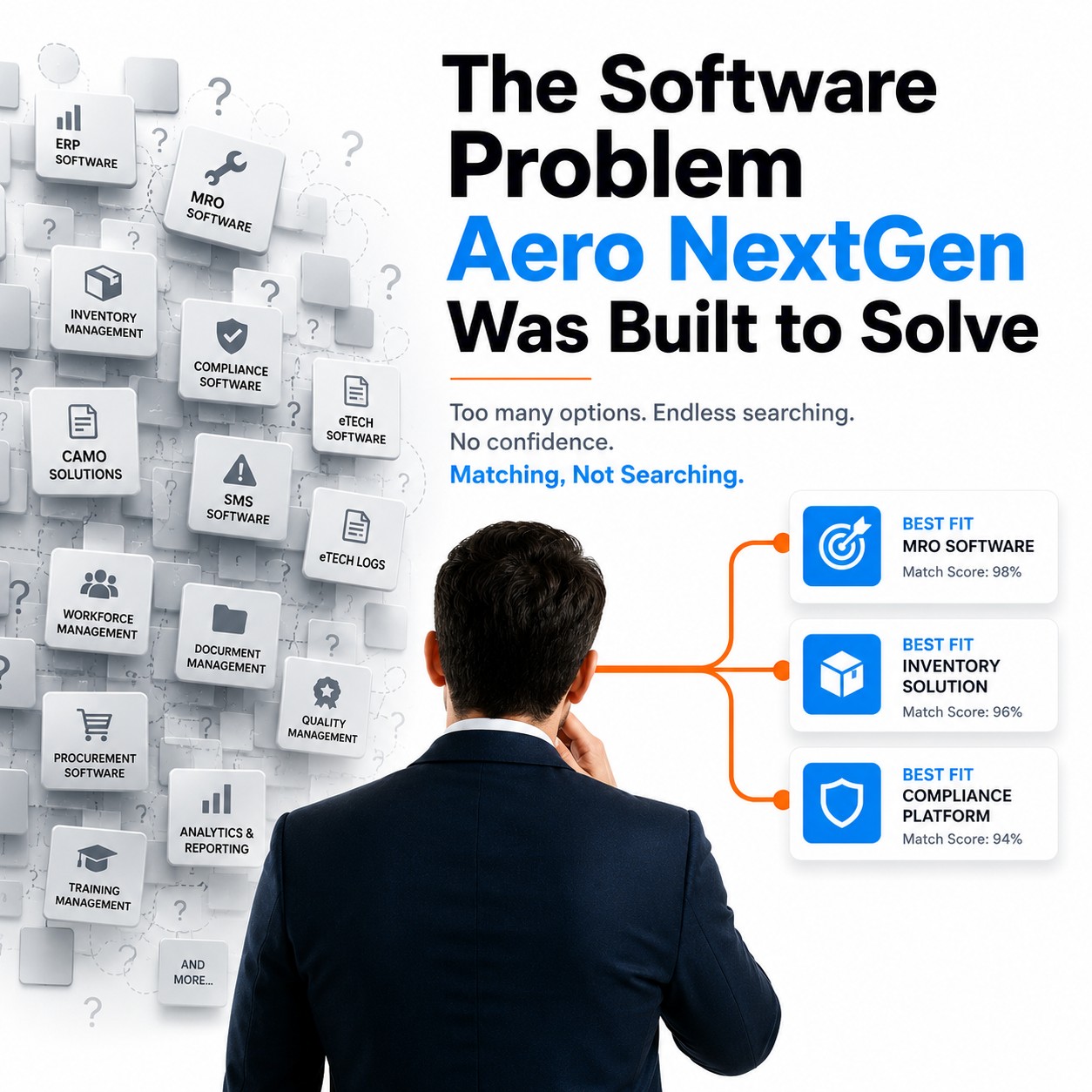
The constraint on this approach has never been the availability of technology. Certified, capable systems exist for every one of these workflows. The constraint is matching a specific operator problem to the right proven provider efficiently — without a multi-month evaluation cycle that itself consumes scarce hours.
The Aero NextGen take
Aviation MRO does not have a technology gap. It has a matching gap. The solutions that recover technician hours already exist and are already certified; the difficulty is identifying which provider fits a given operation's workflow, scale, and regulatory environment, and doing so quickly enough to matter. That is the problem Aero NextGen is built to solve — mapping each of the 150+ MRO pain points we track to a curated shortlist of vetted solution providers, so operators move from problem to proven solution without the evaluation overhead.
"The industry has spent years trying to hire its way out of a capacity constraint. The faster, more rational path is to return the hours our existing technicians already have to the work only they can do. That is what modern MRO software delivers, and it is the standard we hold every provider on our platform to." — Monica Badra, Founder & CEO, Aero NextGen
Browse vetted providers in the Aero NextGen marketplace, built specifically to connect aviation operators with the technology partners that fit their operation.
Find your fit in 3 minutes: Take the Aero NextGen Solution Finder Quiz and receive a custom shortlist of aviation and MRO software matched to your operation, size, and region.
.png)
Sources
- Oliver Wyman / consulting.us — 2025 MRO survey: market >$136B, super cycle, labor rates +5.5–6.0%, workforce deficit 17,800→22,000, attrition (link) — May 2026
- ATEC / Oliver Wyman 2025 Pipeline Report — 431,000 workforce, ~10% mechanic shortage, certificates issued (ATEC, AVweb) — Sept 2025
- McKinsey — Addressing the shortage of aviation maintenance technicians (wrench time 15–45%, 2029 outlook) (link)
- Veryon — engine MRO cut 25+ hours per inspection cycle going digital (link) — Nov 2025
- AviTrader / Vallair — paperless MRO becoming standard within 3–5 years (link) — Dec 2025
- Oxmaint — digital CMMS recovers 15–25% of check duration (link) — Mar 2026
- Aviation Titans — EASA approving electronic technical logs and digital signatures (link) — Feb 2026






.webp)





.png)

.png)
.png)


%20(1).png)








.png)













.jpeg)



.png)












Aviation Solutions, Find your Match
Run the survey to get a shortlist of the systems that match your operational needs – fast, simple, free.
Related Posts


.jpg)



%20(1).png)
%20(1).png)
.png)
%20(1)%20(1)%20(1).png)
.png)
.png)

%20(1).png)
.png)







%20(1)%20(1)%20(1)%20(1).png)
.png)
%20(1).png)
.png)
%20(1).png)
.png)
%20(1)%20(1).png)
.png)
.png)
.png)
%20(1)%20(1)%20(1)%20(1).png)
%20(1).webp)
.png)
.jpeg)
%20(1).webp)

.webp)
%20(1).webp)

Aero NextGen matched us to the right solution providers that helped us standardize the data in such a way that we can now put it to use. Aero Nextgen’s ability to quickly understand the business needs and translate them into tangible solutions was impressive.


Aero NextGen matched us to the right solution providers that helped us standardize the data in such a way that we can now put it to use. Aero Nextgen’s ability to quickly understand the business needs and translate them into tangible solutions was impressive.
Aero NextGen matched us to the right solution providers that helped us standardize the data in such a way that we can now put it to use. Aero Nextgen’s ability to quickly understand the business needs and translate them into tangible solutions was impressive.
We generate a tremendous amount of data. Aero NextGen matched us to the right solution providers that helped us standardize the data in such a way that we can now put it to use. Aero Nextgen's ability to quickly understand the business needs and translate them into tangible solutions was impressive.


Aero Next Gen quickly identified our challenges and matched us with the right ERP solution. Their expertise saved us time, and transformed our MRO operations.


My experience working with Aero NextGen is extremely positive. We setup a battery shop in the middle of Brexit in under 6 months with their help. Thoroughly professional. Attention to detail is second to none with innovative and creative ideas.
.png)

We have been struggling to performance manage our shopfloors for ages. Aero NextGen has connected us to solution providers that solved this for us within weeks. We are now capable of tracking capacity, productivity, utilization, and operational efficiency with instantaneously. The level of expertise has made the engagement seamless for our internal teams.


Straight to Your Inbox.
Subscribe to receive the latest trends on aviation software and services.