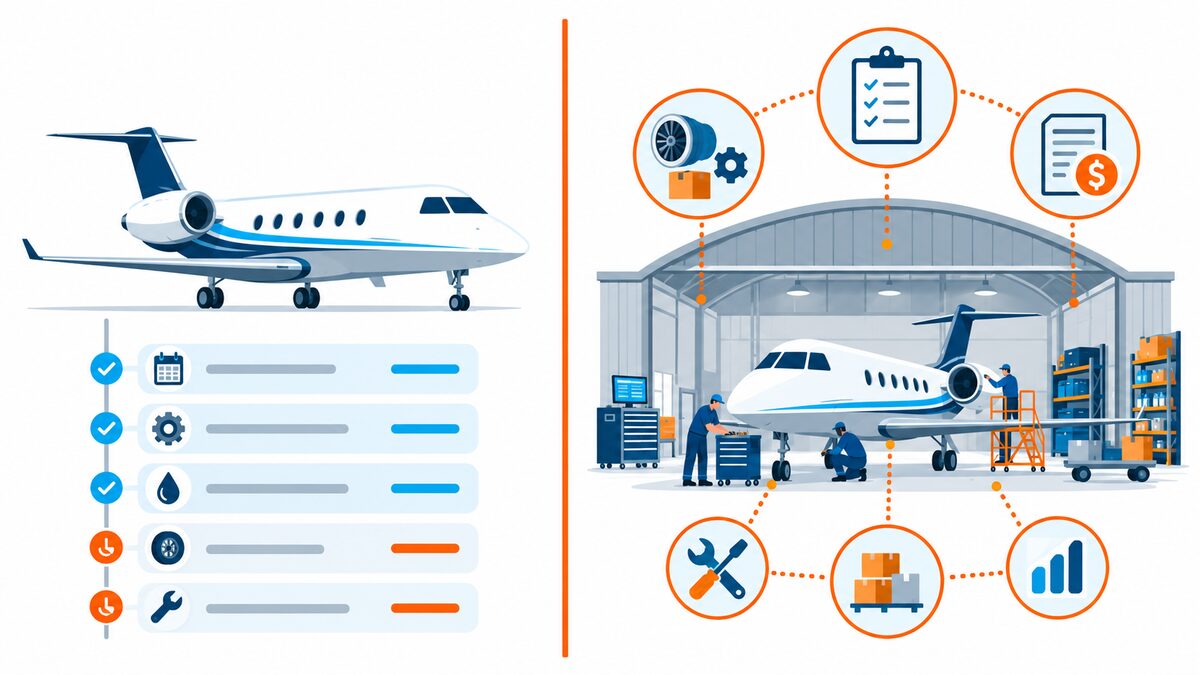
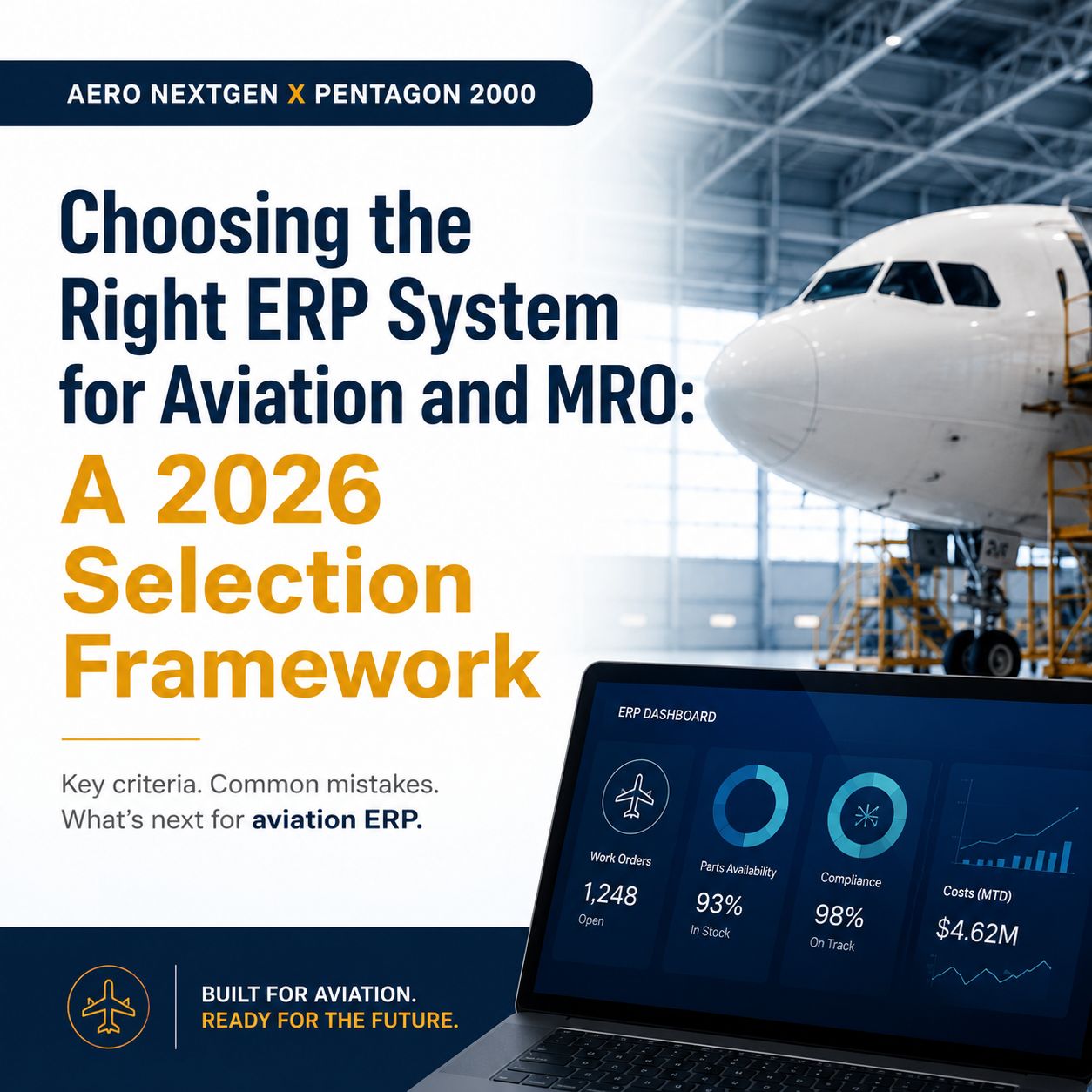
Aviation maintenance is in the middle of a demand super cycle, and the systems that run the shopfloor have become the constraint. The global MRO market is forecast to reach $156 billion by 2035, yet most operators still select aviation ERP software the way they did a decade ago. The result is predictable: budget overruns, stalled go-lives, and platforms that fight the technician value stream instead of serving it. The forward move is a structured, criteria-first selection that treats aviation-specific functionality, traceability, and integration as non-negotiable. This piece sets out the selection criteria that hold up, the mistakes that derail projects, and where aviation ERP is heading.
The stakes have changed: ERP selection is now an operating decision
The aviation aftermarket is running hotter than it has in years, and software is now the bottleneck, not the hangar. Three numbers frame the decision every MRO, airline, OEM, and lessor is facing in 2026:
- Oliver Wyman puts the MRO market at $119 billion in 2025, climbing to $156 billion by 2035 – a roughly 31% increase over the decade.
- A record 5.2 billion passengers flew in 2025 and global airline revenue passed $1 trillion, while aircraft production cannot keep pace with demand.
- North America alone is projected to be short 40,000 aviation mechanics by 2028, and engine MRO demand is growing at 7.5% on durability issues with next-generation engines.
When capacity is the constraint and skilled labor is scarce, the ERP an operator runs determines how much throughput it can pull from the people and the footprint it already has. A system that bends the workflow around its own limitations caps growth at exactly the moment the market is paying for output. ERP selection has moved from an IT line item to an operating decision.

Five criteria that actually separate aviation ERP systems
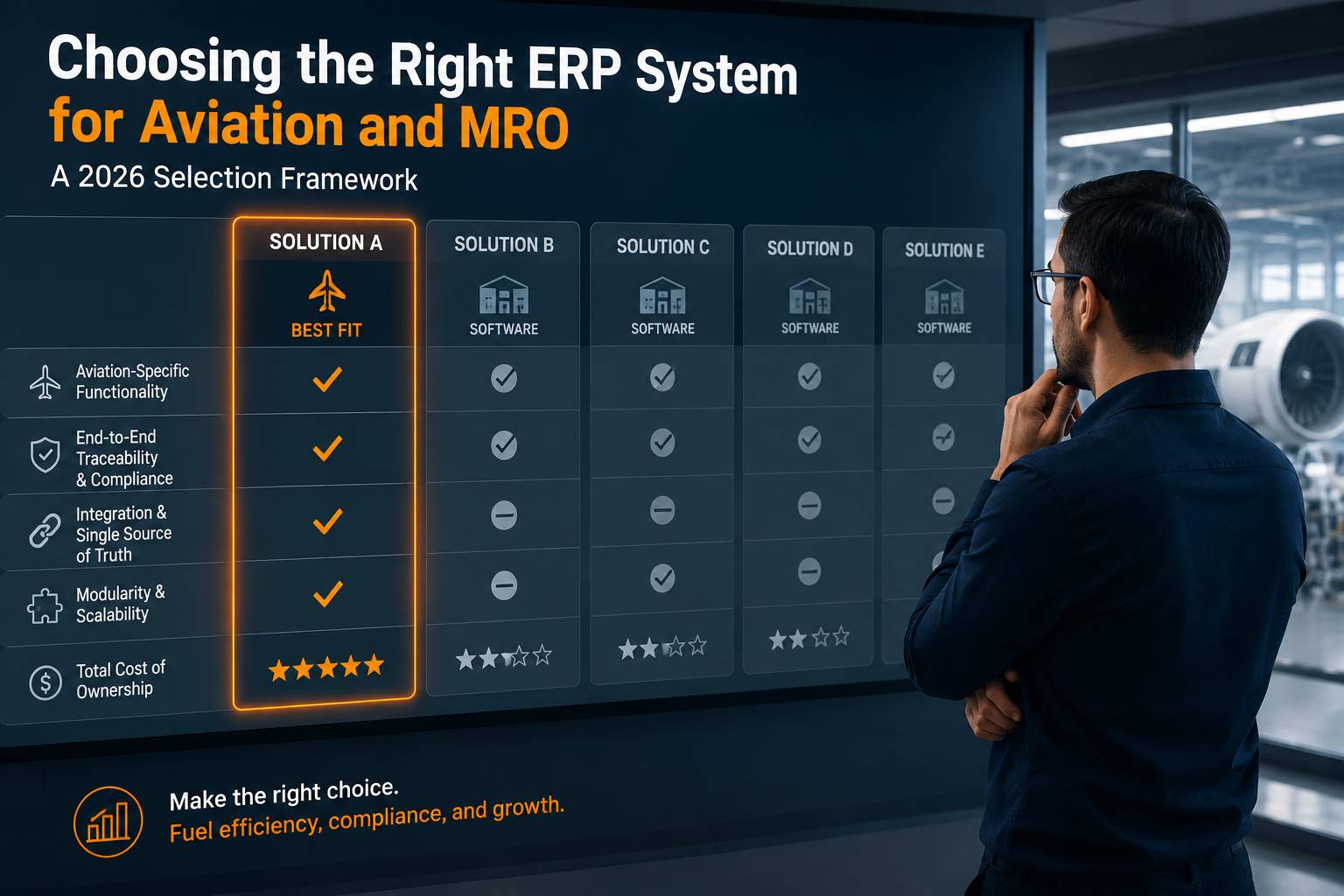
Generic enterprise software was not built for serialized parts, certifications, or airworthiness. Five criteria do most of the work in separating a fit from a near-miss:
- Aviation-specific functionality. The platform should carry MRO, distribution, manufacturing, and operator workflows natively – repair orders, component maintenance, teardown, CAMO – rather than retrofit them onto a generic ERP. Purpose-built systems such as Pentagon 2000 report that more than 90% of recent customers need little to no custom development, which is what keeps an implementation on schedule.
- End-to-end traceability and compliance. Full lifecycle tracking of parts, repairs, labor, certifications, and documents, mapped to FAA and EASA expectations and standards such as SOC-2 and GDPR. In aviation, traceability is not a feature – it is the license to operate.
- Integration and a single source of truth. The system has to connect to industry marketplaces, finance, and existing major ERPs such as SAP and Oracle, instead of creating one more silo. Disconnected systems are the most common reason MRO data cannot be trusted for decisions.
- Modularity and scalability. The ability to adopt only the modules a shop needs today and add capability as it grows, rather than paying for a monolith and using a fraction of it.
- Deployment model and total cost of ownership. On-premise, private cloud, or browser-based, with an implementation timeline measured in weeks to months and a transparent total cost of ownership – not a figure that surfaces only after signing.
The mistakes that derail aviation ERP projects
Most failed implementations are decided during selection, not deployment. The recurring errors are well documented:
- Buying on the demo, not the fit. A polished demo is not evidence the platform handles your part numbers, your certifications, or your volume.
- Underestimating data migration. Fragmented, low-quality records are the single most common reason go-lives slip. We covered this in depth in data migration in aviation MRO.
- Ignoring change management. Panorama Consulting’s 2026 research found that more than a quarter of organizations exceeded their ERP project budgets, with additional, unplanned technology needs the leading cause.
- Over-customizing. Every custom line of code is a future upgrade liability. Configuring within the application standard keeps a system upgradeable and lowers lifetime cost.
- Treating ERP as an IT-only project. ERP shapes the technician’s day. If the shopfloor is not represented in the selection, the workflow ends up bent around the software instead of the other way round.
Where aviation ERP is heading: automation and the single source of truth
The next phase of aviation ERP is automation applied to the highest-volume, lowest-value tasks. The direction of travel is clear:
- AI-assisted RFQ-to-quote and smart pricing are moving from pilots to production. Pentagon 2000 now runs email-to-quote processing and high-volume quoting to cut manual sales and procurement work.
- Business intelligence is the most-deployed digital initiative in Panorama’s latest study, at 55.3% of organizations, as operators move to forecast demand, cost, and capacity in near real time.
- The destination is a single source of truth across maintenance, supply chain, and finance – achievable only on a platform built to integrate rather than to wall off data.
IN PARTNERSHIP WITH PENTAGON 2000
Pentagon 2000 has built aviation ERP for more than 40 years. Its modular platform spans more than 100 modules and serves over 1,000 organizations across commercial aviation, defense, business and general aviation, helicopter, and UAM. The design choices map directly to the criteria above: aerospace-dedicated workflows, full traceability, flexible hosting, and integrations with marketplaces and major ERP systems.
“After going through ERP selection with hundreds of aviation companies, the pattern is always the same. The projects that work start from one question: does the system already fit how you work, or are you paying to make it fit later? In aviation, parts, repairs, certifications, and finance all move together, and the team should be focused on the business, not on the software. The right ERP is the one that already fits how a company works, not the one that promises to fit after enough custom development.
– Guy Danon, Global Head of Sales & Marketing
The Aero NextGen take
The operators that win the super cycle will not be the ones that buy the biggest system. They will be the ones that match the right system to their actual workflow before they commit. Aero NextGen exists to make that match precise: 150+ documented MRO pain points mapped to a vetted set of solution providers, so the selection starts from the problem and ends at a proven fit.
“ERP is no longer a back-office purchase. It is the operating system of an MRO, and the selection decision determines whether a shop scales or stalls. We match the operator’s specific requirements to a proven, vetted system before a dollar is committed.”
– Monica Badra, Founder & CEO, Aero NextGen
Find your fit in 3 minutes: complete the Solution Finder quiz. Answer a short set of questions and get matched to the providers built for your operation.
Hear more from Guy Danon on aviation ERP selection in our upcoming podcast episode with Pentagon 2000, available soon on the Aero NextGen Podcasts page.
Sources
- Oliver Wyman, Global Fleet and MRO Market Forecast 2025-2035 (Feb 2025) – www.oliverwyman.com/our-expertise/insights/2025/feb/global-fleet-and-mro-market-forecast-2025-2035.html
- Oliver Wyman press release, fleet and MRO forecast – 40,000 mechanic shortfall, engine MRO 7.5% (Feb 2025) – www.oliverwyman.com/media-center/2025/feb/oliver-wyman-fleet-forecast-shows-aircraft-order-backlog-breaks-record-at-17000.html
- Oliver Wyman, Global Fleet and MRO Market Forecast 2026-2036 – 5.2B passengers, $1T revenue (Feb 2026) – www.oliverwyman.com/our-expertise/insights/2026/feb/global-fleet-and-mro-market-forecast-2026-2036.html
- Panorama Consulting Group, study of ERP implementation outcomes – budget overruns, BI 55.3% (Mar 2026) – www.panorama-consulting.com/panorama-consulting-group-releases-latest-study-of-erp-implementation-outcomes-across-the-globe/
- Pentagon 2000 – Aero NextGen vendor page – www.aero-nextgen.com/vendors/pentagon-2000