
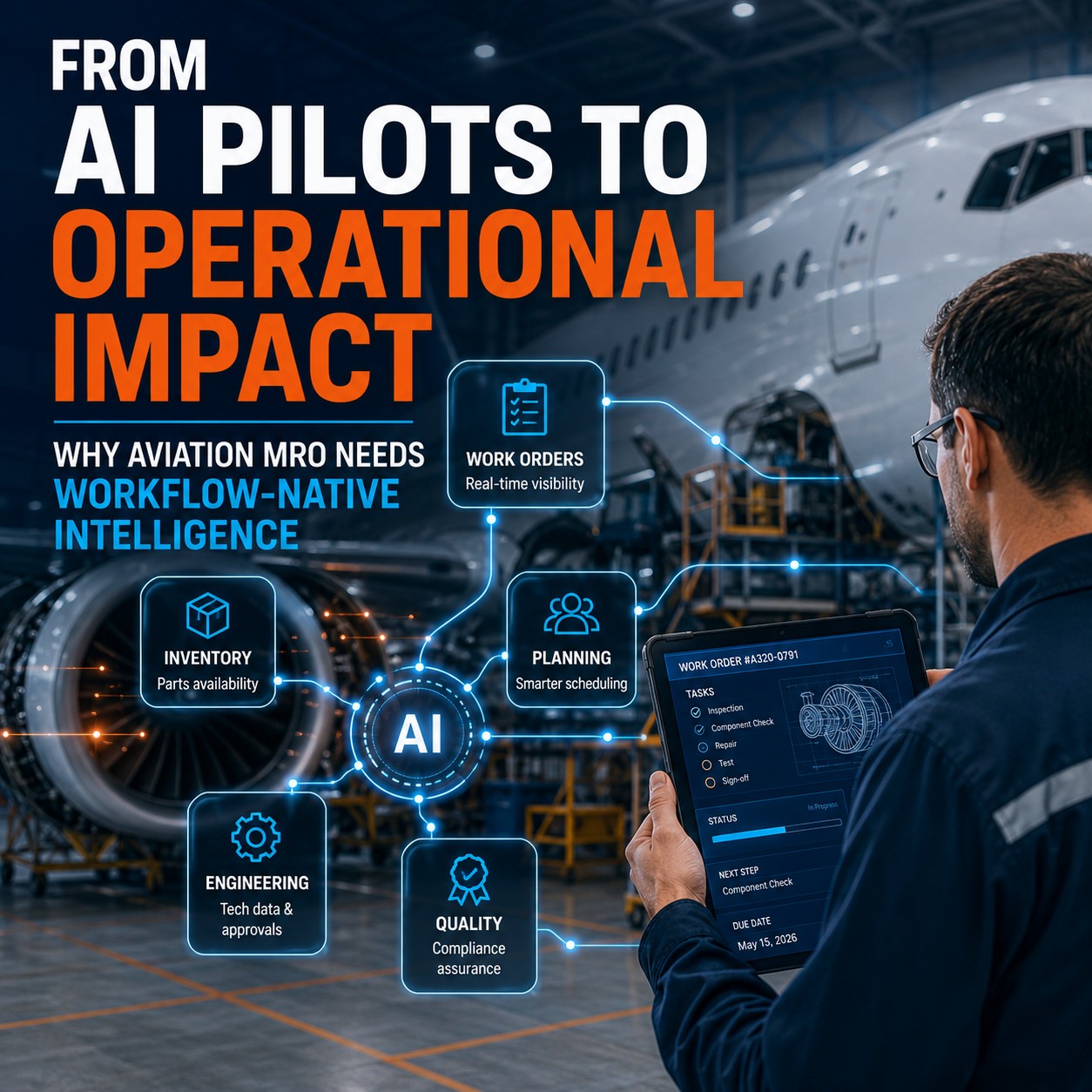
From AI Pilots to Operational Impact: Why Aviation MRO Needs Workflow-Native Intelligence

Aviation AI is moving from experimentation to execution, and the constraint has changed.
The models are ready. The gap is integration. MIT's 2025 research found that 95% of enterprise AI pilots deliver no measurable impact - not because the models are weak, but because they sit outside the workflows teams actually use. The next advantage in aviation MRO will not be defined by the sophistication of the model. It will be defined by how well intelligence is embedded into the daily decisions of maintenance, parts, operations, and service teams. This piece sets out why workflow-native, aviation-grounded AI is the difference between a pilot and an operational result.
AI in aviation is shifting from experimentation to execution
The industry is finally seeing value from AI, but scaling it remains the hard part. Two forces are pushing operators from experiments to execution:
- The aftermarket is in a demand super cycle. Oliver Wyman forecasts the MRO market climbing to $156 billion by 2035, with a record 5.2 billion passengers in 2025 and global airline revenue past $1 trillion, while North America alone is projected to be short 40,000 aviation mechanics by 2028. More work, fewer hands, and no room to run teams the way they ran a decade ago.
- Most AI still does not scale. MIT's State of AI in Business 2025 study, based on 300 deployments and more than 150 executive interviews, found roughly 95% of enterprise AI pilots produce no measurable return. The cause is not model quality. It is the learning gap: tools that do not connect to, or learn from, real workflows stall the moment they meet operational reality.
That same research found a clear pattern in what works. Solutions delivered through specialized partners and integrated into existing systems succeed at roughly twice the rate of internal, standalone builds. For aviation operators facing legacy systems and change-management barriers, the lesson is direct: AI adoption is an integration problem before it is a technology problem.
The next advantage is workflow-native AI
AI creates value when it lives inside the systems teams already run, not beside them. Workflow-native intelligence supports maintenance planning, technician decisions, quoting, inventory, analytics, and customer communication at the point of the decision, inside the ERP and the record of work - not in a separate app that someone has to remember to open.
This is already in production. CAMP Aviate's CORRIDOR AI Operations Manager, launched with West Star Aviation as the exclusive partner, applies predictive intelligence inside the maintenance workflow to plan visits more accurately, provision labor, and reduce unexpected issues during projects. The intelligence sits where the work happens, which is exactly where MIT found the surviving 5% of AI deployments live.
The distinction matters because AI bolted on top of a fragmented stack becomes one more silo. Embedded in the operating system of the business, it influences the decision while there is still time to change the outcome. That is the difference between a dashboard that reports the past and intelligence that shapes the next repair, the next quote, and the next planning cycle.

Aviation AI must be grounded in aviation context
Generic AI is not enough for an environment shaped by maintenance history, parts complexity, regulation, labor limits, and turnaround pressure. An aviation shopfloor runs on serialized parts, certifications, task cards, and FAA and EASA requirements. A general-purpose model has none of that context, which is why generic tools stall in regulated operations even when they impress in a demo.
The learning gap is usually a data gap. AI trained on fragmented, inconsistent records produces output teams cannot trust, and the time spent verifying it erases the time it was meant to save. This is where an aviation-native foundation matters. CAMP Aviate reports its foundation approach cuts manual data entry by up to 40% and holds data consistency at 100% across multi-site operations - the clean, connected base that intelligence needs to be reliable rather than plausible.
Aviation-grounded AI also respects how the industry actually adopts technology. It keeps data secure and in context, and it augments the expert rather than replacing the judgment that keeps aircraft airworthy. The goal is intelligence that a technician, planner, or CSM can act on with confidence, because it speaks the language of the work.
The real measure of AI is organizational evolution
The goal is not to deploy AI for its own sake. It is throughput, decision quality, customer experience, and resilience, achieved without overwhelming the team. That reframes the entire adoption question. Success is not the number of pilots launched. It is whether the organization runs measurably better a quarter later.
Phased adoption is how operators get there without betting the business. Rather than an all-or-nothing migration, a platform like CAMP Aviate lets an operator deploy AI and workflow capabilities alongside existing systems first, prove the value, then move to the full Aviate ERP. This protects prior technology investment and gives teams an on-ramp instead of a cliff - the difference between an operator that pulls ahead and one that stalls waiting for a perfect moment that never comes.
The risk of waiting is a two-speed industry: operators who embed intelligence into daily execution compound their advantage, while those still running isolated pilots fall further behind. The models are no longer the differentiator. Execution is.

In Partnership with Camp Aviate
CAMP Aviate, part of CAMP Systems, is the next generation of Quantum, CORRIDOR, TotalFBO, and FBO One, unified into a single aviation-native platform. It brings maintenance, inventory, finance, and flight operations together, with AI built into planning, execution, and analytics rather than added on top. The portfolio serves more than 2,000 customers and 500,000 users across 70 countries, and is designed to help operators modernize at their own pace.
“AI only creates value when it lives inside the workflow. Aviation teams do not need one more tool to check; they need intelligence at the decision point, grounded in aviation data, that helps them plan, quote, and execute better every day. That is what we built Aviate to do.”
- Peter Velikin, General Manager, CAMP Aviate ERP Solutions
The Aero NextGen take
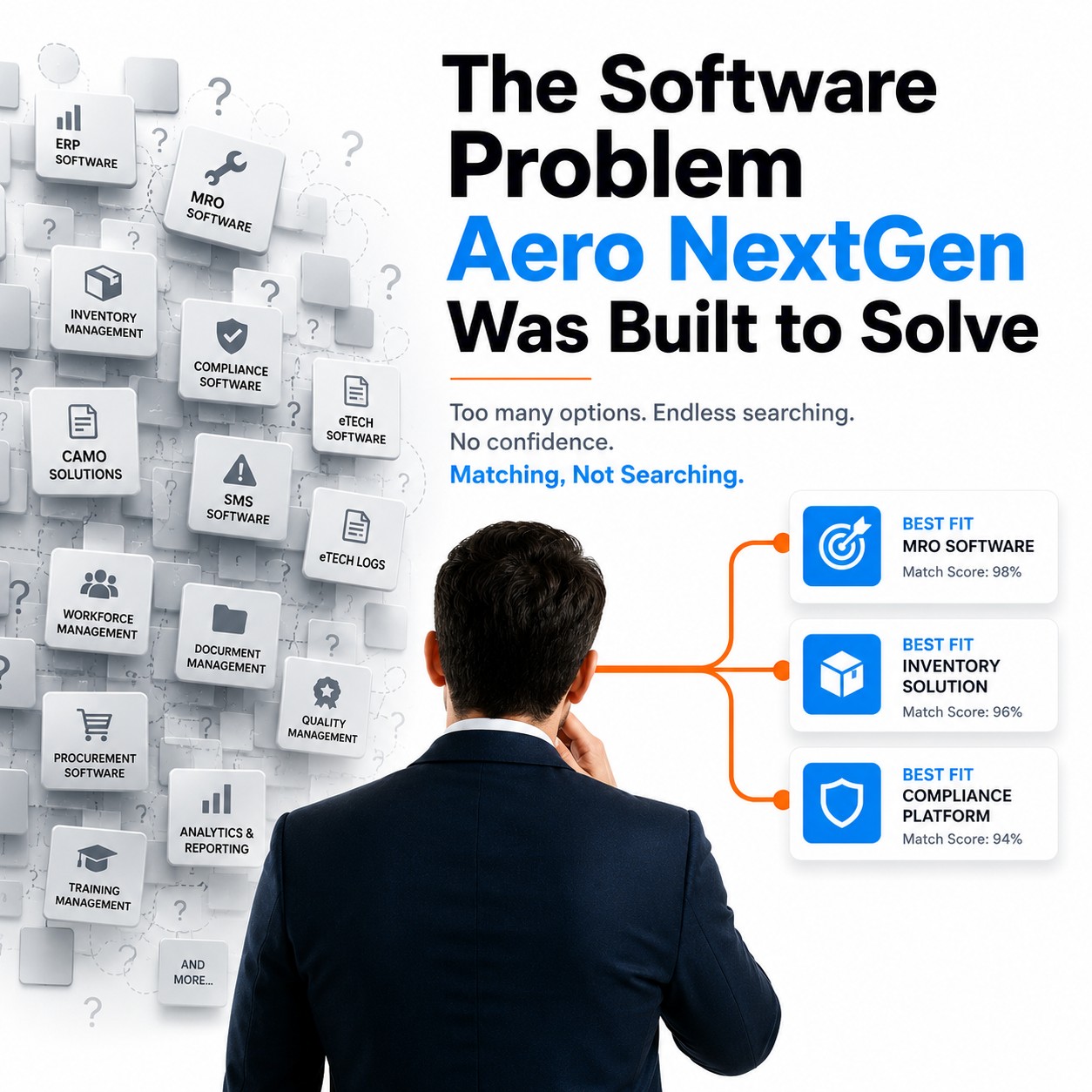
The operators who win this phase will not be the ones with the most advanced model. They will be the ones who embed intelligence into the systems their teams already run, grounded in aviation context, and hold it to operational outcomes. That is a matching problem: the right AI-enabled platform, mapped to the operator's real workflow and constraints. Aero NextGen exists to make that match precise, connecting 150+ documented MRO pain points to vetted, aviation-native providers so intelligence lands where the work is.
“AI stopped being the hard part. Integration is. The operators who win will embed intelligence into the systems their teams already run, grounded in aviation context, and measure it by throughput and decision quality - not by how many pilots they launched. That is the match we make.”
- Monica Badra, Founder & CEO, Aero NextGen
Find your fit in 3 minutes: complete the Solution Finder quiz. Answer a short set of questions and get matched to the aviation-native, AI-enabled providers built for your operation.

Sources
- MIT NANDA, The GenAI Divide: State of AI in Business 2025 - ~95% of enterprise AI pilots show no measurable impact (reported Aug 2025) - fortune.com/2025/08/18/mit-report-95-percent-generative-ai-pilots-at-companies-failing-cfo/
- Oliver Wyman, Global Fleet and MRO Market Forecast 2025-2035 - MRO to $156B by 2035; 40,000 mechanic shortfall by 2028 (Feb 2025) - www.oliverwyman.com/our-expertise/insights/2025/feb/global-fleet-and-mro-market-forecast-2025-2035.html
- Oliver Wyman, Global Fleet and MRO Market Forecast 2026-2036 - 5.2B passengers, $1T airline revenue in 2025 (Feb 2026) - www.oliverwyman.com/our-expertise/insights/2026/feb/global-fleet-and-mro-market-forecast-2026-2036.html
- CORRIDOR (a CAMP Systems product line) launches AI Operations Manager with West Star Aviation (Oct 2025) - aijourn.com/corridor-launches-ai-operations-manager-with-west-star-aviation/
- CAMP Aviate - Aero NextGen vendor page - www.aero-nextgen.com/vendors/camp-aviate







.webp)





.png)

.png)
.png)


%20(1).png)








.png)













.jpeg)



.png)













Aviation Solutions, Find your Match
Run the survey to get a shortlist of the systems that match your operational needs – fast, simple, free.
Related Posts

.jpg)


%20(1).png)
%20(1).png)
.png)
%20(1)%20(1)%20(1).png)
.png)
.png)

%20(1).png)
.png)






%20(1)%20(1)%20(1)%20(1).png)
.png)
%20(1).png)
.png)
%20(1).png)
.png)
%20(1)%20(1).png)
.png)
.png)
.png)
%20(1)%20(1)%20(1)%20(1).png)
%20(1).webp)
.png)
.jpeg)
%20(1).webp)

.webp)
%20(1).webp)

Aero NextGen matched us to the right solution providers that helped us standardize the data in such a way that we can now put it to use. Aero Nextgen’s ability to quickly understand the business needs and translate them into tangible solutions was impressive.


Aero NextGen matched us to the right solution providers that helped us standardize the data in such a way that we can now put it to use. Aero Nextgen’s ability to quickly understand the business needs and translate them into tangible solutions was impressive.
Aero NextGen matched us to the right solution providers that helped us standardize the data in such a way that we can now put it to use. Aero Nextgen’s ability to quickly understand the business needs and translate them into tangible solutions was impressive.
We generate a tremendous amount of data. Aero NextGen matched us to the right solution providers that helped us standardize the data in such a way that we can now put it to use. Aero Nextgen's ability to quickly understand the business needs and translate them into tangible solutions was impressive.


Aero Next Gen quickly identified our challenges and matched us with the right ERP solution. Their expertise saved us time, and transformed our MRO operations.


My experience working with Aero NextGen is extremely positive. We setup a battery shop in the middle of Brexit in under 6 months with their help. Thoroughly professional. Attention to detail is second to none with innovative and creative ideas.
.png)

We have been struggling to performance manage our shopfloors for ages. Aero NextGen has connected us to solution providers that solved this for us within weeks. We are now capable of tracking capacity, productivity, utilization, and operational efficiency with instantaneously. The level of expertise has made the engagement seamless for our internal teams.


Straight to Your Inbox.
Subscribe to receive the latest trends on aviation software and services.