

The Five Execution Imperatives for MRO Leaders: What Record Order Books Mean for the Aftermarket's Execution Gap

Farnborough roducedproduced record order numbers last week. The number that matters is how long they take to clear. About 17,000 unfilled aircraft orders sat on the books at the start of 2026, a backlog Oliver Wyman expects to take more than 12 years to work through at current production rates. That is not a manufacturing story. It is an aftermarket story. Fleets fly longer, shop visits stack up, and the constraint moves from planning to execution. This piece sets out five execution imperatives for MRO leaders operating in that gap.
The order book is not the constraint. Execution is.
Record demand has arrived. The capacity to deliver against it has not. The structural picture heading into Farnborough is consistent across sources:
- More than 5,300 aircraft deliveries are missing against pre-pandemic production trends, average fleet age has risen to 15.1 years, and over 5,000 aircraft remain in storage.
- Turnaround times for newer-generation engines have increased by roughly 150% compared with pre-pandemic norms.
- North America alone is projected to be short 40,000 aviation mechanics by 2028, and engine MRO demand is growing at 7.5% on durability issues driving earlier shop visits.
- Bain's review of 15 major aerospace programmes found 87% cite supplier bottlenecks as the chief obstacle to clearing record backlogs, and describes the gap as structural rather than temporary.
The operational consequence is specific. Older aircraft staying in service means more inspections, more structural and corrosion work, more component and landing gear overhauls, and more engine shop visits, all landing on shops that cannot simply hire their way out. Bain's conclusion is that digital forecasting and predictive analytics now represent the largest available source of competitive advantage. Airbus offers the proof point: its Skywise platform is credited with cutting A350 delivery lead times by 33% through faster resolution of quality issues across the supply chain.
This is why the framing at Farnborough has shifted. As Aviation Business News put it in its show preview, the operators best placed for the next two years will be those that master asset use and lock in their maintenance pipelines, rather than those chasing headline order totals.

The five execution imperatives
Every imperative below targets the same failure mode: the distance between the Turnaround plan and what actually happens on the floor.
- Anticipate constraints before they become delays, starting before induction. An unexpected finding, a long-lead part slip, or a capacity bottleneck can stall a module quietly. The cost is not the blocker; it is the days between the blocker appearing and the team seeing it. The best operators assess feasibility before a unit is inducted — can material, capacity, and certifications support the target turnaround time — and make material readiness the gate. Kitting a work package before coverage is confirmed converts a supply problem into a WIP problem.
- Coordinate across functions — and across enterprise boundaries. Complexity does not break MRO operations. Fragmented execution does. When four teams see the same disruption at different times through different systems, the misalignment is the delay. The coordination surface no longer stops at the shop door: OEMs, repair vendors, and customer representatives each hold a piece of the critical path.
- Prioritize based on impact. Turnaround time is a system outcome. When each function owns a slice, no one owns the result. Not every disruption deserves a response: focus recovery on the constraints that actually move throughput, turnaround time, and revenue at risk — against the current state of the operation, not a static plan.
- Simulate before committing. A single shortage can have a dozen resolution paths: alternate parts, used serviceable material, rotable exchange, DER repair, scope deferral. Modeling the impact of each before acting turns recovery from firefighting into structured, defensible trade-offs.
- Accelerate recovery with intelligent automation — and measure execution, not plans. No team can manually evaluate hundreds of concurrent constraints at the speed the operation demands. Domain-specific agents monitor execution continuously and surface ranked recovery options — humans make the call. Then hold the organization to execution metrics: on-time delivery, throughput per bay, schedule adherence. Plan accuracy only tells you whether the planners are optimistic.
None of these require replacing the ERP. They require a layer that connects what the ERP holds to what the floor is actually doing, and puts the two in front of the same people at the same time.

What record order books actually mean for the aftermarket
A decade-plus backlog transfers the pressure from the factory to the hangar. Boeing's backlog alone represents roughly 10.2 years of production at projected rates. Airlines waiting that long keep flying what they have, which makes every existing asset more valuable and every day of unplanned downtime more expensive.
That changes the commercial position of the MRO. Capacity is scarce, so the shops that deliver predictably will command the pipeline and the pricing. Reliability of turnaround becomes the differentiator, ahead of capability breadth. The operators that treat execution as a discipline over the next 24 months will capture disproportionate share of a market Oliver Wyman expects to keep expanding through 2036, while those running on spreadsheets and status meetings absorb the volatility as margin.
IN PARTNERSHIP WITH PELICO
Pelico is an orchestration platform for real-time execution across complex MRO networks. Founded in 2019 with operations in France, the United States, and Singapore, it is used by AFI KLM E&M, Safran, Airbus, Air France-KLM, and Eaton to anticipate blockers, simulate action plans, and align execution across supply chain and production.
The design maps directly to the imperatives above. Pelico builds a single operational picture across ERP, planning, inspection, supplier portals, and the shop floor, and it understands serialized assemblies, alternates, and supersessions well enough to trace a delay to its downstream impact. Part shortages, inspection holds, scope changes, supplier delays, and capacity constraints surface as they emerge, with recommended recovery options and AI agents that can automate defined steps while humans stay in the loop. Typical implementation runs about 12 weeks.
Results Pelico reports from past MRO shop deployments:

“Record order books do not fix the aftermarket. They expose it. The shops that win the next decade will be the ones that close the gap between the turnaround plan and what actually happens on the floor, every day, under constant change.”
- Marc Riviere, Head of Industry Aerospace & Defense, Pelico
The Aero NextGen take
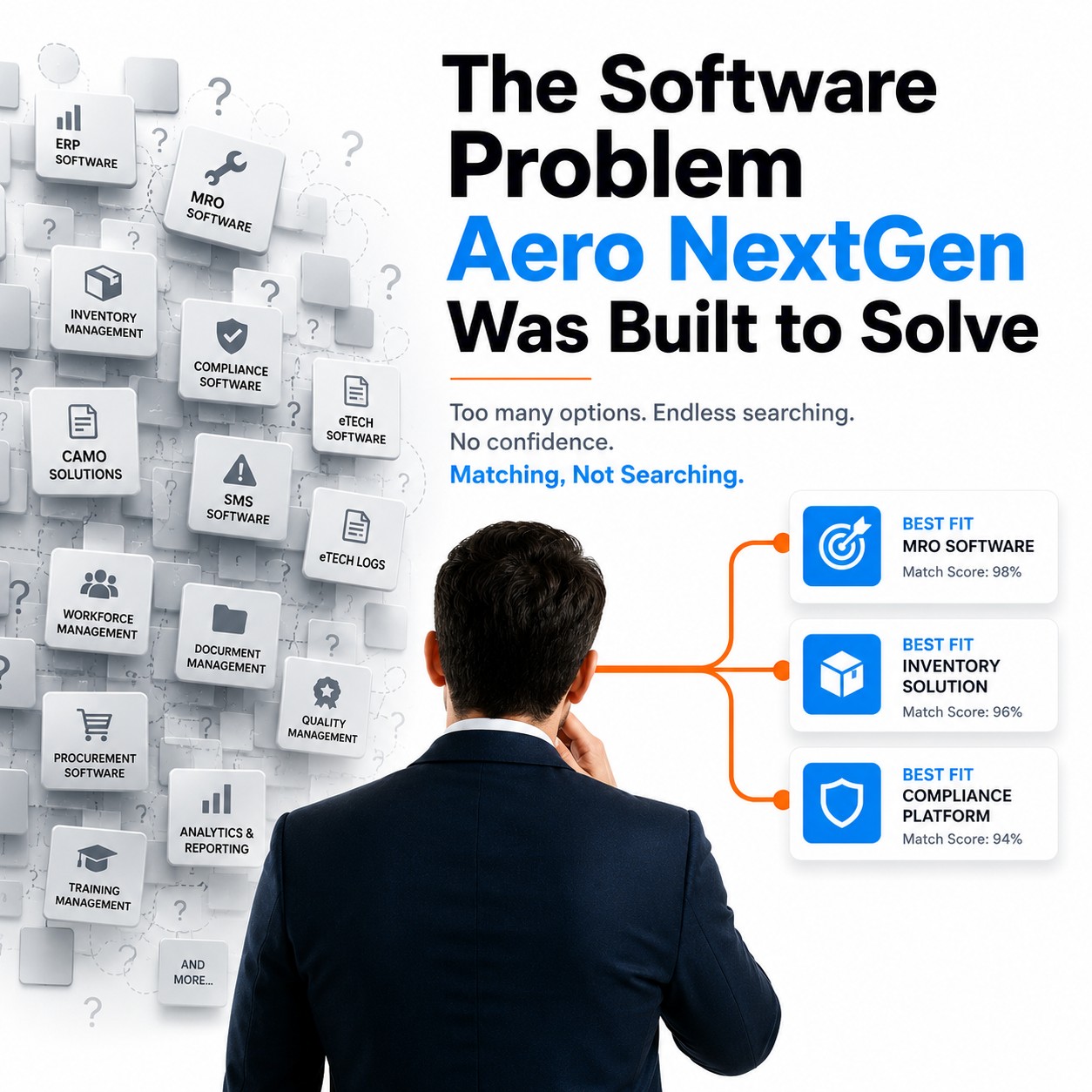
Farnborough was loud about orders. The quieter question is which shops can actually deliver against them. Execution is not a software purchase; it is a discipline that the right system makes possible and the wrong system makes impossible. Aero NextGen maps 150+ documented MRO pain points to vetted providers so operators start from the constraint that is actually costing them days, rather than from a vendor shortlist.
“The order book is the easy headline. The execution gap is the real story, and it is where margin is won or lost. Operators should walk out of Farnborough asking one question: what is stopping a unit from moving today, and would we even know?”
- Monica Badra, Founder & CEO, Aero NextGen
Find your fit in 3 minutes: complete the Solution Finder quiz. Answer a short set of questions and get matched to the providers built for your operation.
Sources
- Oliver Wyman, Global Fleet and MRO Market Forecast 2026-2036 - ~17,000 order backlog, 12+ years to clear (Feb 2026) - www.oliverwyman.com/our-expertise/insights/2026/feb/global-fleet-and-mro-market-forecast-2026-2036.html
- Oliver Wyman, Global Fleet and MRO Market Forecast 2025-2035 - 40,000 mechanic shortfall by 2028; engine MRO +7.5% (Feb 2025) - www.oliverwyman.com/media-center/2025/feb/oliver-wyman-fleet-forecast-shows-aircraft-order-backlog-breaks-record-at-17000.html
- Aerotime - 5,300+ missing deliveries, fleet age 15.1 years, engine TAT up ~150% vs pre-pandemic (May 2026) - www.aerotime.aero/articles/aviation-supply-chain-crisis-aircraft-delays
- Aviation Business News - Bain analysis: 87% of programmes cite supplier bottlenecks; Skywise cut A350 lead times 33% (July 2026) - www.aviationbusinessnews.com/mro/aircraft-delivery-delays/
- Aviation Business News - Farnborough preview: execution, not order books, will decide the show (July 2026) - www.aviationbusinessnews.com/low-cost/farnborough-international-airshow-execution-will-decide-show
- MRO Business Today - Boeing backlog ~10.2 years of production; implications for aftermarket demand (July 2026) - mrobusinesstoday.com/airbus-extends-delivery-lead-as-boeing-gains-sales-momentum-in-june-2026/
- Pelico - MRO operations platform, reported deployment results and capabilities - www.pelico.ai/industry/mro
- Pelico - Aero NextGen vendor page - www.aero-nextgen.com/vendors/pelico








.webp)





.png)

.png)
.png)


%20(1).png)









.png)















.jpeg)



.png)













Aviation Solutions, Find your Match
Run the survey to get a shortlist of the systems that match your operational needs – fast, simple, free.
Related Posts





.jpg)




%20(1).png)
%20(1).png)
.png)
%20(1)%20(1)%20(1).png)
.png)
.png)


%20(1).png)
.png)







%20(1)%20(1)%20(1)%20(1).png)
.png)
%20(1).png)
.png)
%20(1).png)
.png)
%20(1)%20(1).png)
.png)
.png)
.png)
%20(1)%20(1)%20(1)%20(1).png)
%20(1).webp)
.png)
.jpeg)
%20(1).webp)

.webp)

%20(1).webp)

Aero NextGen matched us to the right solution providers that helped us standardize the data in such a way that we can now put it to use. Aero Nextgen’s ability to quickly understand the business needs and translate them into tangible solutions was impressive.


Aero NextGen matched us to the right solution providers that helped us standardize the data in such a way that we can now put it to use. Aero Nextgen’s ability to quickly understand the business needs and translate them into tangible solutions was impressive.
Aero NextGen matched us to the right solution providers that helped us standardize the data in such a way that we can now put it to use. Aero Nextgen’s ability to quickly understand the business needs and translate them into tangible solutions was impressive.
We generate a tremendous amount of data. Aero NextGen matched us to the right solution providers that helped us standardize the data in such a way that we can now put it to use. Aero Nextgen's ability to quickly understand the business needs and translate them into tangible solutions was impressive.


Aero Next Gen quickly identified our challenges and matched us with the right ERP solution. Their expertise saved us time, and transformed our MRO operations.


My experience working with Aero NextGen is extremely positive. We setup a battery shop in the middle of Brexit in under 6 months with their help. Thoroughly professional. Attention to detail is second to none with innovative and creative ideas.
.png)

We have been struggling to performance manage our shopfloors for ages. Aero NextGen has connected us to solution providers that solved this for us within weeks. We are now capable of tracking capacity, productivity, utilization, and operational efficiency with instantaneously. The level of expertise has made the engagement seamless for our internal teams.


Straight to Your Inbox.
Subscribe to receive the latest trends on aviation software and services.